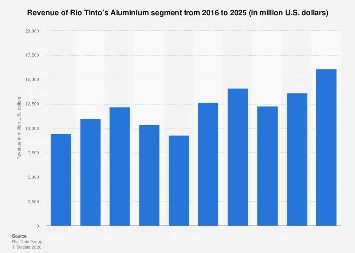
Rio Tinto’s aluminium operations are projected to generate substantial revenue in 2025, marking the segment as a critical revenue driver for the global mining and metals giant. While specific figures remain proprietary for public release beyond 2024, projections indicate a strong performance for the segment, which encompasses the entire aluminium value chain from bauxite extraction and alumina refining to primary aluminium smelting. This segment has consistently held its position as the company’s second-largest contributor to overall revenue, underscoring the strategic importance of aluminium to Rio Tinto’s diversified portfolio.
Headquartered in London, UK, Rio Tinto operates as a multinational corporation deeply involved in the exploration, development, production, and processing of mineral resources. The company’s extensive global footprint allows it to leverage diverse geological assets and market access, with its aluminium business being a prime example of this integrated approach. The aluminium segment’s performance is intrinsically linked to global economic health, industrial demand, and commodity prices, making its revenue trajectory a key indicator of broader market trends.
The aluminium industry itself is a cornerstone of modern manufacturing and infrastructure. Aluminium is indispensable in sectors ranging from automotive and aerospace, where its lightweight properties contribute to fuel efficiency and performance, to construction, packaging, and electronics. The increasing global focus on sustainability and decarbonization further amplifies aluminium’s importance, as it is a highly recyclable material and a critical component in renewable energy technologies, such as solar panels and wind turbines. This growing demand is a significant tailwind for companies like Rio Tinto with substantial aluminium production capacity.
Market analysts closely monitor the financial performance of major aluminium producers to gauge the health of the global manufacturing sector and the outlook for industrial commodities. Rio Tinto’s aluminium segment revenue is influenced by several key factors. The price of aluminium on international exchanges, such as the London Metal Exchange (LME), plays a direct role. Fluctuations in the LME aluminium price, driven by supply and demand dynamics, geopolitical events, and macroeconomic sentiment, directly impact the revenue generated from Rio Tinto’s sales. In recent years, the aluminium market has experienced volatility, influenced by factors such as production curtailments in China, energy price shocks, and the ongoing energy transition.
Beyond market prices, operational efficiency and production volumes are paramount. Rio Tinto’s integrated model, from mining bauxite – the primary ore for aluminium – to smelting the final metal, allows for greater control over costs and supply chain resilience. Investments in modernizing smelters, optimizing refining processes, and ensuring a stable and cost-effective energy supply are crucial for maintaining competitiveness. The company’s strategic mine-to-metal approach aims to capture value at each stage of the production process, thereby bolstering its profitability.
Geographically, Rio Tinto’s aluminium operations are spread across key regions, including Canada, Australia, and Iceland. These locations offer access to essential raw materials, established infrastructure, and, in some cases, competitive energy sources. For instance, its Canadian operations benefit from abundant hydropower, a critical input for energy-intensive aluminium smelting, while its Australian assets provide access to significant bauxite reserves. The strategic positioning of these assets allows Rio Tinto to cater to different regional markets and mitigate risks associated with localized disruptions.
The projected revenue for 2025 is not an isolated figure but reflects a broader economic narrative. Global industrial production has been on an upward trajectory, albeit with regional variations. Emerging economies, in particular, continue to drive demand for aluminium as they expand their manufacturing bases and infrastructure projects. The ongoing electrification of vehicles, a global trend, is also a significant driver, as aluminium is increasingly used in electric vehicle components to reduce weight and enhance battery range.
However, the aluminium sector also faces challenges. Environmental regulations, particularly concerning carbon emissions from smelting, are becoming more stringent. Rio Tinto, like its peers, is investing in technologies to reduce its carbon footprint and explore lower-carbon aluminium production methods. The availability and cost of electricity, a major operational expense for smelters, remain a critical consideration, especially in the context of volatile global energy markets.
Comparing Rio Tinto’s aluminium segment to its global competitors highlights its significant standing. Major players such as Alcoa, Chalco, and Rusal also command substantial market share and revenue. The competitive landscape is characterized by continuous innovation, strategic acquisitions, and a relentless focus on cost management and sustainability. Rio Tinto’s ability to maintain its position as a leading aluminium producer depends on its ongoing investments in technology, its operational excellence, and its strategic response to evolving market demands and regulatory pressures.
The company’s commitment to responsible mining practices and its efforts to enhance the sustainability of its aluminium production are also becoming increasingly important differentiators. Investors and consumers alike are placing a greater emphasis on environmental, social, and governance (ESG) factors. Rio Tinto’s progress in areas such as reducing greenhouse gas emissions, promoting biodiversity, and ensuring ethical supply chains can influence its brand reputation, access to capital, and ultimately, its long-term revenue potential.
In conclusion, Rio Tinto’s aluminium segment is a vital component of its global business, contributing significantly to its revenue. The projected strong performance in 2025 is underpinned by robust global demand for aluminium, the company’s integrated operational model, and strategic investments in its assets. As the world continues to rely on aluminium for a wide array of applications, particularly in the context of the green transition, Rio Tinto’s aluminium business is well-positioned to capitalize on these opportunities, while navigating the inherent complexities and challenges of the global commodities market. The segment’s financial results will continue to be a key indicator of both the company’s success and the broader health of the global industrial economy.