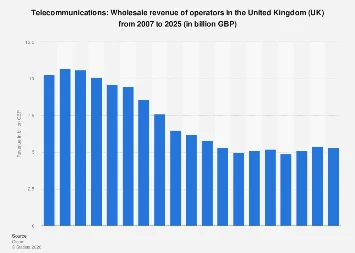
The wholesale telecommunications revenue in the United Kingdom is projected to experience a decline, with estimates for 2025 indicating a contraction from previous years. This trend signals a significant shift in the operational and financial landscape for network operators and service providers within the UK’s critical digital infrastructure sector. While precise figures for 2025 are withheld from public view, the trajectory suggests a continuation of a downward trend observed in the immediate preceding years. This anticipated revenue shrinkage in the wholesale segment warrants a deeper examination of the underlying economic forces and strategic adjustments underway in one of Europe’s most advanced telecommunications markets.
The wholesale telecommunications market serves as the foundational layer of the digital economy, enabling retail service providers to offer a wide array of connectivity services to consumers and businesses. It encompasses the infrastructure and services that allow one telecommunications operator to use the network or services of another. This can include access to fixed lines, mobile spectrum, data transmission capacity, and interconnection services. Therefore, any fluctuations in wholesale revenue have ripple effects throughout the entire value chain, impacting competition, investment, and the ultimate cost and availability of services for end-users.
Several interconnected factors are likely contributing to this projected revenue contraction. Intense competition within the UK’s telecommunications sector has historically driven down wholesale pricing. The presence of major infrastructure providers, coupled with regulatory frameworks designed to foster competition, creates a dynamic environment where price becomes a key differentiator. This pressure is particularly acute as operators invest heavily in upgrading their networks to next-generation technologies such as 5G and full-fibre broadband. The substantial capital expenditure required for these upgrades, while essential for future growth, can strain immediate profitability and necessitate cost-saving measures, including aggressive wholesale pricing strategies.
Furthermore, the ongoing consolidation within the industry, although potentially leading to economies of scale for larger entities, can also lead to renegotiated wholesale agreements with reduced margins. Mergers and acquisitions, when successful, often result in the integration of networks and services, potentially reducing the need for some third-party wholesale access. This can alter the supply-demand balance in certain wholesale segments, leading to downward pressure on prices.
The evolving nature of telecommunications traffic also plays a crucial role. While data consumption continues to surge, driven by video streaming, cloud computing, and the Internet of Things (IoT), the revenue generated per unit of data or per connection may be declining. This is a common phenomenon in rapidly expanding digital markets where increased volume does not always translate directly into proportional revenue growth, especially in the wholesale segment where efficiency and scale are paramount.

Looking at the broader economic context, the UK’s telecommunications sector, like many others, is susceptible to macroeconomic trends. Inflationary pressures can increase operational costs for network maintenance and upgrades, while economic slowdowns or uncertainty can impact the investment capacity of both wholesale providers and their retail customers. Changes in consumer spending habits and business investment decisions, influenced by the wider economic climate, can indirectly affect the demand for wholesale services.
Globally, telecommunications markets are undergoing similar transformations. Many developed economies are grappling with the challenges of monetizing massive network investments and adapting to the rapid pace of technological change. The trend towards open access networks and infrastructure sharing, while promoting competition and investment, can also lead to downward pressure on wholesale revenues as access becomes more commoditized. However, some markets are also seeing growth in specific wholesale niches, such as dedicated fibre backhaul or specialized enterprise connectivity solutions.
The projected revenue decline in the UK wholesale market underscores the strategic imperative for operators to diversify their revenue streams and focus on value-added services. This could involve developing more sophisticated wholesale offerings that go beyond basic connectivity, such as managed network services, cybersecurity solutions tailored for other providers, or specialized IoT connectivity platforms. The ability to offer flexible and scalable solutions that meet the evolving needs of retail operators will be key to navigating this challenging market.
Moreover, regulatory oversight will continue to be a critical factor. Ofcom, the UK’s communications regulator, plays a significant role in shaping the competitive landscape and ensuring fair access to essential infrastructure. Future regulatory decisions concerning wholesale access, pricing, and infrastructure investment will undoubtedly influence the market’s trajectory. Balancing the need for robust competition with the imperative to incentivize long-term network investment remains a delicate act for regulators worldwide.
The long-term outlook for the UK telecommunications wholesale market will depend on the sector’s ability to adapt to these multifaceted challenges. Continued investment in cutting-edge technologies, innovative business models, and a strategic focus on delivering higher-value services will be crucial for operators to thrive amidst the ongoing revenue pressures. The resilience and adaptability of the UK’s wholesale telecommunications infrastructure will be a key determinant of its digital future and its ability to support economic growth in an increasingly connected world.