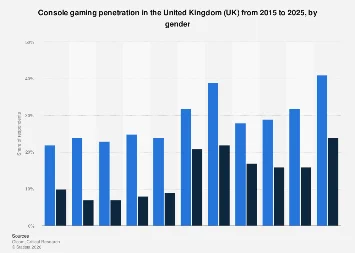
The United Kingdom’s console gaming market is poised for significant evolution, with projections for 2025 indicating a widening gap in engagement between genders, yet also a notable upward trend for female participation. Data reveals that by 2025, an estimated 41% of UK males aged 16 and older will have experience playing games on a console, compared to 24% of their female counterparts. This disparity, while persistent, masks a more dynamic underlying trend: a substantial increase in female console gaming adoption since 2019, suggesting a market becoming increasingly inclusive.
Console gaming currently stands as the second most popular form of video gaming in the UK, trailing only mobile gaming in terms of overall audience reach. This positions the console segment as a crucial pillar within the broader UK digital entertainment ecosystem, contributing significantly to consumer spending and technological innovation. The consistent growth in console adoption over the past decade, particularly the recent surge in female engagement, signals a maturation of the market and a broadening of its appeal beyond traditional demographics.
A closer examination of historical data reveals the trajectory of this evolving landscape. In 2015, console gaming penetration stood at 22% for males and a modest 10% for females. By 2019, these figures had risen to 24% for males and 9% for females, indicating a period of relatively stagnant growth for both, with a slight dip for women. However, the subsequent years have witnessed a marked acceleration. From 2020/21 onwards, male engagement saw fluctuations, reaching 32% and then 39% in 2021 before settling around the high 20s and early 30s in 2022 and 2023. The most striking growth, however, has been observed in female participation. After hovering in the single digits and low teens for several years, female penetration climbed to 21% in 2020/21, then to 22% in 2021, and has maintained a steady upward climb, reaching 16% in 2022 and 2023, with projections suggesting a significant leap to 24% by 2025. This suggests a paradigm shift in how women engage with console gaming, moving from a niche interest to a more mainstream activity.
Several factors likely contribute to this recalibration of the market. The increasing diversity of game genres available on consoles, moving beyond purely action-oriented titles to encompass rich narrative experiences, strategy games, and casual puzzle adventures, has broadened appeal. Furthermore, the rise of esports and streaming platforms has created new avenues for engagement and community building, attracting a wider audience. The social aspect of modern gaming, with integrated online multiplayer experiences and community features, also plays a crucial role in fostering inclusivity. For many women, the ability to connect with friends and family through gaming platforms has become a significant draw.
The economic implications of this demographic shift are substantial. The UK video game market is a multi-billion-pound industry, and an expanding console audience, particularly one that is diversifying, translates directly into increased hardware sales, software purchases, and in-game spending. Companies that can effectively cater to this broader demographic with diverse game offerings, inclusive marketing, and accessible community features are likely to reap significant rewards. This also presents opportunities for new entrants to the market who can identify and serve unmet needs within the growing female gaming demographic.
Globally, the UK’s console gaming market mirrors broader trends of increasing diversity. While historically male-dominated, the global gaming industry is witnessing a significant influx of female players across all platforms. Reports from various international markets indicate similar patterns of growth in female engagement, driven by the same factors of genre diversification and social connectivity. This suggests that the UK’s experience is not an anomaly but rather a reflection of a global phenomenon reshaping the gaming landscape.
The projected figures for 2025, with a 41% male and 24% female penetration rate, indicate that while a gender gap will persist, the gap is narrowing. This sustained growth in female participation suggests that the market is moving towards a more balanced representation. This presents a clear strategic imperative for console manufacturers, game developers, and publishers to continue investing in content and marketing that resonates with a diverse audience. Failure to do so risks alienating a significant and growing segment of potential consumers.
The data also highlights the importance of understanding the nuances within these broad statistics. The survey methodology, which involves face-to-face interviews and online surveys with respondents aged 16 and older, excluding handheld consoles, provides a robust snapshot of the at-home console gaming experience. The substantial number of respondents, totaling 7,533 for the 2025 projection, lends considerable weight to these findings.
Looking ahead, the continued growth of the UK console gaming market will likely be influenced by several key trends. The ongoing development of cloud gaming technologies could further democratize access to high-fidelity gaming experiences, potentially reducing the reliance on expensive hardware and further expanding the audience. The metaverse, while still in its nascent stages, also presents a potential future frontier for console gaming, offering new forms of immersive interaction and community. As these technologies mature, they could further blur the lines between different gaming platforms and attract even more diverse user bases.
In conclusion, the United Kingdom’s console gaming sector is on a trajectory of significant expansion and diversification. The projected data for 2025 underscores a market that is not only growing in overall reach but also becoming increasingly inclusive. The substantial increase in female engagement, coupled with the enduring popularity among males, signals a healthy and dynamic industry that is adapting to the evolving preferences of its audience. For businesses operating within this space, understanding and catering to this broadened demographic will be paramount to sustained success in the years to come. The era of console gaming being a niche hobby is firmly behind us; it is now a mainstream entertainment medium with a growingly diverse and engaged audience.