Alphabet, the parent company of Google, stands as a colossus in the digital landscape, processing billions of search queries daily and commanding a dominant share of the global search engine market. Yet, its influence extends far beyond search, permeating daily life through ubiquitous services like Google Maps, Gmail, Android, and YouTube. Emerging technologies, such as the generative artificial intelligence chatbot Gemini and Waymo’s autonomous driving solutions, are rapidly gaining traction, signaling Alphabet’s forward-looking trajectory. In the first quarter of 2026, the company reported an impressive 350 million paid subscriptions for its Gemini app. Concurrently, Waymo expanded its operations to six new cities and surpassed half a million fully autonomous rides weekly, a remarkable feat that doubled its previous performance in less than a year.
At the helm of this technological giant is Sundar Pichai, who has served as CEO of Google since 2015 and took on the additional role of CEO of Alphabet in 2019. Pichai’s tenure has been marked by steering the company to significant milestones and fostering the growth of products like Google Chrome and Google Drive from nascent concepts into household names. In contrast to some of his more outwardly flamboyant counterparts in the tech industry, Pichai cultivates a more measured, behind-the-scenes leadership style.
"Sundar Pichai’s career path is rooted in product leadership rather than founding mythology, and that shapes how he runs Alphabet," observes Joe Crist, CEO of Transform 42 Inc., a firm specializing in sustainable organizational scaling. Crist attributes Pichai’s success to this consistent, steady approach. "He operates as a scale leader, focused on maintaining stability across a highly complex organization rather than constantly reshaping it. That consistency gives engineering teams continuity and avoids the kind of frequent strategic shifts that can disrupt execution."
Despite these monumental achievements, a key question looms for investors: can Alphabet sustain its current momentum in the fiercely competitive AI race? The company’s vast user base presents both a potential accelerant for innovation and a potential impediment, a dichotomy that Pichai must navigate.
From Humble Origins to Tech Leadership
Born and raised in Chennai, India, Sundar Pichai’s journey to Silicon Valley began in 1993 with a scholarship to Stanford University, where he pursued a master’s degree in materials science and engineering. This academic foundation was later complemented by an MBA from the Wharton School at the University of Pennsylvania.
Pichai’s early career included brief stints at Applied Materials, a semiconductor manufacturer, and McKinsey & Company, a management consulting firm. However, the allure of Silicon Valley proved irresistible. "I used to read about what was happening in Silicon Valley, and I wanted to be a part of it," Pichai recounted in a 2014 interview. His career at Google commenced in 2004 in a product management role. His inaugural project was the Google Toolbar, an initiative designed to enhance the integration of Google’s search engine into popular web browsers like Internet Explorer and Firefox.
His aptitude for product development quickly led to a promotion to vice president of product management. A pivotal role in this period was his significant contribution to the development of Google Chrome, the company’s own web browser. This was a formidable undertaking; Pichai himself noted in a TIME interview that Chrome held just one percent market share a year after its launch, a stark contrast to its current status as the world’s most widely used browser. Throughout his ascent, Pichai demonstrated an uncanny ability to anticipate user needs and develop products that resonated with them. "He has an exceptional sense for craft and the details in a product, all the way down to the pixels on the screen, the sound of a voice, the tactile feedback," remarked Clay Bavor, who worked under Pichai at Google for a decade. His close collaboration with Google co-founder Larry Page was instrumental, with Page famously stating in a 2014 memo announcing Pichai’s promotion to lead Google’s core products, "Sundar has a tremendous ability to see what is ahead and mobilize teams around the super important stuff. We very much see eye-to-eye when it comes to product, which makes him the perfect fit for this role."
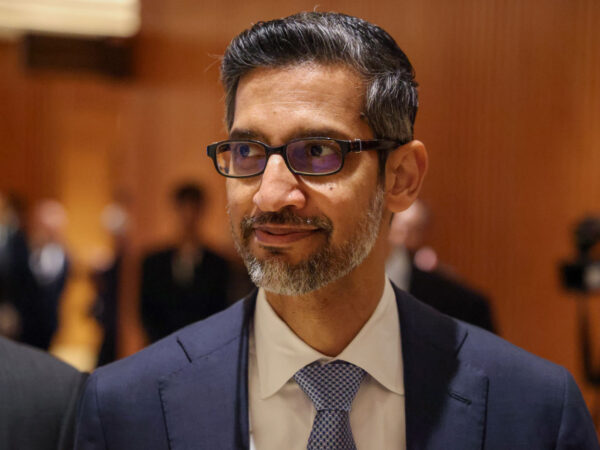
Pichai’s consistent successes reportedly attracted attention from rival tech giants like Twitter and Microsoft for leadership opportunities. However, his loyalty to Google was ultimately rewarded with the company’s top leadership position in 2015, following the restructuring that led to the creation of Alphabet as an umbrella entity by Page and Sergey Brin.
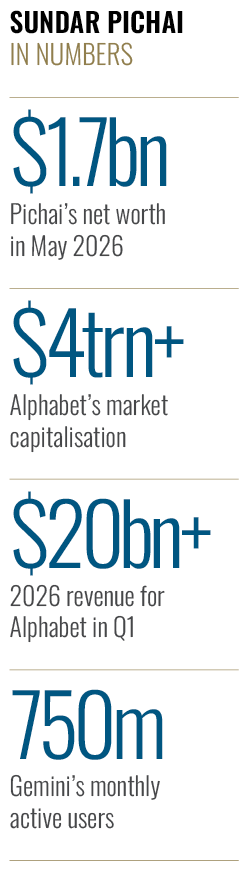
During his leadership at Google, and subsequently at Alphabet, Pichai oversaw the introduction of the Pixel smartphone, the launch of Google Home (later rebranded as Google Nest following the 2014 acquisition of Nest Labs for $3.2 billion), and a vigorous push into AI innovation. These efforts propelled Alphabet’s market capitalization past the $4 trillion mark in early 2026, making it only the fourth company in history to achieve this valuation. Pichai’s personal net worth is estimated to be around $1.7 billion, according to Forbes.
"Pichai’s leadership trajectory is closely tied to product execution at planetary scale," states Will Steward, CEO and co-founder of The SaaS Jobs, who has extensive experience advising tech companies. "His early work on Chrome and later Android positioned him at the center of Google’s distribution infrastructure, which effectively became the foundation of the company’s global reach. That background has shaped a leadership style focused on system coherence, where success is measured by how well large platforms function together rather than isolated product breakthroughs." Steward further elaborates, "As chief executive, he has presided over a shift from single-discipline dominance in search advertising towards a multi-layered platform business. His approach has been to unify and ensure that infrastructure, advertising, devices, and cloud services remain technically aligned. This has allowed Google to evolve without losing continuity across its core systems."
Despite his extraordinary professional achievements, Pichai’s upbringing was modest. Reports indicate that he and his brother shared a living room floor in their family’s small home. His father reportedly saved an entire year’s salary to fund his plane ticket to California for his studies at Stanford.
Pichai’s narrative is a testament to the confluence of opportunity and ambition. "If he wants to do something, you’re not going to be able to stop him," remarked Caesar Sengupta, a former Google colleague. "He is just going to be super nice about it. And then, you cannot move him." While generally well-regarded as a leader at Google, Pichai has faced criticism in recent years, notably from AI ethicist Timnit Gebru, who was dismissed in 2020 and alleged a "hostile work environment" created by Pichai and other managers. More recently, the company has implemented significant workforce reductions.
Pichai’s story also underscores the transformative power of technology, a principle he ardently champions. His childhood in India was characterized by limited access to technological amenities; he recalls a five-year wait for a rotary telephone. The arrival of that single phone had a profound impact on his family. "When you see the appetite and the desire for people to make their lives better by gaining access to technology, that is what compels me to go beyond," Pichai stated in a 2022 interview on Stanford’s "View From the Top" podcast.
The AI Revolution Takes Center Stage
The current technological landscape is characterized by rapid advancements, particularly in the field of artificial intelligence. The emergence of OpenAI’s ChatGPT in late 2022 dramatically reshaped public perception of AI’s practical applications, igniting an intense race among major tech firms. While some observers initially criticized Google for its perceived slow response, Pichai had, as early as 2016, declared Google an "AI-first" company, signaling a strategic pivot from a mobile-centric focus. For years, Pichai has been meticulously building a robust foundation of custom-designed chips, advanced research, and extensive infrastructure, positioning Google to compete effectively in the AI arms race. Today, Gemini accounts for a quarter of all AI traffic, a significant increase from just six percent a year ago, according to Similarweb data.
"Google is structurally strong in AI due to its full-stack control of model development and distribution," explains Steward. "Its custom silicon, global compute infrastructure, and long history in deep learning research give it an end-to-end capability that few competitors can match. This enables efficient training and deployment cycles at a massive scale." Google’s acquisition of DeepMind, its AI research laboratory, in 2014 laid the groundwork for years of quiet breakthroughs in areas ranging from voice recognition to image processing. A watershed moment occurred in 2016 when a DeepMind neural network defeated a world champion in the complex board game Go. This event, Pichai noted, solidified his understanding of the technology’s potential for significant leaps. Since then, he has been instrumental in driving Google’s efforts to integrate AI into practical, user-facing applications.
The company’s integration-led strategy has enabled it to emerge as a seemingly overnight leader in AI. "Instead of focusing primarily on standalone AI tools, the strategy is to embed AI capabilities directly into existing products, which means new features reach users through systems they already rely on without requiring behavior change," Crist observes. This approach provides Google with a distinct advantage over newer startups. "Users don’t need to adopt entirely new platforms, which makes adoption more realistic in regulated or risk-sensitive environments," Crist adds.
Google Search, for instance, now incorporates generative AI models into its core information retrieval functions. "Search is evolving from a list-based interface into a synthesis layer where AI-generated responses reshape how users interact with web content," Steward notes. "This is a fundamental product transition rather than a feature upgrade."
While Google possesses formidable AI research capabilities, Crist argues that its most significant asset lies in its controlled deployment of AI features. Steward concurs, stating, "Compared with competitors, Google’s advantage lies in vertical integration. It can train models, deploy them, and immediately place them inside products used daily by billions of users. That loop between infrastructure and interface is one of its most powerful assets in the current AI cycle."
This emphasis on seamless integration and collaboration aligns with Pichai’s personal philosophy on AI. In a 2023 appearance on the Harvard Business Review’s IdeaCast podcast, he described the current inflection point of AI as being driven by human-AI collaboration. "Software engineers often do something called pair programming. We have found that two programmers working together are better than them working separately," he explained. "So you can now imagine AI being your paired programmer or paired financial analyst or name if you will. So I think that’s the direction, that’s the promise and we are seeing it happen."
Navigating an Uncertain Future
While acknowledging AI’s transformative potential, Pichai is also acutely aware of its inherent risks. He has publicly discussed the potential for AI to disrupt the job market, even suggesting that the role of a CEO might be one of the first to be automated. His own encounter with a large language model, role-playing as the planet Pluto, left him "unsettled" by its power and potential impact on human emotions. He described engaging in a conversation with the chatbot alongside his son, finding it to be a "wonderful learning tool" for facts about the solar system. However, the simulated loneliness and darker turn of the conversation provided a stark illustration of AI’s potential to affect users deeply.
This experience reinforced Pichai’s commitment to balancing AI’s immense opportunities with responsible innovation. "These are powerful models, and I think a lot of us are working on making sure we build in safety systems, we add a layer of responsibility before we really widely deploy it. It is part of the reason I think as Google, we have been more conservative in our approach given the scale at which we serve users," he stated.
Although Google’s AI advancements may appear sudden, they are the culmination of years of dedicated research and development. As the AI race intensifies, Pichai shows no signs of slowing down; in fact, Alphabet is significantly increasing its capital expenditure on AI. Earlier this year, Pichai announced plans to double capital expenditures to up to $185 billion, substantially exceeding analysts’ projections of $120 billion. "Our capex spend this year is an eye towards the future," he told investors. "The demand we are seeing across the board for our services – and what we need to invest in Google DeepMind and in Cloud – is exceptionally strong."
Pichai’s long-standing advocacy for AI makes his current all-in approach unsurprising. He views AI as a "deep platform shift," asserting in the IdeaCast podcast that it is "the most profound technology humanity is working on and will ever work on, more profound than fire or electricity." He reiterates his belief that AI "will touch every aspect of our lives, every aspect of society, every industry sector." While generative AI has captured public attention, Pichai sees it as merely a "moment in time" and "one aspect of AI."
"I think there is more progress to be had, and I do think we will go through some moments of ups and downs, but the progress I think will continue. I think we should channel all this excitement to make sure other stakeholders are getting involved," he urged. Pichai actively seeks collaboration with governments, non-profits, and academic institutions to establish frameworks for AI safety and responsibility on a global scale.
Google, under Pichai’s leadership, has already navigated significant regulatory challenges, including European antitrust investigations and lawsuits in the United States concerning alleged monopolistic practices. Pichai has emphasized the need for well-considered regulation, stating, "AI is too important an area not to regulate, and also too important an area not to regulate well." He advocates for allowing technology to mature in its early stages while concurrently building safeguards, proposing a framework for government or regulatory bodies to validate AI models and ensure their safety for public use. "We need to embrace the excitement and channel it in a way in which as society, as humanity, we are building the foundational blocks to tackle what is coming our way as well," he concluded. This approach, Crist notes, "prioritizes reliability within established workflows. In sectors like healthcare or finance, that discipline matters more than speed. A fast but unstable AI tool creates operational risk, not efficiency."
An Emerging AI Superpower?
Alphabet appears better positioned to contend in the AI race than many anticipated even a couple of years ago, according to Dhruv Datta, a specialist in mobile app development. "Alphabet appears to have significant depth," Datta observes, pointing to Gemini, Google Cloud, custom-designed chips, and years of AI development experience, complemented by the vast distribution channels provided by Google Search and Android.
However, technical prowess alone does not guarantee AI superpower status. "In order for AI to become widely adopted, it will need to be perceived as trustworthy, capable of delivering results rapidly, valuable, and economically viable on a massive scale," Datta states.
Is Pichai the leader to achieve this? Neal Mohan, CEO of YouTube, describes Pichai’s AI insights as both "foreshadowing these huge trends, but they are also very, very precise." Crist characterizes Pichai’s leadership style as "deliberate, incremental, and low drama," qualities that have enabled him to steer a company of Alphabet’s magnitude and technical complexity with remarkable steadiness, particularly amidst regulatory scrutiny and evolving cultural landscapes. "This is not a style built on constant public repositioning or dramatic pivots, but one of operational control and consistency at scale, which is often underestimated in large technology organizations," Crist notes.
Looking ahead, Datta believes Pichai’s primary challenge will be achieving balance. "On the one hand, he must continue to safeguard the core search business which still drives nearly all of Alphabet’s revenue. At the same time, he will need to enable a transformation of how search operates," Datta explains. "He will also need to make significant investments in the infrastructure required for AI applications while demonstrating that those investments generate sustained economic value." Crucially, he adds, Pichai "must be able to do so quickly without damaging the trust and reliability users currently place in Google."
In an era defined by revolutionary technological shifts, the temptation to "move fast and break things" is considerable. However, while Alphabet’s sheer size may inherently impose a degree of caution, Pichai’s consistent track record suggests that being first to market is not necessarily synonymous with being the most successful.