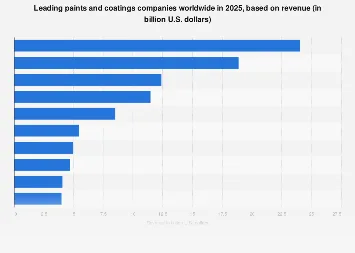
The global paints and coatings industry, a sector critical to construction, automotive, aerospace, and consumer goods, saw the United States-based behemoth Sherwin-Williams solidify its position as the undisputed market leader in 2025, commanding an impressive revenue figure in the billions of U.S. dollars. This preeminence underscores the company’s strategic market penetration and robust product portfolio. Following closely behind, and also hailing from the U.S., was PPG Industries, another significant player that secured the second spot with its own substantial revenue streams. The dominance of these American titans is further emphasized by the fact that five of the top ten global paint and coatings companies, when ranked by revenue, were headquartered in the United States during this period, signaling a strong North American influence in this vital industrial segment.
The paints and coatings sector is a complex ecosystem, characterized by high capital investment, intricate supply chains, and a continuous drive for innovation in both product performance and environmental sustainability. The market’s growth is intrinsically linked to global economic activity, particularly the health of the construction and manufacturing sectors. Demand for paints and coatings is a key indicator of new building projects, infrastructure development, and the production of durable goods, from automobiles to appliances. In recent years, the industry has been navigating a confluence of challenges and opportunities, including fluctuating raw material costs, increasing regulatory scrutiny regarding volatile organic compounds (VOCs) and hazardous substances, and a growing consumer preference for eco-friendly and low-VOC alternatives. Furthermore, the rise of emerging economies has presented new avenues for growth, while geopolitical shifts and supply chain disruptions have necessitated greater agility and resilience among industry players.
Sherwin-Williams’ leadership is not merely a matter of scale but a testament to its multifaceted business strategy. The company’s operational structure is built around three core segments: the Americas Group, the Consumer Brands Group, and the Performance Coatings Group. The Americas Group, in particular, serves as the visible backbone of the Sherwin-Williams brand, encompassing its extensive network of Sherwin-Williams paint stores. These retail outlets, strategically located across the United States, Canada, and the Caribbean, provide direct access to a broad consumer and professional market, fostering brand loyalty and facilitating immediate product availability. This integrated approach, from manufacturing to retail, allows Sherwin-Williams to maintain tight control over its brand experience and customer relationships, a significant competitive advantage in a market where brand reputation and service are paramount.
The Consumer Brands Group caters to a wider retail audience, offering a diverse range of products through various distribution channels, including big-box retailers and independent hardware stores. This segment ensures broad market reach and accessibility for DIY enthusiasts and smaller contractors. Meanwhile, the Performance Coatings Group focuses on industrial applications, serving sectors such as automotive original equipment manufacturing (OEM), refinish, industrial wood, protective and marine, and packaging. This diversified approach mitigates risks associated with over-reliance on any single market segment and allows Sherwin-Williams to capitalize on growth opportunities across a spectrum of industries. The company’s consistent investment in research and development fuels its ability to offer innovative solutions, from high-durability coatings for extreme environments to advanced formulations that reduce application time and environmental impact.
PPG Industries, as the second-largest entity, demonstrates a similar strategic breadth. The company operates across a global footprint, with significant presence in aerospace, automotive OEM and refinish, industrial coatings, packaging coatings, and architectural coatings. PPG’s commitment to innovation is evident in its development of specialized coatings that offer enhanced corrosion resistance, improved energy efficiency, and advanced aesthetic qualities. The company has also been actively pursuing acquisitions to expand its market share and technological capabilities, a common strategy in the consolidating paints and coatings landscape. For instance, its acquisition of SigmaKalon in 2008 significantly boosted its global presence, particularly in Europe and Asia. PPG’s focus on sustainability is also a key differentiator, with ongoing efforts to develop waterborne coatings and powder coatings that minimize environmental footprint.
The global paints and coatings market is a multi-billion dollar industry, with projected growth driven by urbanization, infrastructure development in emerging markets, and the ongoing demand for protective and decorative finishes in both residential and commercial construction. According to market research reports, the sector is anticipated to experience a Compound Annual Growth Rate (CAGR) of approximately 4-5% over the next five to seven years, reaching well over $200 billion by the end of the decade. Key growth drivers include the increasing disposable incomes in developing nations, leading to greater investment in housing and renovation, and the automotive sector’s continuous need for advanced coatings that enhance vehicle aesthetics and durability while meeting stringent environmental regulations. The architectural coatings segment, which includes decorative paints for homes and buildings, typically accounts for the largest share of the market, followed by industrial coatings, which are essential for protecting infrastructure, machinery, and manufactured goods.
Beyond the top two, the competitive landscape is populated by a mix of large multinational corporations and specialized regional players. Companies like Nippon Paint Holdings from Japan, AkzoNobel from the Netherlands, and Axalta Coating Systems (also U.S.-based) are significant contributors to the global market, each with its own strengths and strategic focus. Nippon Paint, for instance, has a strong presence in Asia and is actively expanding its global reach through strategic partnerships and acquisitions. AkzoNobel, a historical leader in decorative paints, has also diversified into performance coatings, emphasizing sustainability and innovation. Axalta, primarily focused on automotive and industrial coatings, is known for its advanced color technologies and its strong relationships with global automotive manufacturers.
The economic impact of the paints and coatings industry extends far beyond its direct revenues. It is a significant employer, creating jobs in manufacturing, research and development, sales, marketing, and logistics. Furthermore, the products it provides are essential for the longevity and aesthetic appeal of countless assets, from the homes we live in and the cars we drive to the bridges that connect our communities and the aircraft that enable global travel. The development of advanced coatings can also contribute to energy efficiency, for example, through reflective roof coatings that reduce cooling costs or by protecting wind turbine blades to optimize performance and lifespan. The industry’s commitment to reducing its environmental impact, through the development of low-VOC formulations and more sustainable manufacturing processes, also plays a crucial role in broader environmental stewardship efforts. As the global economy continues to evolve, the paints and coatings sector, led by giants like Sherwin-Williams and PPG, will remain a foundational element, adapting to new challenges and driving innovation in the protection and beautification of our built environment.