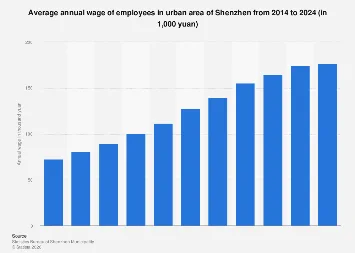
Shenzhen, a beacon of China’s economic reforms and a global hub for technology and innovation, continues to witness significant shifts in its labor market, with the average wage of its urban employees serving as a key indicator of this dynamic evolution. While specific, up-to-the-minute figures can fluctuate and are often proprietary, available data and economic trends paint a compelling picture of Shenzhen’s compensation landscape. The city, consistently ranked among China’s wealthiest and most competitive, attracts a vast pool of talent, driving demand and, consequently, wage levels. However, this upward trajectory is not uniform across all sectors and skill sets, and broader economic forces are beginning to exert their influence.
The narrative of Shenzhen’s wage growth has historically been one of rapid ascent, fueled by its status as a Special Economic Zone and its pioneering role in industries such as electronics, telecommunications, and more recently, artificial intelligence and biotechnology. This growth attracted a significant influx of both domestic and international talent, creating a highly competitive environment for employers. Consequently, average salaries in Shenzhen have generally outpaced national averages, reflecting the higher cost of living and the premium placed on specialized skills in these high-growth sectors. For instance, a decade ago, Shenzhen was already establishing itself as a city where skilled professionals could command significantly higher compensation compared to many other Chinese cities. This trend has been further amplified by the presence of major tech giants and a vibrant startup ecosystem, constantly vying for top engineering, research, and development talent.
However, the global economic climate and evolving domestic policies are introducing new complexities. The recent slowdown in certain technology sectors, coupled with broader global supply chain adjustments and geopolitical uncertainties, may be tempering the previously unchecked wage inflation. While Shenzhen remains a preferred destination for skilled labor, companies are increasingly focused on optimizing operational costs and ensuring sustainable growth. This could translate into more nuanced salary negotiations, with a greater emphasis on performance-based bonuses, stock options, and comprehensive benefits packages rather than solely on base salary increases. Furthermore, the government’s focus on inclusive growth and addressing income inequality may also influence wage distribution, potentially leading to policies that aim to boost compensation for lower-skilled workers or those in emerging, but perhaps less lucrative, sectors.
Looking at broader economic context, Shenzhen’s average urban wage is not just a local statistic but a reflection of China’s larger economic transition. As the nation moves away from being solely a low-cost manufacturing base towards a more innovation-driven economy, cities like Shenzhen are at the forefront of this transformation. The average wage in such a city is therefore a barometer for the success of these strategic economic shifts. When comparing Shenzhen to other major global innovation hubs, such as Silicon Valley in the United States or Tel Aviv in Israel, its wage levels, while rising, often remain competitive on a global scale, particularly when considering purchasing power parity for certain goods and services. However, the rapid pace of technological advancement in Shenzhen means that the demand for highly specialized skills, such as those in AI ethics, quantum computing, or advanced materials science, can command exceptionally high salaries, creating significant earning potential at the upper echelons of the workforce.
The composition of Shenzhen’s workforce also plays a crucial role in understanding its average wage. The city hosts a diverse range of industries, from cutting-edge tech firms to established manufacturing operations and a burgeoning service sector. The average wage is, therefore, an aggregation of these varied earning potentials. For example, employees in the high-margin technology and finance sectors are likely to earn significantly more than those in retail or certain service industries. This disparity underscores the importance of looking beyond a single average figure and delving into sectoral wage data to gain a more granular understanding of the Shenzhen labor market. Recent reports from various HR and recruitment consultancies often highlight that software engineers, data scientists, and product managers in Shenzhen can command salaries that are among the highest in the country, often exceeding RMB 30,000-50,000 per month, depending on experience and company.
Moreover, the cost of living in Shenzhen, which is notoriously high for a Chinese city, is a significant factor influencing wage expectations and the effective purchasing power of those salaries. Housing, in particular, represents a substantial expense for residents. Therefore, while nominal wages may appear high, their real value is significantly impacted by these living costs. This dynamic is common in many global megacities where economic dynamism drives up both wages and the cost of essential goods and services. Shenzhen’s government has acknowledged these challenges and has been implementing policies aimed at moderating housing costs and improving the overall quality of life, which indirectly affects the perceived value of wages.
Looking ahead, several factors will continue to shape Shenzhen’s wage landscape. The ongoing global demand for advanced technology, coupled with China’s strategic emphasis on self-reliance in key technological areas, suggests that demand for skilled talent in sectors like semiconductors, AI, and renewable energy will remain robust. This will likely sustain upward pressure on wages for these specialized roles. Conversely, industries facing intense competition or those with lower productivity growth might experience more moderate wage increases. The increasing adoption of automation and artificial intelligence across various sectors could also lead to a polarization of the labor market, with higher demand for those who can manage and develop these technologies, and potentially reduced demand or stagnant wages for roles that are easily automated.
Furthermore, the development of the Greater Bay Area (GBA) initiative, which integrates Shenzhen with other major cities in the region like Hong Kong and Guangzhou, is expected to have a profound impact. This integration aims to foster greater economic synergy, leading to increased cross-border talent mobility and potentially a more harmonized approach to compensation across the region. As companies within the GBA compete for talent, wage levels in Shenzhen could be influenced by compensation trends in neighboring economic powerhouses, potentially leading to a recalibration of salary benchmarks.
In conclusion, the average wage of urban employees in Shenzhen is a complex metric reflecting a city at the vanguard of China’s economic transformation. While historical trends point to strong wage growth, particularly in high-tech sectors, current economic conditions and evolving policy priorities are introducing new dynamics. Understanding these shifts requires a nuanced view that considers sectoral variations, the impact of the cost of living, and the broader implications of regional and global economic trends. Shenzhen’s journey as a global economic powerhouse is intrinsically linked to its ability to attract and retain talent, and its wage structure will continue to be a critical determinant of its success in the years to come.