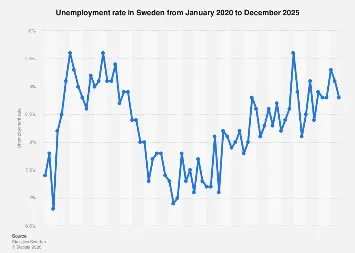
Sweden’s unemployment rate exhibited a marginal decrease towards the close of 2025, settling at 8.8 percent in December, a slight improvement from the 9.1 percent recorded in November. This late-year trend, while modest, offers a glimmer of stabilization in a labor market that has navigated periods of volatility throughout the year. The figures, compiled for the period from January 2020 to December 2025, reveal a complex picture of recovery and adaptation following significant global economic disruptions.
Examining the monthly data from January 2025 provides a granular view of the year’s employment dynamics. The year began with a relatively high unemployment rate of 9.6 percent in January, followed by a dip to 8.9 percent in February. March saw a notable decrease to 8.1 percent, suggesting an initial uplift in economic activity. However, this positive momentum proved somewhat ephemeral, with rates fluctuating through the spring and summer months. April registered 8.5 percent, May saw a rise to 9.1 percent, and June experienced a slight recovery to 8.4 percent. July and August hovered around 8.9 percent and 8.8 percent respectively, before a more pronounced decline to 8.8 percent in September. October and November recorded 9.3 percent and 9.1 percent, respectively, before the year-end improvement to 8.8 percent in December.
The broader historical context from 2020 to 2025 underscores the persistent challenges and gradual recovery in the Swedish labor market. The initial impact of the global pandemic in early 2020 saw unemployment rates climb, with figures reaching as high as 9.6 percent in July 2020. Subsequent months in 2020 showed a general downward trend, albeit with some oscillations, ending the year at 9.2 percent in December.
The year 2021 presented a mixed performance. While the unemployment rate began at 9 percent in January, it experienced fluctuations, peaking at 9.6 percent in March and remaining elevated throughout much of the year, averaging around 8.7 percent. The year concluded with an 8 percent unemployment rate in December 2021, indicating a slight easing of pressure.
2022 marked a period of more consistent improvement. Unemployment started the year at 8 percent and generally trended downwards, reaching lows of 6.9 percent in August and 7 percent in September. While there were minor upticks in the latter part of the year, the overall trajectory was positive, finishing at 7.5 percent in December 2022. This represented a significant reduction from the previous year.
The downward trend continued into early 2023, with unemployment rates frequently falling below 8 percent and even reaching 7.1 percent in January and July. However, the latter half of the year saw a resurgence in unemployment, with rates climbing back towards the 8 percent mark by year-end, concluding at 8.2 percent in December 2023. This late-year increase signaled potential headwinds.
2024 presented a more volatile employment landscape. The year opened at 7.8 percent, dipped to 8 percent in February, and then saw a sustained period of rates between 8 and 8.8 percent for much of the first half. The latter half of the year saw a slight improvement, with rates generally in the 8.2 to 8.7 percent range, ending 2024 at 8.6 percent. This indicated a plateauing of the employment situation, with little significant progress in reducing unemployment from the previous year.
The economic implications of these unemployment figures are multifaceted. For Sweden, a consistently high unemployment rate can translate into increased government spending on social welfare programs and a reduced tax base, impacting public finances. A higher unemployment rate also signifies underutilized human capital, potentially hindering productivity growth and long-term economic potential. The decline in December 2025, though small, could suggest that a combination of government labor market policies, private sector recovery, and potentially global economic tailwinds are beginning to have a more positive impact.
From a broader economic perspective, Sweden’s performance can be benchmarked against its Nordic peers and the wider European Union. Many European economies have grappled with similar post-pandemic recovery challenges, including inflationary pressures and supply chain disruptions, which have indirectly affected labor markets. For instance, Eurostat data often shows a range of unemployment rates across the EU, with some member states experiencing rates significantly lower than Sweden’s, while others face comparable or higher levels. The relative performance of Sweden’s labor market within this international context is crucial for its competitiveness and attractiveness to foreign investment.
The Swedish government and its economic policymakers continuously monitor these indicators to inform fiscal and monetary policy. Factors such as the strength of domestic demand, export performance, investment levels, and the pace of technological adoption all play a role in shaping the employment landscape. The relatively high unemployment figures observed throughout 2024 and much of 2025 suggest that the economy may still be in a phase of adjustment, with certain sectors experiencing labor market tightness while others continue to struggle.
Expert analysis often points to the structural aspects of the Swedish labor market, including the integration of foreign-born workers and the skills mismatch between available jobs and the workforce’s qualifications, as key factors influencing unemployment rates. Policies aimed at improving vocational training, lifelong learning initiatives, and streamlined integration programs are often cited as essential for addressing these challenges and fostering a more resilient and dynamic labor market.
While the December 2025 figures offer a positive signal, a sustained period of declining unemployment will be necessary to fully re-establish a robust labor market. The path forward will likely involve continued attention to economic growth drivers, targeted labor market interventions, and adaptation to evolving global economic conditions. The coming months will be critical in determining whether this late-year improvement represents a sustained trend or a temporary respite in Sweden’s ongoing labor market recovery.