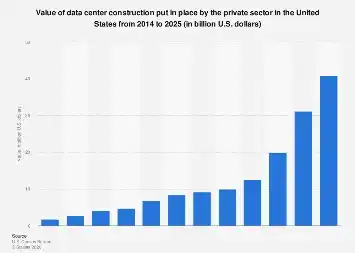
The landscape of American enterprise is undergoing a profound transformation, with the private sector’s investment in data center construction poised for an unprecedented surge. Projections indicate that by the close of 2025, the value of new private data center construction in the United States will have expanded more than twentyfold since 2015. In the coming year, the industry is expected to pour approximately $40.97 billion into building and expanding these critical digital infrastructure hubs, a significant leap of nearly $9.83 billion from the estimated $31.14 billion investment in 2024. This dramatic escalation underscores the pivotal role data centers now play in the global digital economy and highlights the immense opportunities and challenges associated with this rapid expansion.
This remarkable growth trajectory is not a sudden phenomenon but rather the culmination of years of accelerating demand, fueled by a confluence of technological advancements and evolving consumer and business behaviors. The digital revolution, characterized by the proliferation of cloud computing, the explosive growth of big data, the widespread adoption of the Internet of Things (IoT), and the increasing reliance on artificial intelligence (AI) and machine learning (ML), all demand robust and scalable data processing and storage capabilities. These foundational technologies, essential for everything from streaming services and e-commerce to advanced scientific research and financial transactions, are the primary drivers behind the insatiable appetite for more sophisticated and expansive data center facilities.
The sheer scale of investment projected for 2025 paints a vivid picture of the sector’s economic significance. To place this figure in context, $40.97 billion represents a substantial portion of the nation’s capital expenditure, rivaling investments in many other major industrial sectors. This capital infusion translates directly into job creation, not only in the construction trades but also in the manufacturing of specialized equipment, the provision of engineering and design services, and the ongoing operational and maintenance roles within the data centers themselves. Furthermore, the development of these facilities often spurs ancillary economic activity in the surrounding regions, including infrastructure upgrades, increased demand for local services, and potential tax revenue generation.
Examining the historical data reveals a consistent and impressive upward trend. From a modest $1.8 billion in construction value in 2014, the sector saw steady growth, reaching $2.74 billion in 2015. The subsequent years witnessed a sustained acceleration: $4.12 billion in 2016, $4.67 billion in 2017, and a notable jump to $6.93 billion in 2018. By 2019, the figure had climbed to $8.48 billion, followed by $9.23 billion in 2020 and $9.95 billion in 2021. The real acceleration, however, began in 2022 with an investment of $12.58 billion, which then more than doubled to an estimated $20 billion in 2023. The leap to over $31 billion in 2024 and the projected nearly $41 billion in 2025 underscore a paradigm shift in the scale and pace of data center development.
This explosive growth is not uniformly distributed across the United States. Certain regions have emerged as prime locations for data center development, often referred to as "data center hubs." These areas typically benefit from a combination of factors, including access to abundant and affordable electricity, robust fiber optic network connectivity, favorable tax incentives, a skilled workforce, and proximity to major population centers or enterprise clients. States like Virginia, Northern California, Texas, and the Pacific Northwest have long been established leaders, but new markets are rapidly gaining traction as demand continues to outstrip supply in traditional hotspots. The geographical concentration of these investments can have significant localized economic impacts, driving demand for real estate, construction services, and utilities in these specific areas.
The composition of this massive investment is multifaceted. It encompasses the construction of hyperscale data centers, which are massive facilities operated by cloud giants like Amazon Web Services, Microsoft Azure, and Google Cloud, catering to a broad range of clients. It also includes enterprise-owned data centers, built and managed by individual companies for their specific needs, and colocation facilities, where businesses can rent space, power, and cooling within a third-party’s data center. The increasing demand for specialized computing power for AI and ML applications is also driving the development of highly specialized facilities, often requiring more advanced cooling systems and higher power densities.
However, this unprecedented boom is not without its challenges. The immense power requirements of modern data centers are placing significant strain on electricity grids in many regions, prompting concerns about energy sustainability and the environmental impact. Data centers are among the largest consumers of electricity, and their continued expansion necessitates a parallel investment in renewable energy sources and grid modernization. Regulatory bodies and industry stakeholders are increasingly focused on developing more energy-efficient designs, implementing advanced cooling technologies, and exploring power sources like solar, wind, and even small modular nuclear reactors to meet the growing demand sustainably.
Moreover, the demand for skilled labor in construction, engineering, and IT operations is intensifying. The specialized nature of data center construction and maintenance requires a workforce with specific expertise, leading to potential labor shortages and increased recruitment costs. Companies are investing in training programs and partnerships with educational institutions to cultivate the necessary talent pool.
The global context of U.S. data center construction is also crucial. While the United States remains the largest market, significant investments are also being made in Europe, Asia, and other emerging markets. Trends in the U.S. often serve as bellwethers for global developments, and the strategies employed to address challenges like sustainability and workforce development are being closely watched and adapted worldwide. The interconnectedness of the global digital infrastructure means that developments in one region can have ripple effects across others, influencing supply chains, technology adoption, and investment flows.
Looking ahead, the trajectory for data center construction in the U.S. appears set for continued robust growth, albeit with an increasing emphasis on sustainability and efficiency. The ongoing evolution of AI, the metaverse, and other emerging technologies will continue to drive demand for processing power and storage. As the digital economy matures, the data center will remain its indispensable bedrock, and the multi-billion dollar investments seen today are a testament to its critical and ever-expanding role. The challenge for the industry, policymakers, and the broader economy will be to navigate this expansion responsibly, ensuring that digital progress is achieved in an environmentally sound and economically beneficial manner for all stakeholders. The figures for 2025 represent not just an endpoint, but a significant milestone in a continuously evolving digital infrastructure narrative.