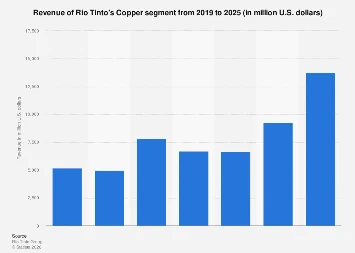
London, UK – Rio Tinto Group, a global leader in the mining and metals industry, is projecting a substantial increase in revenue from its copper segment in 2025, signaling a robust outlook for the crucial commodity. While precise figures for the full year remain proprietary and subject to market dynamics, preliminary data and industry analyses suggest a notable uptick compared to previous periods. This projected growth underscores the escalating importance of copper in the global economy, driven by its indispensable role in renewable energy infrastructure, electric vehicle production, and broader industrial expansion.
The company’s copper operations encompass a wide spectrum of activities, from exploration and extraction to refining. Beyond copper itself, the segment also yields valuable by-products such as silver, gold, and molybdenum, further diversifying its revenue streams. Rio Tinto’s strategic investments in exploration, including its involvement in the ambitious Simandou iron ore project, which falls under the purview of the Copper product group chief executive, highlight a forward-looking approach to resource development. This integrated strategy aims to capitalize on both established mining strengths and emerging resource opportunities.
The projected revenue growth for Rio Tinto’s copper segment in 2025 is not an isolated event but rather a reflection of broader market trends. Global demand for copper has been on an upward trajectory, propelled by the accelerating energy transition. The electrification of transportation, a cornerstone of climate change mitigation efforts, is a particularly potent driver. Electric vehicles (EVs) require significantly more copper than their internal combustion engine counterparts, with estimates suggesting an increase of up to 2.5 times the amount of copper per vehicle. As global EV adoption rates continue to climb, so too does the demand for this essential metal.
Furthermore, the expansion of renewable energy sources, such as solar and wind power, relies heavily on copper for their generation and transmission infrastructure. Solar panels, wind turbines, and the extensive grid networks required to connect these renewable sources to consumers all necessitate vast quantities of copper wiring and components. The International Energy Agency (IEA) has repeatedly highlighted copper as a critical mineral for the clean energy transition, forecasting a doubling of copper demand by 2040 to meet net-zero emissions goals. This sustained demand outlook provides a solid foundation for companies like Rio Tinto to anticipate increased revenues.
Beyond the energy sector, copper remains a vital component in traditional industrial applications, including construction, manufacturing, and electronics. Urbanization and infrastructure development in emerging economies, coupled with the ongoing technological advancements in consumer electronics and telecommunications, continue to contribute to baseline demand for copper.
Rio Tinto’s operational footprint in the copper market is significant, with major assets located in key mining regions across the globe. The company’s disciplined approach to resource management, coupled with its commitment to technological innovation in mining and processing, positions it favorably to meet this growing demand. Investments in automation, digital technologies, and sustainable mining practices are aimed at enhancing efficiency, reducing operational costs, and minimizing environmental impact, thereby bolstering profitability and long-term sustainability.
Market analysts are closely observing the copper sector, with many forecasting sustained price strength for the metal. Factors such as the pace of global economic recovery, geopolitical stability in major producing and consuming nations, and the responsiveness of new mine supply to price signals will influence short-to-medium term price fluctuations. However, the long-term demand fundamentals, driven by decarbonization and technological innovation, appear exceptionally strong.
The restructuring of Rio Tinto’s operating segments in January 2021, which saw diamonds separated from the copper segment to form part of the Minerals segment, has allowed for a more focused approach to its copper business. This strategic realignment enables greater specialization and targeted investment, potentially leading to enhanced operational performance and market responsiveness. The adjusted historical data for the copper segment reflects this organizational change, providing a clearer picture of the segment’s performance trajectory.
Globally, the copper mining industry is characterized by a mix of large multinational corporations, state-owned enterprises, and smaller independent producers. Competition is keen, but the capital-intensive nature of large-scale copper mining, coupled with the long lead times for developing new projects, creates significant barriers to entry. Rio Tinto, as one of the world’s largest diversified mining groups, possesses the scale, financial strength, and technical expertise to navigate these complexities and capitalize on market opportunities.
The economic impact of Rio Tinto’s copper segment extends beyond its direct revenue generation. The company is a significant employer in the regions where it operates, contributing to local economies through job creation, wages, and procurement of goods and services. Furthermore, its operations generate substantial tax revenues for governments, which can be reinvested in public services and infrastructure. The ripple effect of its activities supports a broader ecosystem of suppliers, contractors, and service providers, creating a multiplier effect on economic activity.
As the world continues its transition towards a more sustainable and electrified future, the demand for copper is set to remain robust. Rio Tinto’s strategic positioning, coupled with its operational capabilities and commitment to innovation, suggests that its copper segment will continue to be a pivotal contributor to the company’s overall success and a key player in supplying the essential materials needed for global progress. The projected revenue figures for 2025 serve as an indicator of the market’s confidence in copper’s enduring importance and Rio Tinto’s capacity to meet that demand effectively and profitably. The company’s ongoing investments in exploration and development are testament to its long-term vision, aiming to secure a reliable supply of this vital commodity for decades to come, supporting both economic growth and the global pursuit of a low-carbon future.