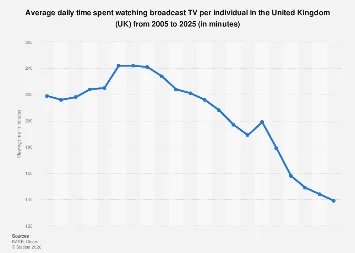
In 2025, the average Briton is projected to spend 139 minutes, or two hours and 19 minutes, each day watching broadcast television. This figure, while still substantial, marks a continued downward trajectory from the peak viewing hours recorded in previous years, signalling a profound shift in how the United Kingdom consumes visual media. This decline underscores the intensifying competition from digital platforms and evolving consumer preferences, posing significant challenges and opportunities for the traditional broadcasting landscape.
The data reveals a stark contrast between the viewing habits of the mid-2000s and the present day. Back in 2005, the average daily viewing time hovered around 219 minutes. Over the subsequent decade, this figure saw a gradual increase, peaking in 2012 and 2010 at 242 minutes per day. This period represented a golden age for linear television, where families gathered around scheduled programming, and major events dominated national conversation. However, the seeds of change were already being sown with the advent of broadband internet and the nascent stages of on-demand content.
The turning point appears to have been around 2015-2016. By 2015, daily viewing had dipped to 221 minutes, and by 2016, it had fallen to 216 minutes. This coincided with the accelerated growth of streaming services like Netflix, Amazon Prime Video, and later Disney+, which offered unprecedented flexibility and a vast library of content accessible at any time. The convenience of binge-watching, coupled with the ability to curate personalized viewing experiences, began to erode the traditional model of scheduled broadcasting.
The impact of the COVID-19 pandemic in 2020 and 2021 provided a temporary, albeit significant, anomaly. During the lockdowns, with people confined to their homes, broadcast television viewing surged. In 2020, daily viewing time climbed to an impressive 199 minutes, and in 2021, it reached a high of 179 minutes. This surge demonstrated the enduring power of television as a source of comfort, information, and escapism during times of crisis. However, as restrictions eased and life returned to a semblance of normality, the long-term trend of decline reasserted itself. By 2022, viewing time had dropped to 158 minutes, and further to 149 minutes in 2023. The projections for 2024 and 2025, at 144 and 139 minutes respectively, indicate that this downward trend is set to continue.
This evolving media consumption landscape has profound implications for the UK’s television industry. Broadcasters are grappling with declining advertising revenues as advertisers increasingly shift their budgets towards digital platforms that offer more precise targeting and measurable returns. The traditional advertising model, which relied on reaching mass audiences at specific times, is becoming less effective in a fragmented viewing environment. This necessitates a strategic pivot towards alternative revenue streams, such as subscription services, content licensing, and direct-to-consumer offerings.
Furthermore, the demographic of the traditional television viewer is also shifting. While older generations may still adhere to established viewing habits, younger audiences, known as digital natives, have grown up with on-demand content and are less likely to be tethered to linear schedules. For these demographics, YouTube, TikTok, and a plethora of niche streaming services offer a more engaging and personalized entertainment experience. This generational divide presents a significant challenge for broadcasters seeking to maintain relevance across all age groups.
The UK’s broadcast television ecosystem is a complex one, comprising major public service broadcasters like the BBC, ITV, Channel 4, and Channel 5, alongside a multitude of commercial channels. Public service broadcasters, in particular, face the dual challenge of maintaining their public service remit – providing high-quality, impartial news, education, and children’s programming – while competing in a market increasingly dominated by commercial imperatives and global digital giants. Their funding models, often reliant on the licence fee (for the BBC) or advertising revenue (for others), are under increasing scrutiny as viewing habits change.
Globally, the UK’s experience is not unique. Many developed nations are witnessing similar trends in television viewing. Countries with advanced digital infrastructures and high internet penetration rates, such as the United States, Canada, and Australia, have seen comparable declines in linear TV consumption. The rise of over-the-top (OTT) streaming services has become a defining characteristic of the modern media market worldwide. However, the pace and extent of these shifts can vary depending on cultural factors, regulatory environments, and the competitive landscape of local media providers.
The economic impact of this transformation is multifaceted. On one hand, the decline in traditional TV viewing poses a threat to established media companies, potentially leading to job losses and consolidation within the industry. The advertising sector, a significant contributor to the UK economy, is undergoing a period of rapid adaptation. On the other hand, the growth of the digital media sector, including streaming platforms, social media content creation, and online advertising technology, is creating new economic opportunities and driving innovation. The demand for high-quality digital content is fueling investment in production, technology, and talent.
Looking ahead, the future of broadcast television in the UK will likely depend on its ability to adapt and innovate. This may involve embracing a hybrid model that integrates linear broadcasting with on-demand services, leveraging data analytics to better understand viewer preferences, and developing compelling original content that can compete with global streaming offerings. The success of platforms like BBC iPlayer and ITV Hub in offering on-demand access to their programming demonstrates a willingness to evolve.
Moreover, the regulatory framework surrounding media consumption will play a crucial role. Governments worldwide are debating how to regulate streaming services and ensure a level playing field for all media providers, while also safeguarding public interest objectives such as media diversity and access to information.
The data clearly indicates a significant and ongoing transformation in how Britons engage with television. While the decline in daily viewing hours suggests a waning dominance for traditional broadcast television, it also signals a dynamic and evolving media ecosystem. The challenge for the industry lies in navigating this complex landscape, embracing new technologies, and adapting content strategies to meet the ever-changing demands of a digitally connected audience. The screen, in its various forms, will undoubtedly remain central to entertainment, but the way we interact with it is fundamentally and irreversibly changing.