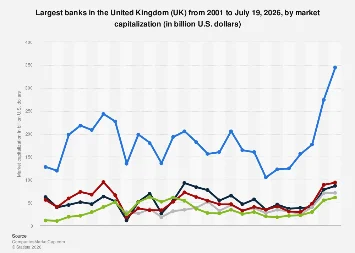
The landscape of the United Kingdom’s banking sector has been a dynamic and often turbulent arena over the past two decades, marked by significant economic shifts, regulatory reforms, and evolving market pressures. Analyzing the market capitalization of the nation’s largest banks provides a critical lens through which to understand these transformations, revealing the enduring strength of established players, the rise and fall of perceived dominance, and the forward-looking projections that shape investor sentiment. From the dawn of the new millennium to anticipated trends in the mid-2020s, the fortunes of these financial titans reflect broader economic currents and strategic adaptations within one of the world’s most significant financial hubs.
In 2001, the UK banking sector was largely characterized by a consolidation phase following the "Big Bang" deregulation of the 1980s. Major institutions like HSBC, Barclays, Lloyds TSB (prior to its merger with HBOS), and NatWest (part of the Royal Bank of Scotland Group at the time) were already dominant forces, their market capitalizations reflecting substantial domestic and international operations. HSBC, with its extensive global reach, particularly in Asia, often held a commanding position. Barclays, a venerable institution, was also a key player, leveraging its strong retail and investment banking arms. The Royal Bank of Scotland Group, having undergone significant expansion, was another heavyweight, though its subsequent trajectory would be dramatically altered by the global financial crisis.
The early to mid-2000s witnessed a period of robust growth for many of these banks, fueled by a booming global economy and a relatively stable financial environment. However, the seeds of future disruption were being sown. The burgeoning financial technology (FinTech) sector, while nascent, began to challenge traditional banking models, particularly in areas like payments and retail banking services. Meanwhile, regulatory scrutiny, though present, was less intense than it would become in the aftermath of the 2008 crisis.
The global financial crisis of 2007-2008 proved to be a watershed moment for the UK banking sector. Institutions that had engaged in aggressive risk-taking, particularly in the subprime mortgage market and complex derivative instruments, faced severe liquidity shortages and solvency concerns. The market capitalizations of many banks plummeted, and some, like Northern Rock, required government intervention and nationalization. The Royal Bank of Scotland, once a symbol of aggressive expansion, was rescued by a massive taxpayer-funded bailout, its market value decimated. This period fundamentally reshaped the competitive landscape, leading to increased regulatory oversight, stringent capital requirements, and a renewed focus on risk management and financial stability.
In the post-crisis era, the narrative shifted towards deleveraging, strengthening balance sheets, and adapting to a more risk-averse regulatory environment. Lloyds TSB’s acquisition of HBOS in a government-brokered deal underscored the consolidation and restructuring that were necessary for survival. The market capitalization of the surviving entities began a gradual recovery, but the era of unchecked growth and seemingly boundless profitability for some segments of the industry was over. New entrants, often digitally-focused challenger banks, began to emerge, nibbling at the edges of the incumbents’ market share in specific services, particularly in the retail and small business segments.
As we look towards projections for 2025 and 2026, several key trends are likely to continue shaping the market capitalization of the UK’s largest banks. Firstly, the ongoing digital transformation remains paramount. Banks that successfully invest in and leverage technology – from AI-driven customer service and personalized financial advice to advanced data analytics and seamless mobile banking – are better positioned to attract and retain customers, thereby bolstering their market valuations. The ability to offer integrated digital ecosystems, encompassing not just traditional banking but also wealth management, insurance, and even lifestyle services, will be a significant differentiator.
Secondly, regulatory evolution, while having stabilized somewhat since the immediate post-crisis period, continues to exert influence. The focus on consumer protection, data privacy, and the resilience of the financial system means that compliance remains a significant operational cost. However, regulatory frameworks are also evolving to accommodate new players and technologies, creating both challenges and opportunities for established institutions. The push for open banking, for instance, has forced incumbent banks to open up their data infrastructure, fostering competition and innovation.
Thirdly, the global economic outlook, geopolitical stability, and interest rate environments will inevitably play a crucial role. Inflationary pressures, potential recessions, and shifts in global trade patterns can all impact corporate profitability and investor confidence. Banks with diversified revenue streams and robust risk management frameworks are more likely to weather economic storms and maintain or grow their market capitalization. The ongoing impact of Brexit also continues to be a factor, influencing the UK’s attractiveness as a global financial center and the operational strategies of its major banks.
Furthermore, the sustainability agenda is increasingly influencing investor decisions. Banks that demonstrate a commitment to environmental, social, and governance (ESG) principles, including responsible lending practices and investments in green initiatives, may find themselves rewarded with higher valuations as investors prioritize sustainable growth. This can manifest in increased access to capital, lower borrowing costs, and a stronger brand reputation.
While precise market capitalization figures are proprietary and fluctuate daily, the general trajectory suggests a continued dominance of the established players like HSBC and Barclays, albeit with increased competition from agile challenger banks and potentially FinTech firms that achieve scale and offer banking-like services. Lloyds Banking Group, having undergone significant restructuring, will likely remain a formidable presence in the retail and commercial banking space. Standard Chartered, with its strong emerging markets focus, will continue to be influenced by global economic dynamics in Asia and Africa.
The challenge for these legacy institutions lies in balancing the need for significant investment in digital innovation and new business models with the imperative to manage legacy IT systems, regulatory compliance, and the expectations of shareholders for consistent profitability. The ability to attract and retain top talent in areas like data science, cybersecurity, and digital product development will be critical.
Looking ahead, the market capitalization of UK banks will be a real-time indicator of their success in navigating these complex forces. It will reflect their ability to innovate, adapt to evolving customer needs, manage risks effectively, and contribute to a sustainable and resilient financial system. The journey from 2001 to 2026 represents not just a series of financial metrics, but a compelling narrative of resilience, adaptation, and the enduring, yet ever-changing, importance of banking in the global economy. The top players will likely be those that can seamlessly blend their historical strengths with the agility and innovation demanded by the 21st-century financial landscape.