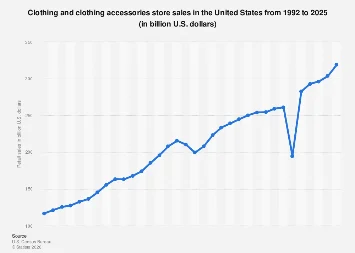
The United States apparel and clothing accessories retail sector is projected to reach approximately $319 billion in sales by the close of 2025, underscoring the enduring significance of brick-and-mortar establishments in the nation’s consumer landscape. This figure, representing a substantial portion of the global apparel market, highlights the continued reliance on fixed-point-of-sale locations for clothing and accessory transactions, as defined by the North American Industry Classification System (NAICS). While e-commerce continues its ascent, the physical store remains a vital channel for this foundational segment of the retail economy.
The U.S. apparel market stands as the preeminent global force, consistently demonstrating robust sales figures. Monthly retail sales within clothing stores in the United States routinely surpass the $15 billion mark, indicating a dynamic and high-volume industry. The most recent available data for December 2024 shows a significant uptick, with clothing store retail sales reaching an impressive $27 billion for that month alone, signaling strong seasonal purchasing patterns. This surge often reflects holiday shopping and year-end promotional activities, common in the retail calendar.
Delving deeper into market segmentation, the revenue generated by the women’s and girls’ apparel segment in the United States was estimated at a formidable $191.4 billion in 2024. This segment consistently outpaces its male counterpart, driven by a diverse range of fashion trends, evolving consumer preferences, and a generally higher propensity for discretionary spending on apparel within this demographic. In parallel, the men’s and boys’ apparel market registered approximately $111 billion in revenue during the same period. While smaller in absolute terms, this segment is far from stagnant, benefiting from trends in athleisure, workwear revival, and a growing emphasis on personal style among men. The combined total for these two major segments alone approaches the projected overall sales figure for the broader clothing and accessories retail sector, indicating the foundational role of these categories.
Leading brands within this competitive landscape continue to command significant consumer attention and loyalty. Levi’s, a heritage brand synonymous with denim, was identified as one of the most popular apparel brands among U.S. consumers in a survey conducted during the fourth quarter of 2024. This enduring popularity is not merely anecdotal; it is demonstrably reflected in the company’s financial performance. Levi Strauss & Co. achieved an all-time high in global net sales, reaching $6.4 billion in 2024. This record-breaking figure underscores the brand’s successful strategy in navigating market shifts, maintaining relevance through product innovation, and leveraging its strong brand equity. Such performance by a single entity within the sector illustrates the concentration of market power and brand recognition that can drive significant revenue.
The economic impact of the U.S. apparel retail sector extends far beyond direct sales figures. It is a significant contributor to employment, encompassing a vast network of designers, manufacturers, marketers, logistics professionals, and retail staff. Furthermore, the industry plays a crucial role in the supply chain, influencing international trade dynamics and raw material markets, such as cotton and synthetic fibers. Fluctuations in apparel sales can have ripple effects across these interconnected industries, impacting commodity prices and manufacturing output globally.
Globally, the U.S. apparel market’s dominance is a long-standing phenomenon. Its sheer size allows it to set trends and influence consumer behavior in other regions. However, the sector is also increasingly subject to global economic forces, including inflation, geopolitical instability, and shifts in international trade policies. For instance, rising energy costs can impact manufacturing and transportation expenses, while trade tariffs can alter the cost and availability of imported garments. The sector’s reliance on global supply chains means that disruptions in one part of the world can quickly translate into challenges for U.S. retailers.
The projected sales of $319 billion for 2025 are not without their challenges and opportunities. The persistent growth of e-commerce, though not negating the importance of physical stores, continues to reshape consumer shopping habits. Retailers are increasingly adopting omnichannel strategies, integrating their online and offline presences to offer seamless customer experiences. This includes services like buy-online-pickup-in-store (BOPIS), ship-from-store, and personalized digital marketing efforts that drive traffic to both online and physical locations.
Furthermore, evolving consumer values are playing an increasingly prominent role. There is a growing demand for sustainable and ethically sourced apparel, prompting brands to re-evaluate their production processes and supply chain transparency. Brands that can effectively communicate their commitment to environmental and social responsibility are likely to gain a competitive edge. This shift is not just a matter of corporate social responsibility; it is becoming a key purchasing driver for a significant segment of consumers, particularly younger demographics.
The influence of fast fashion, while still a powerful force, is also being scrutinized. Consumers are becoming more aware of the environmental footprint of rapidly changing fashion cycles. This has led to a counter-trend of slow fashion and a greater appreciation for durable, high-quality garments. Retailers that can offer a balance of trend-driven items and timeless, well-made pieces are well-positioned to capture a broader market share.
Technological advancements are also set to further shape the retail landscape. Artificial intelligence is being employed for inventory management, personalized recommendations, and optimizing store layouts. Virtual try-on technologies and augmented reality are beginning to bridge the gap between online and in-store shopping, offering enhanced engagement for consumers. The integration of these technologies will be crucial for retailers aiming to maintain and grow their market share in the coming years.
In conclusion, the U.S. clothing and clothing accessories retail sector, projected to achieve $319 billion in sales by 2025, remains a bedrock of the American economy. While facing evolving consumer preferences, the rise of digital commerce, and global economic uncertainties, the sector’s resilience is evident. The continued strength of physical retail, coupled with strategic adaptation to new technologies and consumer values, suggests a dynamic and evolving future for this vital industry. The success of established brands like Levi’s further solidifies the importance of brand loyalty and effective market positioning in capturing a substantial share of this massive consumer market.