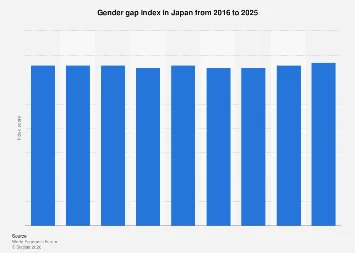
Japan’s overall gender gap index score for 2025 registered at 0.67 points, reflecting a modest improvement over the preceding three years. However, this marginal gain did little to elevate the nation’s standing on the global stage, as it was ranked 118th out of 148 countries surveyed by the World Economic Forum’s comprehensive Global Gender Gap Report. This position places Japan significantly behind its peers within the Group of Seven (G7) advanced economies, raising critical questions about the pace and efficacy of its gender equality initiatives.
While Japan has achieved near parity in the education and health sectors, as indicated by its robust scores in these domains, the persistent chasm in political empowerment and economic participation significantly drags down its overall performance. In political representation, Japan’s score falls substantially below the global average, ranking it among the lowest within the East Asia and Pacific region. This deficit is a direct consequence of the remarkably low proportion of women serving as parliamentarians and holding leadership roles in governmental bodies. The report highlights that only a small fraction of elected officials are women, a statistic that contrasts sharply with more progressive nations and underscores a deep-seated structural challenge.
The economic sphere presents another critical area of concern. A substantial disparity between men and women in economic participation and opportunity is a key driver of Japan’s lackluster ranking. This gap is acutely visible in the corporate landscape, where the ratio of women in managerial and executive positions remains disappointingly low. Despite the increasing presence of women in the workforce, their progression into decision-making roles is severely hampered by a combination of cultural norms, workplace structures, and an often-unacknowledged bias that favors male advancement. This lack of female representation at the highest echelons of business not only limits economic potential but also perpetuates a cycle of limited role models for aspiring women.
The historical context of gender roles in Japan is crucial to understanding these persistent disparities. While contemporary Japanese women benefit from greater freedoms, improved access to education, and a wider array of career prospects compared to previous generations, traditional patriarchal structures and a pervasive culture of male favoritism continue to exert a powerful influence. These deeply ingrained societal expectations often create invisible barriers for women seeking to balance career aspirations with family responsibilities, and they can manifest in workplace cultures that are not always conducive to female advancement. The ongoing public and media discourse surrounding gender equality in Japan frequently underscores the gap between aspirations and reality, highlighting the slow pace of change.
In response to these challenges, the Japanese government has set ambitious targets. By the close of 2025, the administration aims to achieve a significant increase in the proportion of women in political, judicial, and economic leadership positions, with a specific goal of reaching 30 percent or more in a broad range of roles. This strategic push is intended to accelerate a generational shift that many observers believe is long overdue and essential for fostering genuine diversity and unlocking the full potential of the nation’s human capital.
The economic implications of Japan’s gender gap are substantial. According to various economic analyses, closing the gender gap could significantly boost Japan’s Gross Domestic Product (GDP). A report by the McKinsey Global Institute, for instance, projected that advancing women’s equality in economic participation could add trillions of dollars to global GDP, with Japan standing to gain considerably. This untapped economic potential stems from the fact that when women participate fully in the workforce and leadership, economies tend to become more innovative, productive, and resilient. The current underutilization of female talent represents a considerable economic drag.
Globally, Japan’s performance is starkly contrasted by countries that have made substantial progress in closing their gender gaps. Nordic nations like Iceland, Norway, and Finland consistently rank at the top of the Global Gender Gap Index, demonstrating that sustained political will, robust policy interventions, and a societal commitment to equality can yield tangible results. These countries have implemented comprehensive policies such as generous parental leave, affordable childcare, and quotas for women on corporate boards, which have demonstrably improved women’s economic and political participation.
The challenges in Japan are multifaceted and deeply embedded. They include a shortage of affordable and accessible childcare facilities, a demanding work culture that often necessitates long hours and discourages work-life balance, and a societal perception that women are primarily responsible for domestic duties and childcare. Furthermore, the prevalence of non-regular employment for women, which typically offers lower pay, fewer benefits, and less job security, exacerbates economic disparities. While the government’s stated aim of increasing female representation is a positive step, the success of these initiatives will hinge on addressing the underlying structural and cultural barriers.
The legal and policy framework, while evolving, has not yet translated into the widespread societal change required. For instance, while Japan has laws promoting equal opportunity, enforcement mechanisms and societal adherence can be inconsistent. The concept of "M-shaped curve" of female labor participation, where women’s employment drops significantly during their childbearing and early child-rearing years, remains a persistent feature of the Japanese labor market, indicating that returning to the workforce after a break is often difficult.
Looking ahead, the success of Japan’s gender equality agenda will depend on a concerted effort involving the government, corporations, and civil society. Companies will need to actively foster inclusive work environments, implement flexible working arrangements, and promote women into leadership roles. Educational institutions can play a role in challenging traditional gender stereotypes from an early age. Furthermore, a broader societal shift in attitudes towards gender roles and a greater recognition of the economic and social benefits of equality are paramount. Without these fundamental changes, Japan risks remaining a laggard among advanced economies, failing to harness the full potential of its female population and hindering its long-term economic prosperity and social development. The 2025 ranking serves as a critical juncture, signaling that while progress has been made, the path to true gender parity in Japan remains a long and arduous journey.