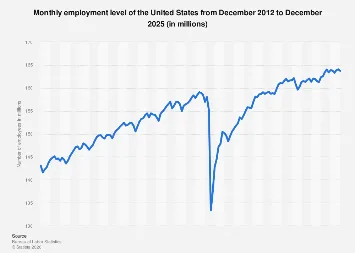
The United States labor market, a critical engine of global economic activity, is projected to maintain a robust employment level as it approaches the end of 2025. While precise figures for December 2025 are subject to ongoing data collection and analysis, available projections indicate a continuation of the recovery and growth trajectory observed in the preceding years. This sustained employment level underscores the resilience and adaptive capacity of the American workforce and its employers in the face of evolving economic landscapes.
The period from December 2012 through December 2025 offers a significant vantage point for understanding employment dynamics. This timeframe encompasses periods of steady growth, a sharp contraction driven by the unprecedented global health crisis in early 2020, and a subsequent, vigorous rebound. The nadir of employment during this span, recorded in April 2020, saw a considerable dip in the number of employed individuals. However, the subsequent recovery has been a testament to the underlying strength of the U.S. economy, with employment figures not only surpassing pre-pandemic levels but also continuing to trend upwards. This sustained growth is a key indicator of a healthy and expanding job market.
Understanding the composition of employed persons is crucial for a comprehensive analysis. The U.S. Bureau of Labor Statistics defines employed individuals as those who, during the survey reference week, engaged in any work for pay or profit. This definition also includes those who contributed at least 15 hours of unpaid work to a family-operated enterprise. Furthermore, individuals temporarily absent from their regular positions due to reasons such as illness, vacation, inclement weather, industrial disputes, or other personal circumstances are still counted as employed. This broad definition ensures that the employment figures accurately reflect the active labor force, encompassing both full-time and part-time workers across various sectors. The age group considered for these statistics typically spans individuals aged 16 and older, representing the primary working-age population.
The trajectory of employment from 2012 to 2025 can be segmented into distinct phases, each influenced by a confluence of macroeconomic factors. The years preceding 2020 were characterized by a generally stable and expanding job market, fueled by technological advancements, increasing consumer demand, and a generally favorable business environment. The COVID-19 pandemic introduced a severe and abrupt shock, leading to widespread business closures, furloughs, and layoffs. The subsequent recovery, beginning in the latter half of 2020 and continuing through 2021 and 2022, was driven by a combination of government stimulus measures, the easing of pandemic-related restrictions, and a pent-up demand for goods and services. By 2023 and into 2024, the labor market demonstrated remarkable resilience, with job creation exceeding expectations in many sectors. Projections for the remainder of 2025 anticipate this momentum to continue, albeit potentially moderated by global economic headwinds and evolving monetary policy.
The global economic context plays an undeniable role in shaping U.S. employment trends. As the world’s largest economy, the United States is intricately linked to international trade, investment flows, and global supply chains. Fluctuations in major international markets, geopolitical events, and shifts in global demand can all have ripple effects on domestic employment. For instance, a slowdown in key trading partners might impact export-oriented industries, potentially leading to reduced hiring or even job losses in those sectors. Conversely, strong global demand for U.S. goods and services can spur job creation and economic expansion. Similarly, foreign direct investment into the U.S. can create new jobs and boost overall employment levels.
Looking ahead to 2025, several key economic indicators and trends will likely influence the employment landscape. Inflationary pressures, while showing signs of moderation, may continue to influence wage growth and consumer spending. The Federal Reserve’s monetary policy, particularly interest rate decisions, will play a crucial role in managing inflation and potentially impacting business investment and hiring decisions. Technological advancements, including automation and artificial intelligence, are expected to continue transforming various industries, leading to both job displacement in some areas and the creation of new roles requiring different skill sets. The transition to a greener economy, driven by climate change initiatives, is also poised to create new employment opportunities in renewable energy, sustainable infrastructure, and related fields.
Industry-specific employment trends will also contribute to the overall picture. Sectors such as healthcare, technology, and professional and business services have historically demonstrated strong job growth and are expected to continue doing so. The healthcare sector, driven by an aging population and advancements in medical technology, remains a consistent source of employment. The technology sector, with its rapid innovation and pervasive influence across all industries, continues to demand skilled workers in areas like software development, data analytics, and cybersecurity. Professional and business services, encompassing a wide range of expertise from consulting to legal services, also tend to mirror overall economic health and expansion. Conversely, sectors that are more sensitive to consumer discretionary spending or global economic cycles, such as retail and manufacturing, may experience more volatility.
The concept of full-time versus part-time employment also warrants attention. While the overall employment figures capture both, shifts in the balance between full-time and part-time roles can offer insights into the quality of employment and the economic well-being of workers. A strong labor market typically sees a preference for full-time positions with benefits, indicating stable and secure employment. A significant increase in part-time employment, particularly if involuntary, could suggest underlying economic weaknesses or a prevalence of precarious work arrangements.
The supplementary notes provided regarding data collection are also important to acknowledge. For instance, the mention of data for October 2025 not being collected due to a federal government shutdown highlights the potential for minor disruptions in reporting and the importance of understanding the methodology behind employment statistics. Such events, while typically temporary, can underscore the complexities of data gathering in a large and dynamic economy.
In conclusion, the projected employment level in the United States for December 2025 signifies a continued state of economic recovery and expansion. The period from 2012 to the present has been marked by significant shifts, with the labor market demonstrating remarkable resilience in overcoming the challenges posed by the pandemic. As the economy navigates ongoing global economic trends, technological advancements, and policy decisions, the sustained strength of the U.S. employment market will remain a critical determinant of overall economic health and prosperity. Continuous monitoring of labor force participation, wage growth, and sectoral employment trends will be essential for stakeholders to understand and adapt to the evolving dynamics of the American workforce.