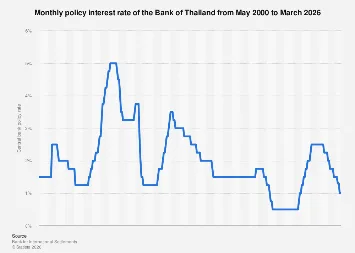
The Bank of Thailand (BOT) has been navigating a complex economic landscape, with its policy interest rate serving as a critical lever to manage inflation and foster sustainable growth. Examining the historical trajectory of the BOT’s policy rate from 2000 to the present, and projecting potential future movements up to 2026, offers valuable insights into the nation’s economic strategy and the global forces influencing it. This analysis delves into the past decisions, the prevailing economic conditions that shaped them, and the forward-looking outlook, considering both domestic and international economic dynamics.
The period from 2000 onwards has witnessed significant fluctuations in Thailand’s policy rate, reflecting responses to a range of economic challenges and opportunities. In the early 2000s, Thailand, like much of Asia, was recovering from the Asian Financial Crisis. The BOT’s monetary policy during this time was largely geared towards stimulating domestic demand and ensuring financial stability. Interest rates were generally kept at levels conducive to borrowing and investment. However, the global economic environment, punctuated by events such as the dot-com bubble burst and subsequent global slowdowns, necessitated a cautious approach.
As the decade progressed, Thailand experienced periods of robust growth, interspersed with bouts of inflationary pressure. The BOT’s response typically involved adjustments to the policy rate. When inflation showed signs of accelerating beyond the target range, the central bank would typically raise rates to curb demand and anchor inflation expectations. Conversely, during periods of economic slowdown or when inflation was below target, rate cuts would be employed to provide stimulus. The global financial crisis of 2008 and the subsequent European sovereign debt crisis also cast long shadows, influencing monetary policy decisions as the BOT sought to insulate the Thai economy from external shocks while maintaining domestic stability.
The period from 2010 to the late 2010s saw Thailand grappling with a more nuanced set of challenges. While economic growth remained a priority, the BOT also had to contend with the lingering effects of global quantitative easing and low interest rates in developed economies. This created a complex environment where managing capital flows and exchange rate stability became increasingly important. The BOT’s policy rate movements during this time were often described as measured, reflecting a careful balancing act between supporting growth, managing inflation, and maintaining financial sector stability. For instance, periods of elevated global liquidity could put downward pressure on the Thai Baht, potentially leading to imported inflation, thus prompting rate adjustments.
The advent of the COVID-19 pandemic in early 2020 marked a significant turning point for global and Thai economies. The BOT, in line with central banks worldwide, responded with an accommodative monetary policy stance. This involved substantial interest rate cuts to cushion the economic impact of lockdowns, supply chain disruptions, and a sharp decline in tourism, a vital sector for Thailand. The goal was to ensure ample liquidity in the financial system, support businesses, and prevent a deep recession. However, this accommodative stance also laid the groundwork for future inflationary pressures as economies began to reopen and demand surged.
In recent years, Thailand has experienced a resurgence of inflation, driven by a confluence of factors including global supply chain bottlenecks, rising energy prices, and pent-up consumer demand. This has necessitated a shift in the BOT’s monetary policy paradigm, moving away from stimulus towards tightening. The central bank began to raise its policy rate in 2022, signaling its commitment to bringing inflation back within its target range. This tightening cycle is a critical phase, as it aims to cool down an overheating economy without stifling the nascent recovery.
The current economic context for Thailand is characterized by a dynamic interplay of domestic recovery and external headwinds. While domestic consumption and investment are showing signs of resilience, the global economic slowdown, geopolitical uncertainties, and persistent inflationary pressures in major economies pose significant risks. The BOT’s decisions on the policy rate will therefore be closely watched by investors, businesses, and consumers alike.
Looking ahead to 2026, the trajectory of Thailand’s policy rate will likely be shaped by several key factors. Firstly, the path of inflation will remain paramount. If inflation proves to be more persistent than anticipated, the BOT may need to continue its tightening cycle or keep rates at elevated levels for an extended period. Conversely, if inflation subsides more rapidly, the central bank might consider pausing or even reversing its tightening stance to support economic growth.
Secondly, the performance of the Thai economy itself will be a crucial determinant. The recovery in key sectors such as tourism and exports, alongside the health of domestic demand, will influence the central bank’s assessment of the appropriate monetary policy stance. Projections for GDP growth will be closely scrutinized, with forecasts indicating varying degrees of optimism and caution among economic analysts. For instance, if growth falters, the pressure to ease monetary policy could intensify.
Thirdly, global economic conditions will continue to play a significant role. The monetary policy stances of major central banks, such as the U.S. Federal Reserve and the European Central Bank, can influence capital flows to emerging markets like Thailand. If developed economies maintain higher interest rates for longer, it could put pressure on the Thai Baht and potentially require the BOT to adjust its policy rate to maintain financial stability and competitiveness. Furthermore, the trajectory of global commodity prices, particularly oil and food, will continue to impact inflation dynamics.
Market data and economic forecasts from institutions like the International Monetary Fund (IMF) and the Asian Development Bank (ADB) provide a framework for understanding these potential future scenarios. These institutions typically provide forecasts for inflation and GDP growth, which directly inform the likely path of interest rates. For example, if forecasts suggest inflation remaining above target, a higher terminal policy rate or a longer period of elevated rates would be anticipated.
Expert insights from economists and financial analysts offer further layers of analysis. They often highlight the trade-offs faced by central banks, such as the delicate balance between controlling inflation and avoiding a recession. The concept of a "soft landing" for the economy—where inflation is brought under control without triggering a significant economic downturn—is a key aspiration, and the BOT’s policy rate decisions will be judged on their success in achieving this.
The economic impact of the BOT’s policy rate decisions is multifaceted. Higher interest rates can increase borrowing costs for businesses and consumers, potentially dampening investment and consumption. This can lead to a slowdown in economic activity. Conversely, lower interest rates can stimulate borrowing and spending, fostering economic growth but also potentially fueling inflation. The transmission mechanisms of monetary policy, including the impact on credit markets, asset prices, and exchange rates, are closely monitored by policymakers and market participants.
In conclusion, Thailand’s monetary policy rate, as set by the Bank of Thailand, has historically been a dynamic instrument responding to a complex array of domestic and international economic forces. From post-crisis recovery to managing global liquidity and combating inflation, the BOT’s decisions reflect a continuous effort to achieve price stability and foster sustainable economic growth. The path forward to 2026 will likely be defined by the evolving inflation outlook, the resilience of the Thai economy, and the prevailing global economic environment, necessitating careful calibration of monetary policy to navigate these challenges effectively.