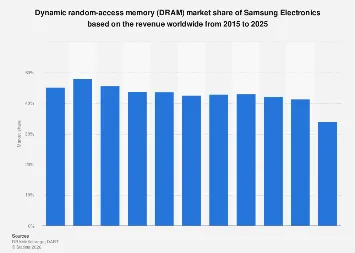
Samsung Electronics, a titan in the semiconductor industry, experienced a notable shift in its global market share for Dynamic Random-Access Memory (DRAM) in 2025. While still a dominant force, the South Korean conglomerate saw its revenue-based share of the worldwide DRAM market contract compared to the preceding year. This adjustment reflects the complex and often volatile nature of the semiconductor landscape, influenced by evolving demand, competitive pressures, and macroeconomic factors.
The DRAM market is a critical component of the global technology ecosystem, underpinning the performance of everything from personal computers and smartphones to servers and advanced artificial intelligence systems. As a memory technology, DRAM is essential for temporary data storage, enabling processors to access information quickly and efficiently. Its demand is intrinsically linked to the growth and innovation cycles across various technology sectors.
In 2025, Samsung Electronics commanded a specific, albeit reduced, percentage of this vital market, as measured by sales revenue. This figure represented a decrease from its market standing in 2024, indicating a narrowing of its dominance. While specific figures for 2025 are subject to proprietary data, historical trends and industry analyses suggest that such fluctuations are not uncommon in this highly cyclical industry. Market share is a dynamic metric, susceptible to shifts in production volumes, pricing strategies, product innovation, and the strategic maneuvers of competitors.
The contraction, even if marginal, in Samsung’s market share underscores the intensifying competition within the DRAM sector. Key rivals, including SK Hynix and Micron Technology, have consistently invested heavily in research and development, capacity expansion, and next-generation memory technologies. These companies are not merely content to be price-takers or followers; they actively strive to capture market share through technological leadership and aggressive market strategies. The pursuit of higher bandwidth, lower power consumption, and increased density in DRAM chips fuels this competitive drive.
Several factors likely contributed to Samsung’s market share adjustment in 2025. Global demand for electronic devices, a primary driver of DRAM consumption, may have experienced a period of stabilization or even slight decline after periods of rapid growth. The lingering effects of global supply chain disruptions, though easing, continued to influence production costs and lead times. Furthermore, shifts in consumer spending patterns and enterprise IT investment cycles can significantly impact the demand for memory components. For instance, a slowdown in PC upgrades or a recalibration of data center build-outs could directly translate to softer demand for DRAM.

The pricing environment for DRAM also plays a crucial role in market share calculations based on revenue. Periods of oversupply often lead to price erosion, which can disproportionately affect the revenue figures of market leaders if they are unable to maintain production discipline or if competitors engage in aggressive pricing to gain volume. Conversely, periods of tight supply and rising prices can bolster revenue for all players, but the ability to secure sales volume remains paramount for market share. Industry analysts closely monitor DRAM contract prices and spot market rates to gauge the overall health and competitive dynamics of the sector.
Beyond the immediate market forces, long-term strategic decisions by Samsung and its competitors are critical. Investments in advanced manufacturing processes, such as High-K Metal Gate (HKMG) technology and Extreme Ultraviolet (EUV) lithography, are essential for producing cutting-edge DRAM chips. Companies that achieve technological breakthroughs or secure early access to next-generation manufacturing capabilities can gain a significant competitive edge, influencing their market share trajectory over several years. Samsung, with its extensive vertical integration and R&D capabilities, is well-positioned to navigate these technological shifts, but maintaining leadership requires continuous innovation and substantial capital expenditure.
The global economic climate in 2025 would have also been a significant backdrop. Inflationary pressures, interest rate hikes in major economies, and geopolitical uncertainties can dampen consumer confidence and corporate spending, leading to reduced demand for electronics. This ripple effect inevitably impacts the semiconductor industry, including the crucial DRAM market. Global comparisons are also pertinent; while Samsung’s performance is measured against global competitors, regional demand patterns can vary. For example, growth in emerging markets or specific technological applications like automotive electronics or industrial IoT could offer pockets of resilience or growth even during a general downturn.
The economic impact of shifts in the DRAM market for a company like Samsung is profound. As a cornerstone of its semiconductor business, the DRAM segment contributes significantly to revenue and profitability. Any erosion in market share, even if accompanied by revenue growth, can signal a need for strategic reassessment. This might involve accelerating the development of new product lines, exploring adjacent markets, or optimizing operational efficiency to reduce costs. For the broader economy, Samsung’s performance in the DRAM market is indicative of the health of the global technology sector, which is a major engine of economic growth, job creation, and innovation.
Looking ahead, the DRAM market is expected to be shaped by emerging technologies such as AI, advanced driver-assistance systems (ADAS) in vehicles, and the metaverse, all of which demand increasingly sophisticated and high-capacity memory solutions. Samsung’s ability to capitalize on these trends, coupled with its response to competitive pressures and market dynamics, will determine its long-term market position. The company’s continued investment in next-generation DRAM, including High Bandwidth Memory (HBM) for AI applications, is a testament to its strategic foresight. The ongoing evolution of the semiconductor industry ensures that the DRAM market will remain a focal point for technological advancement and strategic competition for years to come.