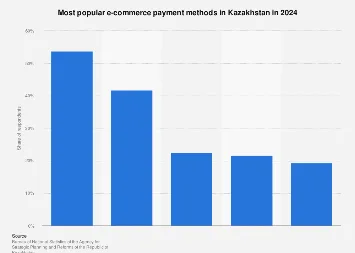
In 2024, Kazakhstan’s burgeoning e-commerce sector is being shaped by evolving consumer payment habits, with card-based transactions emerging as the dominant method for online purchases. A comprehensive survey, encompassing insights from 21,000 households, indicates that approximately [masked percentage] percent of Kazakhstani consumers opted for card payments when shopping online within the preceding three months. This preference highlights a significant maturation of digital payment infrastructure and consumer trust in card security and convenience.
The widespread adoption of card payments underscores a broader trend in emerging markets: the gradual shift away from traditional cash-based transactions towards more digitized financial interactions. As internet penetration increases and financial literacy improves, consumers are increasingly comfortable with online payment gateways, credit, and debit cards. This trend is not unique to Kazakhstan; similar patterns are observed across Central Asia and other developing economies where e-commerce is rapidly gaining traction. For instance, in neighboring Uzbekistan, while cash on delivery remains a strong contender, digital payment methods are steadily gaining ground, mirroring Kazakhstan’s trajectory.
Following closely behind card payments, bank transfers and cash on delivery represent the second and third most popular payment methods, respectively. Bank transfers, often facilitated through online banking portals or mobile applications, offer a secure and direct way to transfer funds, appealing to a segment of the population that prioritizes direct control over their transactions. Cash on delivery, a long-standing preference in many markets, continues to hold its ground by providing a tangible sense of security for consumers who may still harbor reservations about online payment security or prefer to inspect goods before payment. However, the declining share of cash on delivery, as evidenced by its position behind bank transfers, suggests a diminishing but still significant role.
The overall volume of retail e-commerce transactions in Kazakhstan has experienced robust year-on-year growth, surpassing [masked number] million transactions in 2023. This substantial increase signals a dynamic and expanding online marketplace. This growth is fueled by several factors, including increased digitalization efforts by the Kazakhstani government, a growing middle class with higher disposable incomes, and the expansion of logistics networks enabling faster and more reliable delivery across the vast country. Furthermore, the COVID-19 pandemic acted as a significant catalyst, accelerating the adoption of e-commerce out of necessity and establishing new consumer habits that have persisted.
The economic implications of this payment method diversification are far-reaching. For businesses operating within Kazakhstan, understanding these preferences is crucial for optimizing their checkout processes and customer acquisition strategies. Merchants who offer a variety of payment options, particularly card payments and seamless bank transfer integrations, are better positioned to capture a larger market share. The rise of digital payments also presents opportunities for fintech companies to innovate and offer specialized solutions, such as buy-now-pay-later (BNPL) options or localized digital wallets, further catering to consumer needs.
Globally, Kazakhstan’s e-commerce payment landscape aligns with broader trends. While mature markets like the United States and Western Europe show a higher saturation of digital wallets and contactless payments, emerging markets are often characterized by a strong presence of card payments and a gradual adoption of newer digital solutions. The Kazakhstani scenario, with its dominance of cards, followed by bank transfers and cash, is a common evolutionary stage for developing e-commerce ecosystems.
The growth in e-commerce transactions also has a direct impact on the nation’s financial sector. Increased digital transactions can lead to higher volumes of card processing, potentially boosting revenue for acquiring banks and payment processors. It also encourages the development of more sophisticated fraud detection and security systems, vital for maintaining consumer confidence. The government benefits from increased formalization of transactions, potentially leading to greater tax revenues and better economic data for policy-making.
Looking ahead, the trend towards digital payments in Kazakhstan is expected to continue. As e-commerce platforms become more sophisticated and offer a wider range of goods and services, consumer reliance on traditional payment methods will likely decrease further. The integration of mobile payment solutions, including QR code payments and country-specific digital wallets, is anticipated to play a more significant role in the coming years. For instance, countries like China have seen the meteoric rise of super-apps that integrate payments, communication, and a host of services, a model that could potentially inspire future developments in Kazakhstan.
The statistics on payment method preferences are derived from a substantial survey, providing a robust snapshot of consumer behavior. The fact that respondents could utilize multiple payment methods means the total share of reported methods may not sum to 100 percent, which is a common characteristic of such surveys reflecting the multi-faceted nature of consumer choice. This granular data is invaluable for market analysts, e-commerce platform developers, and financial institutions seeking to understand and capitalize on the evolving digital economy of Kazakhstan. The ongoing expansion of the e-commerce sector, coupled with the increasing comfort of consumers with digital payment methods, suggests a bright future for online retail in the Central Asian nation.