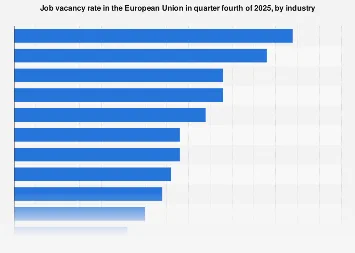
In the final quarter of 2025, the European Union’s labor market presented a varied landscape of demand, with administrative and support service activities emerging as the sector with the most pronounced job vacancy rate. This segment experienced a significant unfilled demand, reflecting a dynamic interplay of economic activity and workforce availability. Following closely behind, the construction sector also grappled with a substantial number of open positions, indicating robust activity and potentially a bottleneck in labor supply within this vital industry. Conversely, the mining and quarrying sector registered a notably lower job vacancy rate, suggesting a more stable or potentially contracting labor demand compared to other economic segments.
These figures, compiled for the fourth quarter of 2025, offer a crucial snapshot of the prevailing labor market conditions across the EU. While specific percentage figures for the top sectors were not publicly disclosed, the comparative data highlights distinct challenges and opportunities. The high vacancy rates in administrative and support services and construction could point to a confluence of factors including rapid business expansion, the retirement of experienced workers, and insufficient skilled labor entering these fields. For administrative and support services, this could encompass a broad range of roles from clerical staff and human resources to logistics and facilities management, all essential cogs in the functioning of modern economies. The construction sector’s high vacancy rate is often a direct indicator of infrastructure projects, housing development, and commercial building activity, all of which were likely experiencing significant momentum in late 2025.
The disparity between these sectors and mining and quarrying underscores the uneven nature of economic recovery and growth across different industries. Mining and quarrying, often subject to global commodity prices, technological advancements, and environmental regulations, may be operating with a more optimized workforce or facing different labor market pressures. The data also reveals important limitations in the available statistics, with specific information absent for sectors such as agriculture, forestry, and fisheries; public administration and defense; education; human health and social work activities; arts, entertainment, and recreation; and other service activities. This omission means that a comprehensive understanding of the EU’s total labor market vacancy picture is not yet complete, leaving critical areas for further investigation.
The economic implications of these vacancy rates are far-reaching. High vacancy rates in key sectors can lead to increased labor costs as employers compete for a limited pool of talent. This can translate into higher prices for goods and services, contributing to inflationary pressures. Furthermore, persistent labor shortages can hinder business growth, delay projects, and reduce overall economic output. For instance, if construction projects are stalled due to a lack of skilled tradespeople, it can impact housing supply and infrastructure development, with ripple effects throughout the economy. Similarly, if businesses in administrative and support services cannot fill essential roles, their operational efficiency and ability to scale can be compromised.
From a policy perspective, these figures highlight the need for targeted interventions. Governments and educational institutions may need to focus on skills development and vocational training programs to address shortages in sectors like construction. Initiatives aimed at attracting and retaining talent in administrative and support services, perhaps through improved working conditions or more flexible employment options, could also be crucial. The relative calm in mining and quarrying might suggest that this sector is either well-staffed or facing different demographic or technological challenges that do not manifest as immediate vacancy spikes.
Globally, labor market trends vary significantly. While some regions might be experiencing high unemployment, others, like the EU in these specific sectors, are grappling with the opposite challenge: a scarcity of available workers. For example, in parts of Asia, rapid industrialization has often led to significant labor demand, sometimes met by large, mobile workforces. In North America, similar to Europe, specific sectors like technology and healthcare frequently report shortages of skilled professionals. The EU’s situation in late 2025, with administrative and support services and construction at the forefront of vacancy rates, paints a picture of an economy actively seeking to expand and deliver on projects, but facing the inherent challenge of matching labor supply with demand.
The underlying reasons for high vacancy rates are complex and can include demographic shifts, such as an aging workforce and declining birth rates, which reduce the overall supply of labor. Technological advancements also play a role, sometimes creating new roles that require specialized skills that are in short supply, while also automating others. The "Great Resignation" phenomenon observed in recent years in various global economies may also have contributed to shifts in worker preferences and expectations, potentially impacting the attractiveness of certain industries or roles.
For businesses operating within the EU, understanding these trends is paramount for strategic planning. It necessitates a proactive approach to talent acquisition, including exploring new recruitment channels, investing in employee training and development to upskill the existing workforce, and potentially rethinking compensation and benefits packages to remain competitive. Companies might also explore automation and technology adoption to mitigate labor constraints where feasible, though this often requires significant capital investment and specialized expertise.
The economic impact extends beyond individual firms to the broader macroeconomic landscape. Persistent labor shortages can influence wage growth, which, if not matched by productivity gains, can contribute to inflation. Central banks monitor such indicators closely when setting monetary policy. Furthermore, the ability of an economy to innovate and grow is directly linked to its access to skilled human capital. If critical sectors cannot find the workers they need, it can dampen the pace of economic progress and reduce a nation’s or bloc’s competitiveness on the global stage.
The data for Q4 2025, while incomplete, serves as a vital indicator of the EU’s labor market pressures. The prominence of administrative and support services and construction in terms of job vacancies suggests these are growth areas demanding immediate attention from policymakers and businesses alike. Future analyses will be crucial to track whether these trends persist, evolve, or are addressed through effective labor market strategies, ultimately shaping the trajectory of the European economy in the years to come. The absence of data for several key sectors also highlights an ongoing need for more comprehensive and granular labor market reporting to facilitate a truly holistic understanding of employment dynamics across the European Union.