For over seven decades, Germany has presented itself to the global stage as an emblem of enduring prosperity, democratic stability, and economic resilience. From the foundational leadership of Konrad Adenauer through the chancellorships of Willy Brandt, Helmut Schmidt, Helmut Kohl, and the transformative 16-year tenure of Angela Merkel, the Federal Republic of Germany appeared to embody an unshakeable economic and political equilibrium. This perceived robustness was so profound that Germany was able to integrate the economically ailing East German state into its fabric within a year of the Berlin Wall’s collapse. While the post-war decades were not without their challenges, including the terrorism of the Red Army Faction in the 1970s and the economic turbulence triggered by oil price shocks, Germany’s economy largely experienced steady, inclusive growth, fueled by a formidable export sector. However, the nation now finds itself grappling with a pervasive economic malaise. Its once-invincible export-led model is struggling to maintain competitiveness against the ascendant economic power of China. Simultaneously, public sentiment towards immigration has reached its highest postwar levels, a direct consequence of Chancellor Merkel’s 2015 decision to open the country’s borders to over a million migrants. This confluence of economic pressures and social anxieties has fueled a significant rise in right-wing populism, with parties like the Alternative für Deutschland (AfD) actively challenging the fundamental political norms and assumptions that have guided Germany since its inception in 1949. The nation that rose from the ashes of war now faces a critical juncture, questioning its ability to reinvent itself without succumbing to another period of profound crisis.
The architects of Germany’s remarkable post-war resurgence, often referred to as the "Wirtschaftswunder" or economic miracle, are conventionally credited to the currency reform spearheaded by Ludwig Erhard and the infusion of capital from the European Recovery Programme (ERP), commonly known as the Marshall Plan. Both initiatives were launched in 1948. The Marshall Plan, officially enacted by US President Harry Truman on April 3, 1948, saw initial aid shipments reach Germany by early July. In return for this substantial economic assistance, Germany was mandated to adhere to a series of reforms: balancing its budget, curbing inflation, dismantling rationing systems, removing price and wage controls, fostering private enterprise, and liberalizing trade. These directives closely mirrored what would later be termed the "Washington Consensus" economic philosophy.
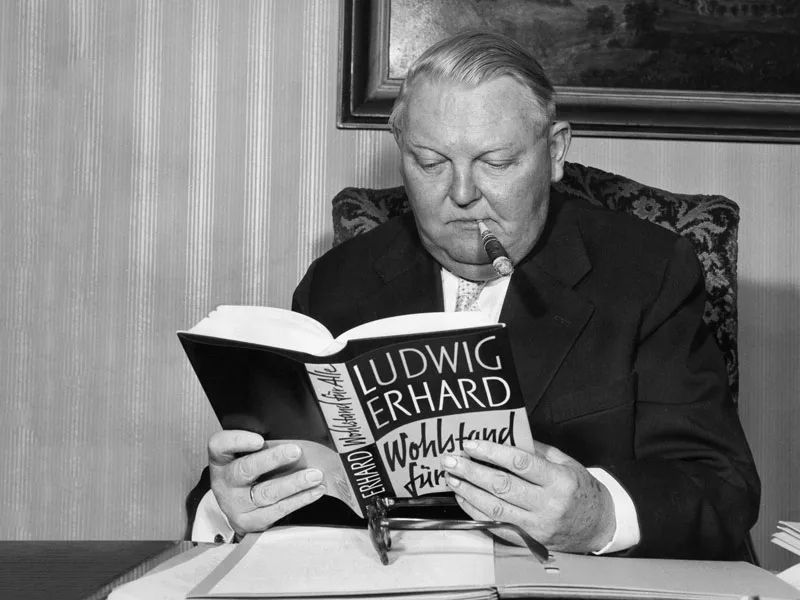
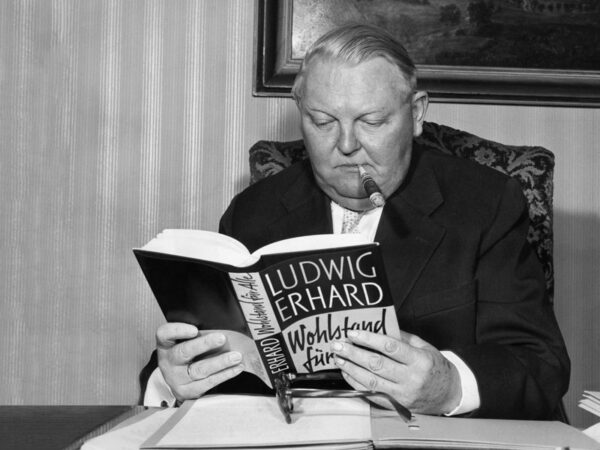
A pivotal element in this economic resuscitation was Erhard’s currency reform, implemented on June 20, 1948, midway between the signing of the ERP and the arrival of the first aid shipments. This reform saw the Deutsche Mark replace the Reichsmark as the official currency in the Bizone, the western occupation zone jointly administered by the United States and Great Britain. The reform effectively neutralized the "monetary overhang"—an excess of currency in circulation that had fueled black market inflation and led to widespread shortages in the controlled economy—by converting Reichsmarks into Deutsche Marks at a ratio of approximately 10:1. Ludwig Erhard, serving as the highest-ranking German economic official under the occupation authorities, oversaw the introduction of the new currency. Critically, on June 21, 1948, Erhard unilaterally abolished the majority of price controls and rationing measures.
The combination of eliminating the monetary overhang, implementing fiscal discipline, and lifting price controls led to a swift and dramatic resurgence of goods available in the marketplace, transforming previously bare store shelves. Farmers, now possessing a stable and valuable currency, could invest in equipment and fertilizers, much of which was supplied by the US through the Marshall Plan. The prospect of tangible returns incentivized them to bring their produce to market, effectively alleviating food shortages. Exchange rate stabilization further empowered German firms, enabling them to export profitably while also selling domestically, which in turn spurred hiring, investment, and increased production. This period of unprecedented growth, averaging an impressive six percent annually over the subsequent quarter-century, propelled West Germany to become the world’s third-largest economy by 1973.
However, this widely accepted narrative of the Wirtschaftswunder is being challenged by recent scholarship. Two new books, one by Carl-Ludwig Holtfrerich, former Professor of Economics at the Free University of Berlin, and another by Tobias Straumann, Professor of Economics at the University of Zurich, offer revised perspectives. Holtfrerich contends that Ludwig Erhard played no significant role in the design of the currency reform, despite claiming credit for it throughout his political career. Straumann, meanwhile, argues that the economic recovery of West Germany was far from secure in the immediate aftermath of the 1948 reforms. He posits that the long-term sustainability of Germany’s economic miracle was critically dependent on the 1953 London Debt Agreement. This agreement effectively absolved Germany of the potentially crippling reparation obligations that had been imposed after World War I, a burden that contributed to the downfall of the Weimar Republic and the subsequent rise of Nazism.
The London Debt Agreement, the culmination of years of negotiations between a German delegation led by Hermann Josef Abs of Deutsche Bank and twenty creditor nations, notably the United States, the United Kingdom, and France, represented a significant departure from post-WWI reparations settlements. Straumann attributes this outcome to a powerful "lessons of history" hypothesis. Negotiators on all sides, acutely aware of the devastating economic and political consequences of the 1921 reparations imposed on Germany, were determined to avoid a similar historical sequence. The specter of hyperinflation, political instability, and ultimately, the rise of Adolf Hitler, served as a stark warning.
While historical lessons were undoubtedly influential, the full context of the London Debt Agreement reveals a more complex interplay of factors. The burgeoning Cold War played a crucial role in shaping the economic imperatives of the 1950s. With the Soviet Union posing a significant threat to Western Europe, the rapid economic recovery of West Germany—the continent’s most vital source of capital goods—became paramount. This necessitated avoiding an excessive reparations burden while simultaneously normalizing Germany’s financial relationships with the international community. This normalization was essential to enable German firms to secure foreign loans and export goods without the fear of asset seizure, thereby fostering confidence and facilitating trade.
Under the terms of the London Debt Agreement, the new West German government committed to servicing and repaying its pre-war foreign debts and post-WWII loans from Western governments. Crucially, Nazi-era war debts and occupation costs were excluded, and all reparations obligations were deferred until the hypothetical future reunification of East and West Germany. Another significant differentiating factor from the post-WWI era was the advancement of European integration. In parallel with debt negotiations, France, under the leadership of Foreign Minister Robert Schuman, proposed a plan for the joint control of French and German heavy industry, which eventually materialized as the European Coal and Steel Community (ECSC). The Soviet threat underscored the urgent need to restore the operational capacity of Western Europe’s heavy industry, particularly Germany’s. However, this also required assurances that Germany’s industrial might would not again be weaponized against its neighbors. The ECSC provided this crucial framework, and it is difficult to envision its successful establishment without parallel progress on the debt front. The agreement also facilitated the normalization of relations between the Federal Republic and Israel, a crucial step given the atrocities of the Holocaust. Without the financial capacity and political will generated by the agreement, Germany would have struggled to provide essential aid and imports to the nascent Jewish state.
Delving deeper into the origins of the currency reform, Holtfrerich’s biography of Edward Tenenbaum suggests that Tenenbaum, not Erhard, was the true architect of the Deutsche Mark’s introduction. Tenenbaum’s early life, marked by his Jewish parents’ immigration from Polish Galicia, his childhood in New York, and his education at the International School of Geneva and Yale, offers an interesting parallel with Harry Dexter White, the principal architect of the Bretton Woods system, another foundational element of the post-war monetary order. Tenenbaum served as an intelligence officer during World War II and subsequently in the Office of Military Government, United States (OMGUS), which administered the American occupation zone. After his discharge in 1946, he continued as a civilian advisor to OMGUS, where he developed the currency reform plan. During his service in Army Intelligence and OMGUS, Tenenbaum collaborated closely with Charles Kindleberger, a prominent economist and economic historian at MIT. Kindleberger’s influence is acknowledged in Holtfrerich’s account; it was from Kindleberger, during a sabbatical in Cambridge, Massachusetts, in 1975-76, that Holtfrerich first learned of Tenenbaum’s instrumental role in the currency reform.
The question of why Erhard, rather than Tenenbaum, received and continues to receive widespread credit for the currency reform is addressed by Holtfrerich through three primary explanations. Firstly, Tenenbaum was remarkably self-effacing, a trait that even eluded his biographer. When reportedly confronted with Erhard’s appropriation of credit, Tenenbaum is said to have responded with characteristic humility, "Who cares who gets the credit?" Secondly, Erhard, in stark contrast to Tenenbaum, was a masterful self-promoter. This disparity highlights the differing roles and approaches of economists and politicians. Erhard also possessed a remarkable adaptability, capable of shifting his policy stance to align with prevailing political winds. Prior to and during the war, he had advocated for strong state intervention in the economy; however, with the advent of the Marshall Plan, he embraced the principles of sound money, private enterprise, and free market competition.
Thirdly, and perhaps most significantly, post-war West Germany was desperately in need of a positive national identity. The profound guilt associated with the Third Reich’s atrocities created an urgent requirement for leaders and, indeed, heroes who could embody a new, hopeful narrative. The idea of a home-grown currency reform, masterminded by a German, resonated deeply with this national imperative. Today’s Germany, the inheritor of the Wirtschaftswunder, stands as a testament to its post-war success: a prosperous, democratic nation firmly integrated into the European project. However, the foundations of this success are not immutable. To preserve the gains painstakingly achieved over the past decades, Germany faces the pressing need for another significant economic overhaul and the emergence of political leadership capable of navigating the complex challenges of the 21st century. The nation that rose from ruin must now demonstrate its capacity for reinvention in a rapidly changing global landscape.