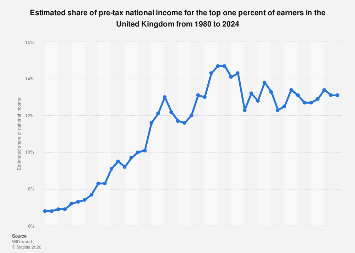
The United Kingdom’s economic landscape in 2024 continues to be shaped by a widening chasm between the highest earners and the rest of the population, with the top one percent of income earners capturing an increasingly significant share of the nation’s total income. This trend, often a barometer of economic inequality, suggests a concentration of wealth at the apex of the income distribution, with potential ramifications for social mobility, consumer spending, and broader economic stability. While precise, real-time figures for 2024 are still emerging and subject to rigorous statistical analysis, available data and economic projections point towards a continuation, if not an acceleration, of this long-standing pattern.
The concentration of income among the wealthiest segment of society is not a new phenomenon in the UK. Historically, periods of economic growth have sometimes coincided with a disproportionate benefit accruing to those at the top. However, the sustained and, in some analyses, increasing share held by the top 1% warrants close examination by policymakers, economists, and international observers. This group, defined by earning the highest incomes nationally, not only benefits from substantial earnings but also from the compounding effects of investments and capital gains, which often outpace wage growth for the majority.
Understanding the drivers behind this income concentration is multifaceted. Several factors are frequently cited in economic discourse. Firstly, globalization and technological advancements have created new avenues for wealth accumulation for a select few, particularly in sectors like finance, technology, and specialized professional services. These industries often reward highly skilled individuals with global reach and significant leverage, leading to compensation packages that dwarf those in other sectors. Secondly, changes in tax policy over recent decades, including reductions in top marginal tax rates and capital gains taxes in some periods, may have contributed to allowing higher earners to retain a larger portion of their income.
Furthermore, the structure of executive compensation in large corporations, often tied to stock performance and executive bonuses, can lead to substantial income spikes for top management. This can significantly influence the average income of the top 1%, especially during periods of strong market performance. The increasing financialization of the economy, where financial markets play a larger role in wealth creation, also tends to benefit those with significant capital to invest.
Examining international comparisons provides valuable context. While the UK’s income concentration is a notable feature, it is part of a broader global trend observed in many developed economies. Countries like the United States have historically shown even higher levels of income inequality, with the top 1% often commanding a larger share. However, nations with more robust social welfare systems and progressive taxation, such as some Scandinavian countries, tend to exhibit lower levels of income concentration. The UK’s position often falls somewhere in the middle, indicating a complex interplay of market forces, policy choices, and societal structures.
The economic implications of such a skewed income distribution are significant. A high concentration of income at the top can lead to a dual economy. While the wealthiest individuals may drive demand for luxury goods and services and invest heavily in global markets, the majority of the population might experience stagnant or declining real incomes, leading to reduced aggregate demand for everyday goods and services. This can create a drag on overall economic growth. Moreover, reduced purchasing power for the broader population can impact sectors reliant on mass consumption, from retail to housing.
Socially, a widening income gap can exacerbate concerns about social mobility and fairness. If opportunities for advancement are perceived to be increasingly tied to inherited wealth or access to exclusive networks, it can lead to disillusionment and social stratification. This can, in turn, place additional strain on public services as governments attempt to address the consequences of inequality.
From a policy perspective, understanding the precise share of income captured by the top 1% is crucial for informing fiscal and social policies. Governments may consider various levers to address income inequality, including progressive taxation, investment in education and skills training to enhance earning potential across the population, and policies aimed at strengthening the bargaining power of labor. The debate around wealth taxes, inheritance taxes, and corporate tax structures often intensifies when income concentration statistics highlight a growing disparity.
While definitive 2024 figures require official statistical releases, preliminary indicators and ongoing economic trends suggest that the UK’s top earners are likely to continue their significant claim on national income. The ongoing economic climate, characterized by inflation, interest rate adjustments, and global geopolitical uncertainties, adds another layer of complexity. These factors can disproportionately affect different income groups, potentially widening or narrowing the gap depending on how they manifest in wage growth, investment returns, and the cost of living.
The persistent concentration of income among the UK’s wealthiest one percent is a critical economic indicator that warrants continuous monitoring and thoughtful policy response. It raises fundamental questions about the distribution of economic gains, the fairness of the system, and the long-term sustainability of inclusive economic growth. As data for 2024 solidifies, the narrative of the UK’s wealth divide will undoubtedly continue to be a central theme in economic and political discussions, shaping the nation’s trajectory for years to come. The challenge for policymakers remains to foster an economy where prosperity is more broadly shared, ensuring that growth benefits not just a select few, but the nation as a whole. This requires a nuanced understanding of the intricate forces driving income distribution and a commitment to implementing strategies that promote both economic efficiency and social equity.