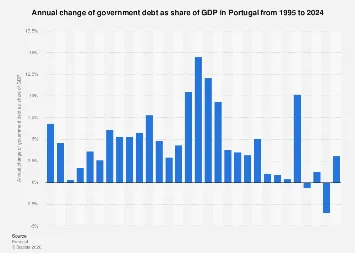
Portugal’s public debt as a percentage of its Gross Domestic Product (GDP) has undergone significant fluctuations, a key indicator of the nation’s fiscal health and its capacity to manage financial obligations. While recent trends suggest a positive trajectory, the historical context and the broader European economic landscape provide crucial insights into the challenges and opportunities facing the Portuguese economy. Understanding this metric is paramount for investors, policymakers, and international financial institutions alike, as it directly impacts borrowing costs, sovereign credit ratings, and overall economic stability.
The debt-to-GDP ratio, a fundamental macroeconomic indicator, measures a country’s total government debt against its annual economic output. A lower ratio generally signifies a stronger economy with a greater ability to repay its debts, while a persistently high ratio can signal fiscal vulnerability, potentially leading to higher interest rates on government bonds, increased risk of default, and constrained public spending. Portugal, like many European nations, has grappled with its debt levels, particularly in the aftermath of the 2008 global financial crisis and the subsequent European sovereign debt crisis.
In recent years, Portugal has made commendable progress in reducing its debt-to-GDP ratio. Data from Eurostat, the statistical office of the European Union, indicates a notable decline from its peak. For instance, in the first quarter of 2023, Portugal’s general government debt stood at 111.7% of GDP. While this figure remains elevated compared to many of its EU peers, it represents a significant decrease from the highs witnessed in previous years. For context, at the end of 2020, the ratio had reached approximately 133.6% of GDP, highlighting the effectiveness of fiscal consolidation measures and economic recovery efforts.
This reduction is not merely a statistical anomaly; it reflects a concerted effort by successive Portuguese governments to rein in public spending, improve tax collection, and foster economic growth. The Portuguese economy has demonstrated resilience, with GDP growth rates showing a positive trend in the post-pandemic era. According to the Bank of Portugal, the country’s GDP grew by 6.8% in 2022 and is projected to continue its expansion, albeit at a more moderate pace, in the following years. This economic expansion is crucial as it increases the denominator in the debt-to-GDP calculation, thereby lowering the ratio even if the absolute level of debt remains relatively stable.
However, the challenges are far from over. Portugal’s debt-to-GDP ratio remains one of the highest within the Eurozone. As of the second quarter of 2023, the Eurozone average stood at 81.7% of GDP, and the European Union average was 78.7%. This disparity underscores the ongoing need for fiscal prudence and structural reforms. The high debt burden can limit the government’s flexibility to respond to future economic shocks, such as unexpected recessions or increases in interest rates.
Several factors contribute to Portugal’s elevated debt levels. Historically, a combination of persistent budget deficits, the cost of bank bailouts during the financial crisis, and the commitment to public services have all played a role. Furthermore, demographic trends, including an aging population and a declining birth rate, place increasing pressure on social security and healthcare systems, potentially contributing to future fiscal deficits if not managed proactively.
Economists point to the importance of sustained economic growth as a primary driver for debt reduction. "For Portugal to effectively manage its debt, it needs to not only control its fiscal spending but also ensure that its economy can grow robustly enough to outpace its debt accumulation," notes Dr. Sofia Fernandes, a senior economist at a leading Lisbon-based think tank. "This requires a multi-pronged approach, including boosting productivity, encouraging foreign direct investment, and fostering innovation across key sectors."
The impact of interest rates on Portugal’s debt servicing costs is another critical consideration. As global interest rates have risen in response to inflation, the cost of borrowing for governments has also increased. Higher interest payments on its substantial debt can divert funds away from essential public services or investments in infrastructure and education, creating a fiscal drag. The European Central Bank’s monetary policy decisions, therefore, have a direct and significant influence on Portugal’s debt sustainability.
Looking ahead, Portugal’s commitment to fiscal discipline, coupled with its ongoing efforts to modernize its economy and attract investment, will be key to further reducing its debt-to-GDP ratio. The European Union’s fiscal rules, specifically the Stability and Growth Pact, will continue to provide a framework for member states to manage their public finances. Adherence to these rules, while sometimes challenging, is essential for maintaining macroeconomic stability and confidence among international creditors.
The country’s economic strategy is increasingly focused on leveraging its strengths in tourism, renewable energy, and technology. Investments in digital transformation and green initiatives are expected to create new avenues for growth and enhance the country’s long-term competitiveness. Successful implementation of these strategies could lead to higher tax revenues and improved fiscal balances, further contributing to debt reduction.
Moreover, the composition of Portugal’s debt also warrants attention. A significant portion of its debt is held by domestic investors, including banks and pension funds, which can mitigate some of the risks associated with foreign currency exposure. However, a substantial reliance on short-term debt can increase refinancing risks, particularly in periods of market volatility.
In conclusion, Portugal’s journey towards fiscal sustainability is an ongoing process. The recent decline in its debt-to-GDP ratio is a positive development, reflecting the efficacy of implemented policies and the resilience of the Portuguese economy. Nevertheless, the ratio remains high relative to its European counterparts, necessitating continued vigilance in fiscal management, a steadfast commitment to structural reforms, and a focus on sustained, inclusive economic growth. The nation’s ability to navigate these complex economic currents will ultimately determine its long-term financial stability and its capacity to achieve its developmental objectives.