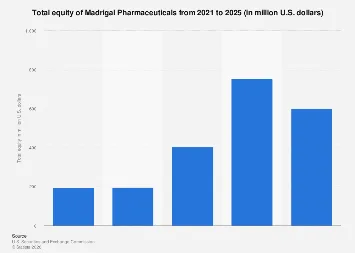
The financial landscape for Madrigal Pharmaceuticals, a biopharmaceutical company focused on developing therapies for fibrotic diseases, is poised for significant evolution in the coming years, with projections pointing towards a robust increase in total equity by 2025. While specific, real-time figures for future equity are inherently dynamic and subject to numerous market forces and company-specific developments, industry analysis and company guidance offer a framework for understanding this anticipated growth. This expansion is not merely a matter of accounting entries; it reflects the culmination of extensive research and development, successful clinical trial outcomes, potential regulatory approvals, and strategic market positioning.
Understanding the components of equity is crucial for a comprehensive financial assessment. Total equity, often referred to as shareholders’ equity or net worth, represents the residual interest in the assets of an entity after deducting its liabilities. For a publicly traded company like Madrigal Pharmaceuticals, this comprises several key elements: common stock, additional paid-in capital, retained earnings, and accumulated other comprehensive income (or loss). Changes in these components directly impact the overall equity figure. For instance, the issuance of new shares to raise capital, successful product launches that generate substantial profits and increase retained earnings, or even positive revaluations of assets can all contribute to an upward trend in total equity. Conversely, significant losses, share buybacks, or substantial dividend payouts could exert downward pressure.
Madrigal Pharmaceuticals has been a subject of intense interest within the biopharmaceutical sector, particularly for its lead drug candidate, resmetirom, an investigational thyroid hormone receptor-beta (TRβ) selective agonist. This compound is being developed for the treatment of nonalcoholic steatohepatitis (NASH), a chronic liver disease that affects millions globally and for which there are currently no approved therapies. The potential market for an effective NASH treatment is immense, estimated to be in the tens of billions of dollars annually. Success in this therapeutic area could dramatically alter Madrigal’s financial trajectory.
The company’s strategic decisions, including its approach to clinical development, regulatory engagement, and potential commercialization, are intrinsically linked to its equity performance. Madrigal has advanced resmetirom through multiple phases of clinical trials, with the Phase 3 MAESTRO-NASH study being a pivotal point. Positive results from such trials not only validate the drug’s efficacy and safety but also significantly enhance investor confidence, potentially leading to increased share valuations and, consequently, a higher market capitalization. This market valuation, while not directly equity, influences investor sentiment and the company’s ability to raise further capital, which in turn can bolster equity.
Furthermore, the capital structure and financing strategies employed by Madrigal Pharmaceuticals play a critical role in shaping its equity. As a company in the development stage, it has historically relied on a combination of equity financing (selling shares) and debt financing to fund its operations and extensive research endeavors. The balance between these forms of capital influences the total equity. For example, successful equity offerings, particularly at favorable valuations, directly increase the paid-in capital component of equity. Conversely, taking on significant debt increases liabilities, which, if not matched by a proportionate increase in assets or profitability, can lead to a decrease in the debt-to-equity ratio and potentially impact the overall financial health perception.
Looking towards 2025, several factors are expected to contribute to Madrigal’s projected equity growth. Foremost among these is the anticipated progress in the regulatory review and potential approval of resmetirom. Should resmetirom receive marketing authorization from major regulatory bodies like the U.S. Food and Drug Administration (FDA) and the European Medicines Agency (EMA), it would unlock substantial revenue-generating opportunities. The transition from a development-stage company to a commercial-stage entity typically triggers a re-rating by the market, often accompanied by increased investor interest and potentially higher share prices. This positive market sentiment can translate into a stronger financial position and an upward revision of equity forecasts.
The global market for liver disease treatments is experiencing rapid expansion, driven by rising obesity rates and metabolic syndrome, which are primary risk factors for NASH. According to market research reports, the global NASH therapeutics market is projected to grow at a compound annual growth rate (CAGR) of over 20% in the coming years, reaching significant valuations by the end of the decade. Madrigal Pharmaceuticals, with its first-mover advantage in resmetirom, is strategically positioned to capture a substantial share of this burgeoning market. Successful commercialization would lead to significant revenue streams, which, if reinvested effectively, would bolster retained earnings, a key component of shareholders’ equity.
Beyond resmetirom, Madrigal’s pipeline may also hold future value. While NASH is the primary focus, the company may have other promising drug candidates in earlier stages of development, targeting various fibrotic conditions. The successful progression of these other assets through preclinical and clinical stages can further enhance the company’s long-term growth prospects and its overall equity valuation. Investors often look at a company’s pipeline as a measure of its future potential, and a robust pipeline can command a premium.
Comparatively, other biopharmaceutical companies operating in the NASH space, such as Gilead Sciences and Intercept Pharmaceuticals, have also been investing heavily in research and development. However, Madrigal’s focused approach on TRβ agonism and its current lead in late-stage clinical development with resmetirom, assuming positive trial outcomes and regulatory approvals, could provide it with a distinct competitive edge. The financial performance of these peers, their R&D expenditures, and their market valuations offer benchmarks for assessing Madrigal’s potential. For instance, companies with approved treatments in similar therapeutic areas often exhibit higher revenue multiples and stronger equity bases due to established commercial operations.
The economic impact of a successful drug launch for Madrigal Pharmaceuticals extends beyond its balance sheet. It could lead to job creation, increased investment in manufacturing and distribution, and contribute to the broader economic ecosystem of the biopharmaceutical sector. Furthermore, the availability of effective NASH treatments could significantly reduce healthcare burdens and improve patient outcomes, yielding substantial societal benefits.
However, it is imperative to acknowledge the inherent risks associated with pharmaceutical development. Clinical trial failures, regulatory setbacks, unexpected side effects, and the emergence of competing therapies can all derail even the most promising drug candidates. The highly competitive nature of the pharmaceutical industry, coupled with stringent regulatory requirements and lengthy development timelines, means that projections, especially those extending several years into the future, must be viewed with a degree of caution. Market dynamics can shift rapidly, influenced by scientific breakthroughs, competitor actions, and evolving healthcare policies.
For Madrigal Pharmaceuticals, the period leading up to and beyond 2025 is critical. The successful navigation of regulatory pathways, the establishment of effective commercial infrastructure, and the ongoing management of its financial resources will be paramount in realizing its projected equity growth. The company’s ability to generate consistent revenue, manage its operational costs, and maintain a healthy balance sheet will be closely scrutinized by investors, analysts, and the broader financial community.
In conclusion, while specific, definitive equity figures for Madrigal Pharmaceuticals in 2025 are not publicly available as forward-looking proprietary data, the trajectory indicated by its strategic focus on resmetirom, the immense market potential of NASH treatments, and its ongoing development progress strongly suggests a significant upward trend in its total equity. This anticipated growth is underpinned by the prospect of bringing a much-needed therapy to market, which would fundamentally transform the company’s financial standing and its position within the global biopharmaceutical industry. The coming years will be a testament to Madrigal’s execution capabilities and its ability to capitalize on the significant opportunities that lie ahead.