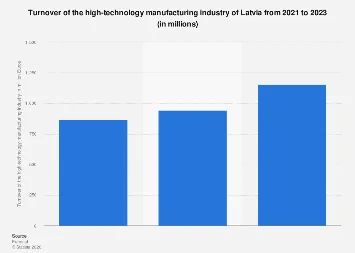
Latvia’s high-technology manufacturing industry is demonstrating a dynamic trajectory, with recent data indicating significant turnover figures that reflect its growing importance within the national and European economic landscape. While precise, up-to-the-minute figures are subject to proprietary data access, the overarching trend points to a sector that is increasingly sophisticated and globally integrated, contributing substantially to the country’s export capacity and innovation ecosystem. This sector, encompassing sub-industries such as electronics, precision instruments, and advanced machinery, is a crucial engine for economic growth, driving job creation and fostering technological advancement.
The intricate web of global supply chains and the relentless pace of technological innovation present both opportunities and challenges for Latvia’s high-tech manufacturers. Companies operating in this space are constantly adapting to evolving market demands, navigating complex regulatory environments, and competing on a global stage. The ability to pivot, invest in research and development, and secure strategic partnerships is paramount to sustained success. Furthermore, the sector’s performance is intrinsically linked to broader economic indicators, including global demand for electronics, the pace of digital transformation across various industries, and geopolitical stability, which can influence trade flows and investment decisions.
Delving deeper into the components of this sector reveals a diverse landscape. Latvia has cultivated expertise in areas such as radio, television, and communication equipment manufacturing, alongside a growing specialization in medical and precision optical instruments. These niche areas often require highly skilled labor, advanced manufacturing processes, and a commitment to quality control, positioning Latvian firms as reliable suppliers for demanding international markets. The emphasis on precision and innovation allows these companies to carve out profitable segments within the global market, often competing not on sheer volume but on specialized capabilities and product excellence.
The economic impact of this sector extends beyond direct revenue generation. High-technology manufacturing is a significant driver of indirect employment, supporting a network of suppliers, logistics providers, and service industries. Moreover, the intellectual property and know-how developed within these companies contribute to a broader knowledge-based economy. Investment in research and development by these firms often leads to spillover effects, benefiting other sectors and contributing to a more skilled workforce overall. The presence of a robust high-tech manufacturing base can also attract foreign direct investment, as international companies seek to leverage Latvia’s expertise and strategic location within the European Union.
Comparing Latvia’s high-tech manufacturing performance with other European nations provides valuable context. While countries like Germany, the Netherlands, and Sweden often dominate in terms of sheer scale and output due to their larger economies and established industrial bases, Latvia is carving out a significant presence within its regional context. Its success can be attributed to a combination of factors, including a skilled and adaptable workforce, competitive operating costs, and targeted government support for innovation and export promotion. The agility of smaller economies like Latvia’s can sometimes be an advantage, allowing for quicker adaptation to market shifts and a more focused approach to niche specialization.
The European Union’s emphasis on digital transformation and the green transition also presents significant opportunities for Latvia’s high-tech manufacturers. As industries across the continent seek to modernize their operations and reduce their environmental footprint, the demand for advanced technological solutions is set to increase. Latvian companies that can offer innovative products and services aligned with these trends, such as energy-efficient machinery, smart manufacturing solutions, or components for renewable energy technologies, are well-positioned for future growth. The EU’s recovery and resilience facility, with its focus on digital and green investments, could further catalyze expansion and innovation within the sector.
However, the sector is not without its challenges. The global semiconductor shortage, which has impacted industries worldwide, has also presented hurdles for Latvian electronics manufacturers, potentially affecting production timelines and costs. Furthermore, the ongoing geopolitical tensions and their impact on global trade routes and raw material availability require constant vigilance and strategic planning. Companies must invest in supply chain resilience, explore alternative sourcing options, and potentially localize some aspects of their production to mitigate these risks. The war in Ukraine, for instance, has disrupted established trade patterns and necessitated a re-evaluation of market access and logistical dependencies for many European businesses.
The availability of skilled labor remains a critical factor for the sustained growth of high-technology manufacturing. Latvia, like many developed economies, faces the challenge of an aging workforce and the need to attract and retain talent in highly specialized fields. Educational institutions and vocational training programs play a crucial role in ensuring a pipeline of qualified engineers, technicians, and researchers. Initiatives that foster collaboration between industry and academia, such as joint research projects and apprenticeship programs, are vital for bridging the skills gap and ensuring that the sector has the human capital it needs to thrive.
Looking ahead, the outlook for Latvia’s high-technology manufacturing sector appears cautiously optimistic, contingent on its ability to adapt to evolving global dynamics. Continued investment in research and development, a focus on niche markets and specialized capabilities, and a commitment to sustainability will be key differentiators. As the world increasingly relies on advanced technologies to address complex challenges, from climate change to healthcare, Latvia’s high-tech manufacturers are poised to play an increasingly significant role, contributing to both national prosperity and global technological advancement. The ability to foster a supportive business environment, coupled with strategic industrial policies, will be instrumental in unlocking the sector’s full potential in the years to come.