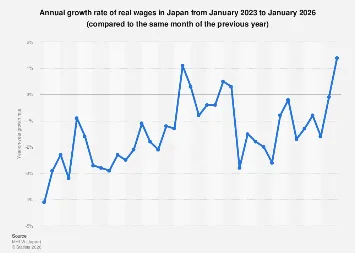
Preliminary data for January 2026 indicates a projected increase in Japan’s real wages, a development closely watched by economists and policymakers aiming to stimulate domestic consumption and combat decades of deflationary pressures. While specific percentage figures remain proprietary and require subscription access, the forecast suggests a positive year-on-year growth rate compared to January 2024. This anticipated uptick, however, must be viewed within the context of a prolonged period of wage stagnation and recent declines that have challenged household purchasing power.
The Japanese economy has grappled with the challenge of translating corporate profits into tangible gains for the average worker. For establishments employing five or more individuals, the period since 2023 has been marked by significant fluctuations. January 2023, for instance, saw a notable dip in real wages, underscoring the persistent difficulties in achieving consistent real wage growth. This figure, also subject to subscription access for precise quantification, represented a substantial setback for consumers already contending with rising living costs and the lingering effects of economic slowdowns.
Understanding the nuances of real wage growth is crucial for assessing the health of an economy. Real wages, which account for inflation, provide a more accurate measure of a worker’s purchasing power than nominal wages. When real wages decline, individuals can afford fewer goods and services, leading to reduced consumer spending, a critical engine for economic expansion. In Japan, the struggle to achieve robust real wage growth has been a central theme in economic discourse, impacting everything from consumer confidence to the efficacy of monetary policy.
The projected positive growth for January 2026, if realized, could signal a turning point. Several factors are contributing to this cautious optimism. A tight labor market, driven by a declining workforce and increasing demand for skilled labor in certain sectors, has begun to exert upward pressure on nominal wages. Companies are increasingly recognizing the need to offer more competitive compensation packages to attract and retain talent. Furthermore, government initiatives aimed at promoting wage increases, coupled with corporate efforts to improve productivity and profitability, are starting to bear fruit.
However, the specter of inflation remains a significant variable. While moderate inflation is often seen as a sign of a healthy, growing economy, uncontrolled price increases can quickly erode the benefits of nominal wage gains. For real wages to truly rise, nominal wage increases must outpace the rate of inflation. Japan has historically operated in a low-inflation environment, but recent global inflationary trends have not entirely bypassed the archipelago. The Bank of Japan’s monetary policy continues to navigate this delicate balance, aiming to foster sustainable inflation without jeopardizing economic stability.
The historical data from January 2023 to January 2026, though partially obscured by access restrictions, paints a picture of a challenging economic landscape. The sharpest decline in real wages observed in January 2023 serves as a stark reminder of the vulnerabilities within the Japanese labor market. This period likely saw a confluence of factors, including the lingering impact of global supply chain disruptions, rising energy costs, and a cautious approach by some businesses to significant wage hikes.
Economists often point to the structure of the Japanese labor market as a contributing factor to wage rigidity. The prevalence of non-regular employment, characterized by lower wages and fewer benefits, has historically suppressed overall wage growth. While there have been efforts to address this disparity and encourage more equitable compensation, the deep-seated nature of these labor market structures means that change is often incremental.
The projected real wage growth in 2026 is particularly significant when considered in a global context. Many developed economies are also grappling with the challenges of inflation and the need to ensure that wage growth keeps pace with the cost of living. Countries like the United States and those within the Eurozone have experienced significant inflationary pressures and subsequent interest rate hikes. Japan’s situation, while distinct in its deflationary history, shares the universal concern of maintaining the purchasing power of its citizens.
The economic impact of sustained real wage growth in Japan could be profound. Increased disposable income would likely translate into higher consumer spending, boosting demand for goods and services. This, in turn, could encourage businesses to expand production, invest in new technologies, and create more jobs. A virtuous cycle of economic growth, driven by increased consumption and investment, is the ultimate goal for policymakers.
Moreover, a sustained rise in real wages could help to address demographic challenges. With an aging population and a declining birthrate, Japan faces the prospect of a shrinking workforce. Higher wages, coupled with improved working conditions, could make employment more attractive, potentially encouraging greater labor force participation, including among women and older workers. It could also make Japan a more appealing destination for skilled foreign talent.
The specific figures for January 2026, when fully disclosed, will provide a more granular understanding of the magnitude and sustainability of this projected growth. However, the anticipation of a positive trend is a welcome development. It suggests that the multifaceted strategies employed by the Japanese government and corporations to revitalize the economy are beginning to yield results.
The journey towards robust and sustained real wage growth in Japan has been a long and complex one. Decades of low inflation and sluggish wage increases have created deep-seated economic habits and expectations. The preliminary figures for January 2026 offer a glimmer of hope, suggesting that the tide may be turning. The ability of Japan to translate this projected growth into a sustained upward trend will be a key determinant of its economic future, impacting everything from household well-being to its standing in the global economic arena. The coming months and years will be critical in observing whether this projected rebound can overcome the historical headwinds and usher in a new era of economic prosperity for the nation.