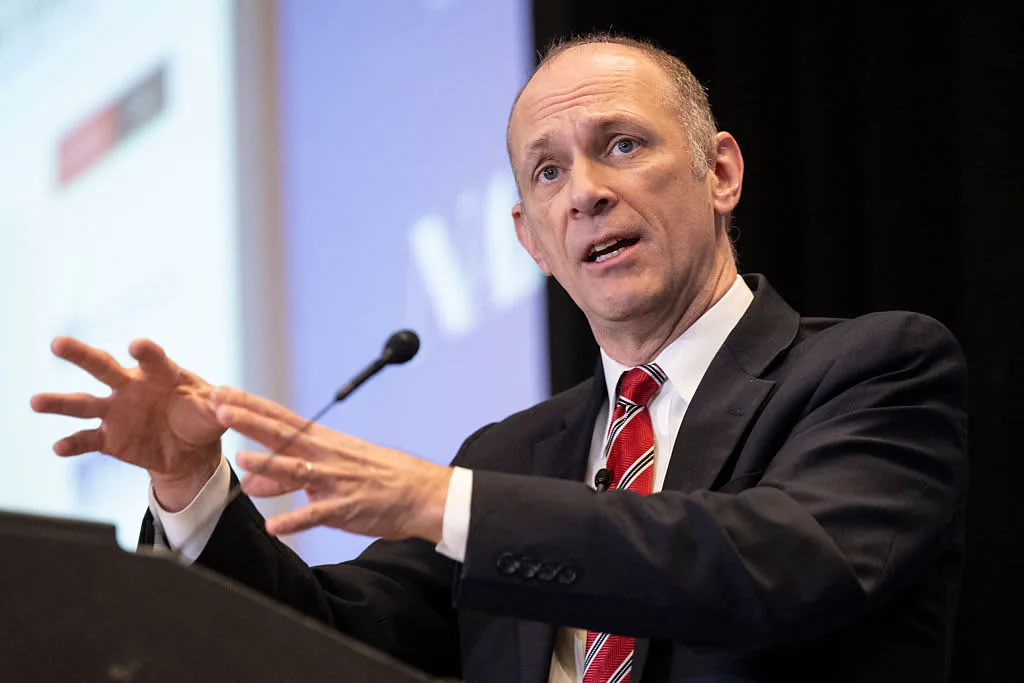
The delicate balancing act of American monetary policy has entered a new and more complex phase, as Chicago Federal Reserve President Austan Goolsbee warns that the specter of persistent inflation has supplanted labor market concerns as the primary threat to domestic economic stability. In an era defined by what Goolsbee describes as a "fraught but intense" climate, the intersection of volatile Middle Eastern geopolitics and stubborn price indices is forcing a re-evaluation of the Federal Reserve’s projected glide path for interest rates. While recent diplomatic developments regarding Iran have provided a momentary reprieve for global energy markets, the underlying message from the central bank remains one of guarded vigilance rather than premature celebration.
The immediate catalyst for this shift in sentiment was a series of high-stakes diplomatic maneuvers involving the United States and Iran. Following an announcement by President Donald Trump that progress had been made in negotiations—leading to a five-day moratorium on attacks against energy infrastructure—global markets reacted with characteristic whiplash. Crude oil prices, which had been buoyed by a significant geopolitical risk premium, saw a sharp decline, while equity markets rallied on the prospect of a de-escalation. However, for Goolsbee and his colleagues at the Federal Open Market Committee (FOMC), the relief provided by a five-day window is insufficient to alter the long-term calculus of price stability.
For central bankers, the primary challenge lies in discerning the "through-line" of economic data amidst the noise of international conflict. The "fraught" nature of the current environment stems from the inherent unpredictability of ground-level realities in the Middle East. If energy infrastructure remains under the constant threat of disruption, the volatility in oil and liquified natural gas (LNG) prices creates a feedback loop that complicates the Fed’s ability to anchor inflation expectations. Goolsbee’s apprehension is rooted in the realization that while the central bank can control the cost of borrowing, it remains largely powerless against external supply shocks that drive up the cost of living for the average American household.
This shift in focus toward inflation over unemployment represents a significant pivot in the Fed’s internal discourse. For much of the past year, economists have debated whether the aggressive rate-hiking cycle initiated in 2022 would eventually fracture the labor market. Yet, the American employment engine has proven remarkably resilient, with jobless claims remaining near historic lows and payroll additions consistently defying cooling expectations. This labor market strength has effectively removed one side of the Fed’s dual mandate from the immediate "danger zone," allowing officials to concentrate their firepower on the 2% inflation target.
Goolsbee, who has transitioned from a more accommodative stance to a position of strategic caution, has been a notable voice of dissent within the FOMC. Having dissented on a rate cut proposal in December, he supported the committee’s decision to hold rates steady during the January and March sessions. Although Goolsbee does not hold a vote on the committee this year, his influence remains substantial as he prepares to rejoin the voting rotation in 2025. His current stance serves as a bellwether for a growing faction of central bankers who fear that cutting rates too early could reignite the inflationary fires that took nearly two years to dampen.
The historical memory of the "team-transitory" era looms large over these deliberations. In 2021, the Federal Reserve faced criticism for characterizing the post-pandemic surge in prices as a temporary phenomenon, a miscalculation that allowed inflation to reach forty-year highs before a policy correction was enacted. Goolsbee explicitly cautioned against repeating this mistake, noting that the Fed must see definitive "proof" that the economy is on a sustainable path back to 2% inflation before easing the monetary brakes. The current geopolitical "wrench" in the works—the instability in the Middle East—only heightens the risk of a secondary inflation wave, similar to the double-peak inflation cycles seen in the 1970s.

Market participants have been forced to recalibrate their expectations in real-time. Following Goolsbee’s remarks and the updates on the Iran negotiations, the futures market saw a notable shift. While traders still price in the likelihood of a rate cut in 2027, the probability of an additional rate hike before the end of the current year has seen a modest uptick. This "higher for longer" narrative is gaining traction as the "last mile" of the inflation fight proves to be the most arduous. Core inflation, which excludes the volatile food and energy sectors, has shown signs of "stickiness," particularly in the services and housing sectors, suggesting that the era of ultra-low interest rates is not returning anytime soon.
The broader economic impact of this cautious approach is felt across the global landscape. As the U.S. dollar maintains its strength bolstered by high domestic interest rates, emerging markets face increasing pressure on their own currencies and debt servicing costs. Furthermore, the global energy trade remains on edge. The Strait of Hormuz, a critical chokepoint through which approximately one-fifth of the world’s oil consumption passes, remains a focal point of concern. Any sustained disruption there would render the Fed’s inflation targets nearly impossible to achieve in the short term, regardless of domestic demand-side policies.
The Federal Reserve’s "Dot Plot," which maps out individual members’ expectations for future rates, indicated last week that a slim majority still anticipates at least one rate cut this year. However, Goolsbee’s commentary suggests that this consensus is fragile. The divide within the FOMC appears to be widening between those who prioritize preventing a recession and those who believe that the credibility of the central bank depends entirely on its ability to crush inflation. For Goolsbee, the data has not yet provided the "all-clear" signal. He remains optimistic about the possibility of lower rates by the end of 2026, but his optimism is strictly conditional upon the absence of further external shocks.
From a business and investment perspective, the current climate necessitates a strategy of extreme adaptability. Corporations are navigating a landscape where the cost of capital remains high, and supply chain reliability is once again under threat from geopolitical maneuvering. The five-day halt in infrastructure attacks mentioned by President Trump may provide a brief sigh of relief for logistics and energy firms, but it does little to encourage long-term capital expenditure in a high-interest-rate environment.
Ultimately, the Federal Reserve finds itself in a period of "data dependence" that is more literal than ever before. Every CPI print, every payroll report, and every diplomatic dispatch from the Middle East is being scrutinized for its potential to alter the path of the federal funds rate. Goolsbee’s focus on inflation reflects a broader institutional desire to avoid the "stop-go" policy errors of the past. By signaling that he is more worried about prices than jobs, he is preparing the public and the markets for a period of continued austerity.
As the talks with Iran continue, the global community remains hopeful for a lasting resolution that might stabilize energy prices and allow the Fed to pivot toward easing. However, until that stability is codified and reflected in the consumer price index, the "fraught but intense" climate will persist. The Federal Reserve, led by voices of caution like Goolsbee, appears determined to hold its ground, ensuring that the progress made against inflation is not sacrificed at the altar of short-term market enthusiasm. The road to 2% remains a steep and uncertain climb, where the geopolitical terrain is as influential as the economic numbers themselves.