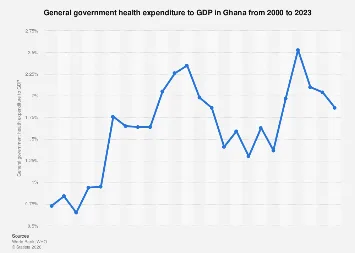
Ghana’s domestic general government health expenditure as a share of its Gross Domestic Product (GDP) experienced a notable, albeit fluctuating, increase between 2000 and 2023. While precise figures for the most recent year, 2023, remain undisclosed in publicly available data, the trend indicates a significant evolution in the nation’s commitment to its healthcare infrastructure and services. Over this 23-year period, the proportion of national economic output allocated to public health spending is understood to have risen substantially, marking a dynamic trajectory rather than a steady, linear progression. This period of change reflects evolving national priorities, economic conditions, and potentially, a growing recognition of the critical role of robust public health systems in fostering overall national development and citizen well-being.
Understanding the nuances of government health expenditure relative to GDP is crucial for assessing a nation’s dedication to its population’s health. This metric serves as a key indicator of how much of a country’s total economic output is being channeled into its health sector. For Ghana, a developing West African economy with a rapidly growing population, this indicator offers insights into the government’s capacity to fund essential healthcare services, invest in medical infrastructure, train healthcare professionals, and implement public health initiatives. The fluctuations observed over the past two decades suggest a dynamic interplay of factors influencing budgetary allocations, including economic performance, international aid, and the evolving health challenges faced by the nation.
Globally, health expenditure as a percentage of GDP varies considerably, influenced by a nation’s income level, healthcare system structure, and demographic profile. Developed nations typically allocate a higher proportion of their GDP to healthcare, reflecting advanced medical technologies, aging populations, and comprehensive social welfare systems. For instance, countries in the Organisation for Economic Co-operation and Development (OECD) often see health expenditure as a percentage of GDP ranging from 8% to over 17%. In contrast, many low- and middle-income countries, including those in Sub-Saharan Africa, historically allocate a smaller share, often below the recommended 15% of GDP benchmark set by the World Health Organization (WHO) for essential health services. Ghana’s journey within this global context highlights its efforts to bridge this gap and strengthen its health system.
The upward trend in Ghana’s government health expenditure as a share of GDP, despite its uneven path, points towards a strategic investment in public health. This investment is vital for several reasons. Firstly, it directly impacts the accessibility and quality of healthcare services available to citizens. Increased spending can translate into better-equipped hospitals and clinics, a wider availability of essential medicines, and improved diagnostic capabilities. Secondly, it supports the development of a skilled healthcare workforce. Higher budgetary allocations can fund medical education, training programs, and initiatives to retain healthcare professionals within the country, mitigating the brain drain that often plagues developing nations. Thirdly, it underpins public health programs, such as vaccination campaigns, disease surveillance, and health education initiatives, which are critical for preventing and controlling infectious diseases and improving overall population health outcomes.
The uneven trajectory mentioned suggests that Ghana’s health spending has not followed a predictable pattern. This could be attributed to a variety of macroeconomic and policy-related factors. Economic downturns or periods of fiscal constraint might lead to reduced allocations to the health sector, while periods of economic growth or targeted government initiatives could result in significant increases. Furthermore, shifts in national health priorities, the emergence of new health crises (such as pandemics), or the successful implementation of health financing reforms could also contribute to these fluctuations. For example, the government might have prioritized other sectors during certain economic periods, or conversely, responded to a specific health emergency with increased funding.
The implications of these spending patterns extend beyond the immediate health sector. A well-funded and efficient healthcare system is a cornerstone of economic productivity. A healthier population is a more productive workforce, leading to increased economic output and reduced losses due to illness-related absenteeism. Furthermore, robust public health infrastructure can attract foreign investment, as businesses often consider the quality of life and social services, including healthcare, when making investment decisions. Conversely, underinvestment in health can lead to a cycle of poor health outcomes, reduced productivity, and increased poverty.
To gain a more comprehensive understanding, it is important to consider how Ghana’s health expenditure compares to its regional peers. Many countries in the West African sub-region face similar developmental challenges and resource constraints. Examining how Ghana’s investment in health stacks up against countries like Nigeria, Côte d’Ivoire, or Senegal can provide valuable context. Such comparisons can highlight best practices, identify areas where Ghana may be leading or lagging, and inform policy decisions by drawing lessons from the experiences of its neighbours. This comparative analysis is essential for understanding Ghana’s position within the broader African health landscape and its progress towards achieving universal health coverage.
Looking ahead, sustained and strategic investment in Ghana’s health sector is paramount. While the exact figures for 2023 require further clarification, the overall trend suggests a growing commitment. However, the effectiveness of this spending is as crucial as the amount allocated. Ensuring that funds are used efficiently, transparently, and are directed towards evidence-based interventions is critical for maximizing the impact on public health. This includes strengthening governance within the health ministry, improving procurement processes for medicines and equipment, and investing in health information systems to better track outcomes and allocate resources effectively. The ultimate goal is to build a resilient and equitable health system that can meet the current and future health needs of all Ghanaians, contributing to the nation’s overall socio-economic development and prosperity. The evolution of government health expenditure as a share of GDP in Ghana is a narrative of ongoing commitment, adaptation, and the persistent pursuit of improved health for its citizens within a complex global economic environment.