The Federal Reserve elected to maintain its benchmark interest rate on Wednesday, navigating a precarious economic landscape defined by stubborn inflation, a resilient but softening labor market, and the destabilizing outbreak of a major regional conflict in the Middle East. In an 11-1 vote, the Federal Open Market Committee (FOMC) kept the federal funds rate within the 3.5% to 3.75% range. While the decision was widely anticipated by institutional investors, the accompanying policy statement and economic projections underscored a central bank increasingly wary of external shocks and the persistent "last mile" of its inflation-fighting mandate.
This decision serves as a pivotal moment for the U.S. central bank, which is attempting to engineer a "soft landing" while the global energy market faces its most significant disruption in years. The benchmark rate, which dictates the cost of overnight lending between banks, remains at its highest level in decades, influencing everything from the interest rates on 30-year fixed mortgages to the cost of corporate debt issuance. Despite the pause, the committee’s updated "dot plot"—a visual representation of individual members’ interest rate expectations—suggests that the era of aggressive tightening has not yet fully transitioned into a period of rapid easing.
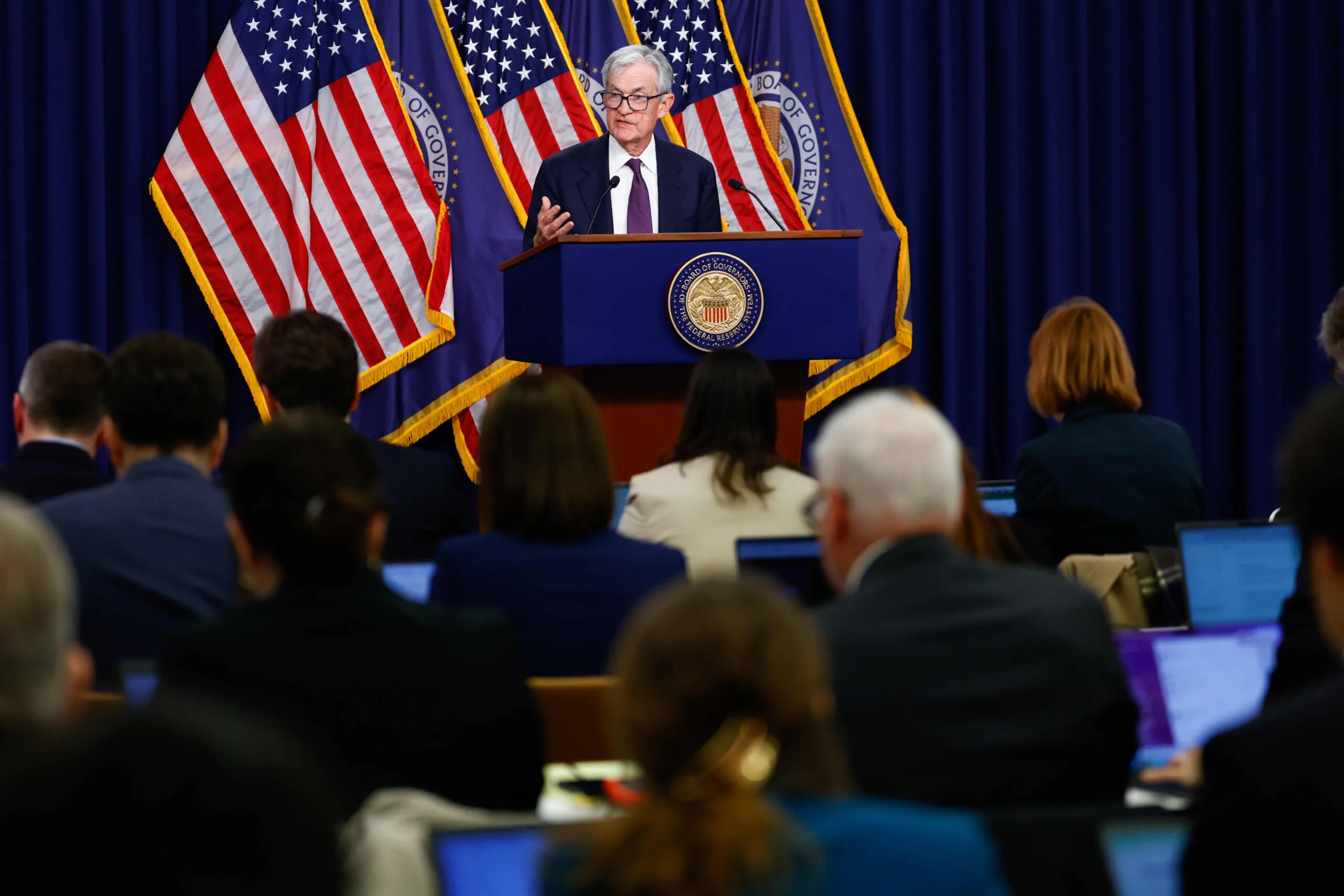
The shadow of the three-week-old conflict with Iran loomed large over the proceedings. The war has injected a fresh dose of uncertainty into global markets, primarily through the prism of energy security. As fighting persists, the threat to the Strait of Hormuz—a vital maritime artery through which roughly one-fifth of the world’s daily oil consumption passes—has triggered a "geopolitical premium" in crude prices. Federal Reserve Chair Jerome Powell acknowledged the difficulty of forecasting the economic fallout from these developments, noting that near-term inflation expectations have ticked upward in direct response to supply chain anxieties.
Market participants reacted to the Fed’s cautious stance with a wave of selling, pushing major indices to session lows. The realization that the central bank may only implement a single rate cut in 2026—a significant departure from the two or three cuts priced in by futures markets earlier this year—has forced a recalibration of investment strategies. The shift reflects a "higher for longer" sentiment that is becoming entrenched as inflation proves more durable than previously hoped.
The Fed’s updated Summary of Economic Projections (SEP) reveals a nuanced view of the American economy. Policymakers have revised their Gross Domestic Product (GDP) growth forecast upward to 2.4% for the current year, an increase from the 2.3% projected in December. This resilience in the face of restrictive monetary policy suggests that consumer spending and corporate investment have not yet buckled under the weight of high borrowing costs. However, this strength is a double-edged sword, as it provides the foundation for continued price pressures.
On the inflation front, the Fed now expects the Personal Consumption Expenditures (PCE) price index—the central bank’s preferred metric—to hit 2.7% by year-end, both in headline and core figures. This is a notable upward revision that moves the target further away from the Fed’s 2% goal. While the committee anticipates that inflation will eventually subside as the immediate impacts of the war and existing trade tariffs fade, the timeline for that convergence remains elusive. The labor market, meanwhile, presents a paradox; while payroll data has shown signs of weakening, officials still expect the unemployment rate to settle at a relatively low 4.4% by the end of the year.
The lone dissenting voice in the Wednesday vote was Governor Stephen Miran, who advocated for a 25-basis-point reduction. Miran’s stance highlights a growing concern within a minority of the board that the Fed risks over-tightening and triggering a recessionary spiral, particularly as the "lagged effects" of previous rate hikes continue to permeate the economy. Conversely, Governor Christopher Waller, who had previously leaned toward a cut, moved back into the majority camp, signaling a preference for stability amidst the geopolitical firestorm.

The Fed’s policy path is further complicated by an increasingly volatile domestic political environment. President Donald Trump has maintained a steady drumbeat of criticism against the central bank, frequently taking to social media to demand immediate rate cuts to stimulate growth. Earlier this week, the President criticized Chair Powell for failing to convene an emergency session to lower rates, arguing that the central bank is stifling the economy during a period of international crisis.
The institutional independence of the Federal Reserve is currently facing a unique legal challenge that has become intertwined with its leadership succession. Chair Powell’s term is slated to expire in May, and the administration has already named former Fed Governor Kevin Warsh as his successor. However, a legal dispute involving a Justice Department subpoena regarding the Fed’s multi-billion-dollar headquarters renovation has created a stalemate. U.S. Attorney Jeanine Pirro has sought evidence from Powell, a move the Chair has characterized as a politically motivated attempt to undermine the Fed’s autonomy.
While a judge recently sided with Powell and quashed the subpoenas, the legal battle is far from over. The situation has reached a fever pitch in the Senate, where North Carolina Senator Thom Tillis has vowed to block Kevin Warsh’s confirmation until the investigation into the Fed’s renovation projects is resolved. Powell has remained defiant, stating during his post-meeting press conference that he has "no intention of leaving the board" until the investigation is concluded with full transparency. This suggests a potential scenario where Powell remains at the helm beyond the official end of his term, serving as a "lame duck" chair in a highly polarized environment.
From a global perspective, the Federal Reserve’s decision to hold rates steady places it in a different cycle compared to some of its peers. While the European Central Bank (ECB) and the Bank of England have also grappled with inflationary shocks, the U.S. economy’s relative insulation from European energy dependencies—balanced against its high sensitivity to Middle Eastern oil disruptions—creates a unique policy divergence. If the Fed maintains high rates while other central banks begin to ease, the U.S. dollar is likely to remain strong, potentially exacerbating trade imbalances and putting pressure on emerging market economies that hold significant dollar-denominated debt.
The economic impact of the Iranian conflict extends beyond the gas pump. Rising energy costs act as a "tax" on consumers, reducing discretionary spending and increasing the input costs for manufacturers and logistics providers. If the war leads to a prolonged closure or disruption of the Strait of Hormuz, global GDP could see a measurable contraction. The Fed’s statement that the implications are "uncertain" is an admission that traditional economic models may struggle to account for the "black swan" nature of modern geopolitical warfare.
Looking toward the horizon, the "dot plot" suggests a median outlook for one more rate reduction in 2027, with the federal funds rate eventually stabilizing at a "neutral" level of approximately 3.1%. This long-term projection indicates that the era of "zero-bound" interest rates—which defined much of the decade following the 2008 financial crisis—is firmly in the rearview mirror. For businesses and households, the message is clear: the cost of capital will remain structurally higher for the foreseeable future.
As the Federal Reserve concludes its latest deliberations, the focus shifts to the incoming data. Every consumer price index (CPI) release and jobs report will now be viewed through the dual lens of domestic economic health and Middle Eastern stability. For Chair Powell, the remaining months of his scheduled term will likely be defined by a delicate balancing act—protecting the Fed’s institutional integrity from political incursion while navigating an economy that is being reshaped by forces far beyond the reach of the Eccles Building. The path to 2% inflation has never looked more arduous, and the margin for policy error has never been thinner.