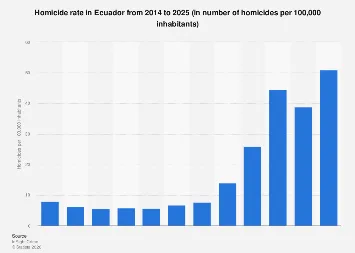
Quito, Ecuador – Ecuador’s homicide rate in 2025 surged to an alarming 50.9 per 100,000 inhabitants, marking the highest figure recorded in the South American nation since at least 2014. This dramatic increase represents a significant deterioration in public safety, with the rate jumping from 38.8 per 100,000 in 2024. The stark escalation over the past year underscores a troubling trend that has seen violent crime rates more than triple since 2020, when the country registered a comparatively low 7.7 homicides per 100,000.
The data reveals a consistent upward trajectory in homicides following a period of relative stability. From 2014 to 2020, Ecuador’s homicide rate remained largely below 10 per 100,000, hovering between 5.6 and 8. However, a noticeable uptick began in 2021, with the rate climbing to 14, and continued its ascent through subsequent years: 25.9 in 2022 and 44.5 in 2023, before the latest surge in 2024 and 2025. This sharp increase has placed Ecuador among countries experiencing some of the most rapid escalations in violent crime globally, raising serious concerns for its citizens, economy, and international standing.
Experts attribute this dramatic rise in violence to a complex interplay of factors, including the country’s strategic geographical position as a transit point for illicit drugs, the growing influence of transnational organized crime syndicates, and internal governance challenges. The proximity to major cocaine-producing nations and its extensive coastline have made Ecuador a coveted territory for cartels seeking to control trafficking routes to North America and Europe. This has led to increased territorial disputes and violent confrontations between criminal factions, often spilling over into public spaces and impacting civilian populations.
The economic ramifications of this escalating insecurity are profound. For a nation heavily reliant on trade, tourism, and foreign investment, a deteriorating security situation poses a significant deterrent. Businesses face increased operational costs due to enhanced security measures, potential disruptions to supply chains, and a heightened risk of extortion. The tourism sector, a vital source of foreign exchange and employment, is particularly vulnerable. Reports of violence and a perception of lawlessness can severely damage Ecuador’s image as a safe destination, leading to cancellations and a decline in visitor numbers. According to World Travel & Tourism Council data, the travel and tourism sector’s contribution to Ecuador’s GDP, which was projected to grow significantly in the coming years, now faces considerable headwinds. Analysts estimate that a sustained period of high crime rates could shave billions off projected tourism revenues and deter much-needed foreign direct investment.
Furthermore, the strain on public resources is immense. Governments facing such a surge in violent crime are forced to divert substantial funds towards law enforcement, judicial systems, and correctional facilities, often at the expense of crucial social and economic development programs. Increased policing efforts, military deployments, and the need for enhanced border security all place a heavy burden on the national budget. The cost of crime, including direct expenses related to security and healthcare for victims, as well as indirect costs such as lost productivity and reduced economic growth, is projected to rise substantially, impacting the nation’s fiscal health.
Globally, Ecuador’s situation reflects a broader trend in parts of Latin America where organized crime has become increasingly sophisticated and pervasive. Countries like Mexico, Colombia, and El Salvador have historically grappled with high homicide rates linked to drug trafficking and gang violence. Ecuador’s rapid ascent in these statistics places it in a concerning new category, suggesting that the dynamics of criminal activity and state capacity to control it are shifting. Compared to its regional neighbors, Ecuador’s 2025 homicide rate now significantly exceeds that of countries like Chile (historically below 5) and Uruguay (typically around 10-12), and is rapidly approaching or surpassing rates seen in some of the more historically challenged nations in the region, though still lower than the peak rates seen in countries like El Salvador during its most intense periods of gang violence.
The social fabric of Ecuador is also under immense pressure. The pervasive fear of violence can erode trust in institutions, lead to widespread social unrest, and exacerbate existing inequalities. Marginalized communities are often disproportionately affected, bearing the brunt of criminal activity and the subsequent security crackdowns. The psychological toll on citizens, particularly in areas most affected by violence, is significant, impacting mental health and overall quality of life.
In response to the escalating crisis, the Ecuadorian government has implemented various measures, including increased police presence, military patrols, and declared states of emergency in specific regions. However, the effectiveness of these measures in reversing the trend remains a critical question. Analysts suggest that a comprehensive strategy is required, addressing not only law enforcement but also the underlying socio-economic factors that contribute to crime, such as poverty, lack of opportunity, and corruption. International cooperation, including intelligence sharing and joint operations with neighboring countries and global law enforcement agencies, is also seen as crucial in tackling transnational criminal networks.
The long-term implications for Ecuador are significant. If the current trajectory continues, the country risks further entrenching itself in a cycle of violence, undermining its development prospects and the well-being of its citizens. The challenge ahead is immense, requiring sustained political will, effective policy implementation, and broad societal engagement to restore security and build a more resilient future. The coming years will be critical in determining whether Ecuador can successfully navigate this security crisis and steer its course towards stability and prosperity.