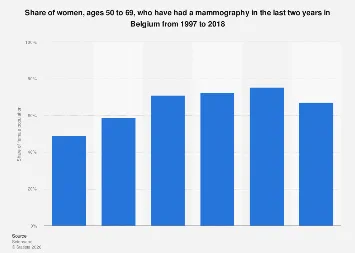
In the period between 1997 and 2018, Belgium witnessed a notable evolution in its approach to early breast cancer detection among women aged 50 to 69. While the overall trend indicated an increasing participation in mammography screenings over these two decades, the final year of available data, 2018, presented a slight deceleration. This nuanced pattern underscores the ongoing efforts and challenges in public health initiatives aimed at cancer prevention and early diagnosis within the European nation.
Data compiled from surveys conducted between 1997 and 2018 reveals that the proportion of Belgian women within the target demographic who underwent mammography screenings experienced growth. This upward trajectory is a testament to sustained public health campaigns, increased awareness about the benefits of regular screening, and improved accessibility to diagnostic services. Early detection of breast cancer is widely recognized as a critical factor in improving treatment outcomes, reducing mortality rates, and enhancing the quality of life for affected individuals. The World Health Organization (WHO) consistently advocates for organized screening programs for breast cancer in women, particularly those in higher-risk age groups.
By 2018, the statistics indicated that approximately two-thirds of Belgian women between the ages of 50 and 69 had participated in mammography screenings. This figure represents a significant achievement in public health outreach, suggesting that a substantial portion of the population is adhering to recommended screening protocols. However, the same year also saw a marginal decrease in the prevalence of women undergoing these crucial examinations compared to prior periods within the surveyed timeframe. This slight dip warrants further investigation into potential contributing factors, which could range from shifts in screening guidelines, variations in participation across different regions or socioeconomic groups, to potential impacts from external events.
The economic implications of effective breast cancer screening programs are multifaceted. On one hand, the cost of screening programs, including equipment, personnel, and outreach, represents a significant investment for national healthcare systems. However, these costs are often offset by the substantial savings realized through early detection. Cancers identified at earlier stages are typically less advanced, requiring less aggressive and therefore less expensive treatment modalities, such as surgery with less extensive procedures, and potentially avoiding the need for prolonged chemotherapy or radiation therapies. Furthermore, reducing the burden of advanced cancer on the healthcare system frees up resources for other medical needs.
Globally, breast cancer remains a leading cause of cancer-related deaths among women. Consequently, many countries have implemented national screening programs. The participation rates and effectiveness of these programs can vary considerably, influenced by factors such as healthcare infrastructure, cultural attitudes towards health screenings, funding levels, and the specific design of the programs. For instance, countries with well-established, publicly funded screening programs often report higher participation rates. Belgium’s experience, with its gradual increase and subsequent slight decline, mirrors the dynamic nature of public health interventions, which require continuous monitoring and adaptation.
The statistical methodology employed in gathering this data, involving an online survey with a sample size of 1,569 respondents in 2018 (with a broader respondent base in earlier years), provides a valuable snapshot of screening behavior. The supplementary notes indicate that the share of women screened was calculated using statistical regression, considering age, gender, and the overall Belgian population in 2018. This approach allows for estimations that can be representative of the broader population, even when direct census data for every individual screening event is not available.
Understanding the factors that influence screening participation is crucial for public health policy. These can include perceived risk, fear of the procedure or potential results, lack of physician recommendation, time constraints, transportation issues, and cultural beliefs. Addressing these barriers through targeted educational campaigns, improved accessibility, and patient-centered approaches is vital for sustaining and enhancing screening rates. The slight decrease observed in 2018 could be an indicator that certain barriers have re-emerged or intensified, or that the effectiveness of current outreach strategies needs to be re-evaluated.
The economic impact analysis of breast cancer screening extends beyond direct healthcare costs. Early detection and successful treatment can enable women to maintain their employment and contribute to the economy, reducing the societal costs associated with long-term illness and disability. Conversely, delayed diagnosis can lead to prolonged absence from the workforce, increased reliance on social support systems, and a greater emotional and financial burden on families.
As Belgium navigates the complexities of public health, the trends in mammography screening for women over 50 serve as a critical indicator. The sustained effort to promote early detection highlights the nation’s commitment to women’s health. Future strategies will likely focus on understanding the reasons behind the recent marginal decline and implementing evidence-based interventions to ensure that a high proportion of women continue to benefit from this vital preventive measure, thereby contributing to both individual well-being and the broader economic health of the nation. Continuous data collection and analysis will be essential to refine these efforts and adapt to the evolving landscape of healthcare and public health challenges.