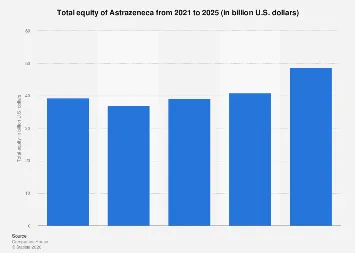
London, UK – The financial health of global pharmaceutical titan AstraZeneca, a company headquartered in the United Kingdom, is projected to demonstrate a significant upward trend in its total equity, reaching a substantial undisclosed figure in U.S. dollars by the fiscal year ending December 31, 2025. This projected growth represents a considerable increase compared to its total equity in 2021, indicating a robust expansion of its shareholder value over the four-year period. However, the journey to this projected 2025 figure has not been a linear progression, suggesting a dynamic financial landscape influenced by various strategic decisions and market forces.
The pharmaceutical industry, a cornerstone of global healthcare and a significant contributor to economic output, operates within a complex ecosystem. Factors such as research and development expenditure, patent expirations, regulatory approvals, competitive pressures, and global health trends all play a crucial role in shaping the financial performance of companies like AstraZeneca. Total equity, a key indicator of a company’s financial strength, represents the residual interest in the assets of an entity after deducting all its liabilities. An increase in total equity generally signifies a company’s ability to generate profits, retain earnings, and effectively manage its balance sheet, thereby enhancing its capacity for future investment and growth.
AstraZeneca, a biopharmaceutical powerhouse with a broad portfolio spanning oncology, cardiovascular, renal & metabolism, and respiratory & immunology, has consistently been at the forefront of scientific innovation. The company’s strategic investments in cutting-edge research, including advancements in areas like gene editing, antibody-drug conjugates, and personalized medicine, have been instrumental in driving its pipeline and, consequently, its financial performance. The projected increase in total equity by 2025 is likely a reflection of successful drug launches, expansion into new therapeutic areas, and the commercial success of its existing blockbuster products. Furthermore, strategic acquisitions and divestitures, aimed at optimizing its business portfolio and focusing on high-growth areas, would also contribute to shifts in its equity structure.
Analyzing the trend from 2021 to 2025, the non-continuous nature of the equity increase suggests periods of both accelerated growth and potential fluctuations. These fluctuations could be attributed to a variety of factors. For instance, significant R&D expenditures, while essential for long-term innovation, can temporarily impact profitability and, by extension, equity. Similarly, large-scale capital investments in manufacturing facilities or strategic partnerships, while strategically vital, can also influence the equity figures. Market dynamics, such as pricing pressures in key markets, the emergence of generic competition for older drugs, or unexpected clinical trial outcomes, can also introduce volatility. Moreover, the global economic climate, including interest rate environments and currency fluctuations, can indirectly affect a company’s financial reporting and, therefore, its equity.
Global pharmaceutical market data provides a broader context for understanding AstraZeneca’s position. The global pharmaceutical market is projected to continue its growth trajectory, driven by an aging global population, increasing prevalence of chronic diseases, and advancements in medical technology. According to various industry reports, the market is expected to reach trillions of U.S. dollars in the coming years. Within this vast market, AstraZeneca has consistently maintained a strong competitive position, often ranking among the top global pharmaceutical companies by revenue. Its ability to navigate the complex regulatory landscapes of major markets like the United States, Europe, and Asia is critical to its sustained success.
Comparatively, other major pharmaceutical players are also engaged in similar strategic maneuvers to bolster their equity and market standing. Companies like Pfizer, Roche, and Novartis are also investing heavily in R&D, pursuing strategic mergers and acquisitions, and adapting to evolving healthcare policies. The competitive landscape is characterized by intense innovation, with companies vying for market share through differentiated product offerings and strategic pipeline development. AstraZeneca’s projected equity growth, therefore, needs to be viewed within this broader competitive context, highlighting its ability to outmaneuver rivals and capture market opportunities.
The economic impact of AstraZeneca’s financial performance extends beyond its shareholders. As a major employer and a significant contributor to the tax base in the regions where it operates, the company’s financial health has a ripple effect on local and national economies. Investments in research and development translate into high-skilled job creation and foster innovation ecosystems. Furthermore, the successful development and commercialization of new medicines contribute to improved public health outcomes, reducing the burden of disease and enhancing overall societal well-being, which has significant indirect economic benefits.
Understanding the precise figures behind AstraZeneca’s total equity requires access to detailed financial statements. While the exact figures for 2025 remain undisclosed in this context, the trend points towards a company that is actively managing its financial resources to drive growth and shareholder value. The non-linear progression of its equity highlights the inherent complexities and strategic decisions involved in operating a large, research-intensive pharmaceutical enterprise. As AstraZeneca continues to innovate and expand its global reach, its financial trajectory will remain a key indicator of its success in addressing unmet medical needs and delivering value to its stakeholders in the years ahead. The company’s ability to balance significant R&D investments with commercial success and strategic financial management will be critical in solidifying its position as a leader in the global biopharmaceutical industry.