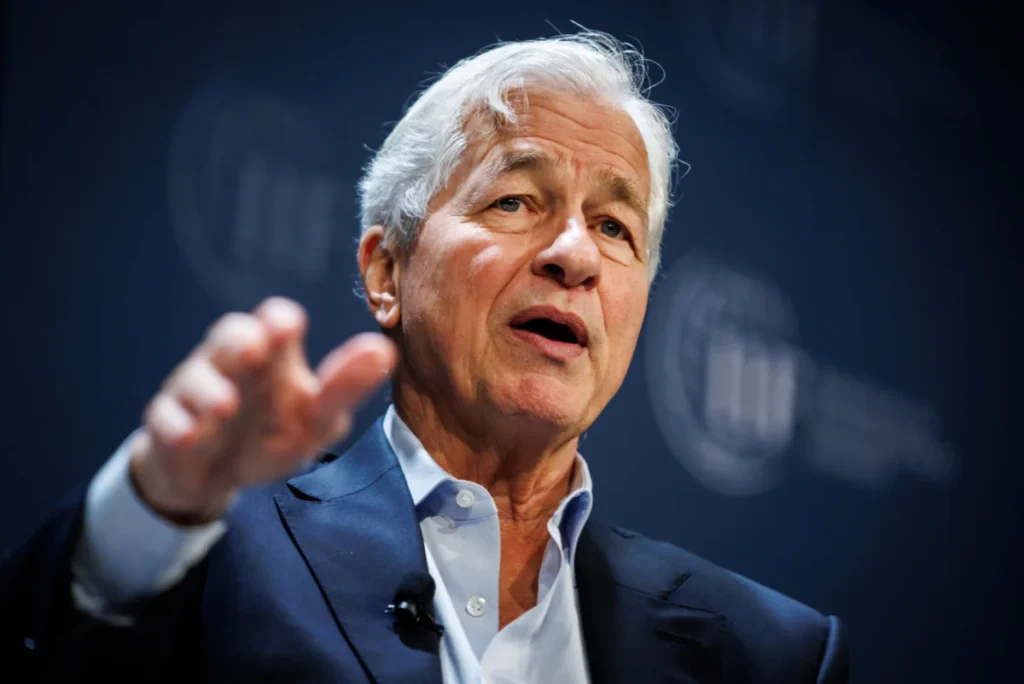

The prevailing optimism defining modern financial markets is increasingly at odds with the structural realities of the global economy, according to Jamie Dimon, the Chairman and CEO of JPMorgan Chase. In a comprehensive assessment of the current investment landscape, the leader of the world’s largest bank by market capitalization has issued a stern warning to investors, suggesting that the risks of a significant economic inflection point are being dangerously underestimated. Dimon’s perspective offers a sobering counter-narrative to the "soft landing" consensus that has propelled equity indices to record highs, as he explicitly states that he is currently avoiding both broader equity markets and long-dated U.S. Treasurys at their current valuations.
The divergence between market performance and Dimon’s outlook highlights a growing tension in high finance. While the S&P 500 has demonstrated remarkable resilience, returning nearly 10% in the early months of the year, Dimon argues that this growth is built on a fragile foundation. The enthusiasm surrounding artificial intelligence, coupled with moderating inflation figures, has led many to believe that the Federal Reserve has successfully threaded the needle of monetary policy. However, Dimon contends that the market is failing to account for a "perfect storm" of geopolitical instability, fiscal profligacy, and the structural return of higher interest rates.
Central to Dimon’s thesis is the belief that the "bond vigilantes" are poised for a return to the forefront of the global economy. For decades, the U.S. benefited from a period of low inflation and falling interest rates, which allowed for the expansion of government debt with minimal immediate consequence. That era, Dimon suggests, has reached its conclusion. With the U.S. national debt continuing to climb and annual budget deficits showing no signs of meaningful contraction, the cost of servicing that debt is becoming a primary economic driver. Dimon posits that even if the Federal Reserve manages to bring inflation back down to its 2% target, the structural demand for capital—driven by green energy transitions, re-militarization, and social safety nets—will keep long-term yields elevated.
Specifically, Dimon notes that he would expect the 10-year U.S. Treasury yield to settle between 4% and 4.5%. At current prices, he views the risk-reward profile of long-dated sovereign debt as unattractive. This perspective challenges the traditional "60/40" portfolio model, suggesting that the "risk-free" return offered by government bonds may not be sufficient to compensate for the duration risk and the potential for further price depreciation if yields continue to climb. This skepticism toward Treasurys is not merely a technical observation; it is a fundamental critique of the sustainability of current U.S. fiscal policy.
The equity markets face a similar valuation hurdle in Dimon’s view. While acknowledging that specific, well-managed companies may still offer value, he expressed a clear reluctance to buy into the broader indices. The current market concentration, where a handful of technology giants drive the lion’s share of gains, creates a "priced for perfection" scenario. In this environment, any deviation from the expected growth trajectory or any unforeseen geopolitical shock could trigger a disproportionate correction. Dimon’s caution serves as a reminder that market liquidity and consumer spending, while robust today, can evaporate quickly when sentiment shifts.
Geopolitics remains the most volatile variable in Dimon’s calculus. He points to the ongoing conflicts in Ukraine and the Middle East as more than just localized tragedies; they are disruptions to the global supply chain and the established world order. The "peace dividend" that fueled global growth following the Cold War is effectively exhausted. As nations pivot toward "friend-shoring" and domestic manufacturing to ensure national security, the efficiency gains of globalization are being replaced by the inflationary costs of redundancy and security. The tensions between the United States and China further complicate this picture, creating a bifurcated global economy where trade is increasingly used as a tool of statecraft rather than purely economic benefit.

Dimon’s analysis of the artificial intelligence boom further illustrates his disciplined approach to cycles. Drawing a direct parallel to the early days of the internet, he acknowledges the transformative potential of AI while warning of the inevitable "shakeout" period. During the late 1990s, companies like Yahoo and Netscape were the darlings of the stock market, perceived as the permanent winners of the digital age. Yet, the eventual long-term victors, such as Google and Meta, emerged or achieved dominance only after the initial bubble burst. Dimon suggests that while the massive capital expenditure currently being poured into AI infrastructure will likely pay off for the global economy in the long run, the timeline and the specific winners are far less certain than the market currently assumes. The risk is that the "AI trade" has pulled forward years of future growth into today’s stock prices, leaving little room for error.
The resilience of the U.S. economy has, thus far, surprised many analysts, including those at JPMorgan. Blockbuster quarterly results from major financial institutions have been bolstered by surging trading volumes and a resurgence in investment banking. This strength is partly due to the fact that the global economy is less dependent on energy than it was during the stagflationary 1970s. However, Dimon warns against complacency. He uses the metaphor of "straws on the camel’s back" to describe the cumulative effect of rising deficits, geopolitical friction, and monetary tightening. While the economy has absorbed several "straws" already, there is a tipping point where the weight becomes unsustainable.
The fiscal situation in the United States is particularly concerning to Dimon. As interest rates remain higher for longer, the cost of financing the national debt begins to crowd out other forms of investment. This creates a feedback loop: higher debt leads to higher interest payments, which leads to larger deficits, which eventually requires higher yields to attract buyers for government bonds. This "fiscal reckoning" is a slow-moving crisis that Dimon believes the market is largely ignoring in favor of short-term earnings reports.
From a global perspective, the challenges facing the U.S. are mirrored, and in some cases magnified, in other regions. Europe continues to struggle with the energy transition and the economic fallout of the war on its doorstep, while China faces a structural slowdown driven by a property crisis and demographic shifts. In this interconnected system, a shock in one region can rapidly transmit through financial channels. Dimon’s refusal to buy into the current market enthusiasm is a hedge against this systemic fragility.
In his role as a leading voice in global finance, Dimon’s warnings carry significant weight, though they are often met with skepticism by those riding the current wave of momentum. His "economic hurricane" warnings of previous years have been criticized by some as overly pessimistic, yet his core arguments regarding the end of the "easy money" era have largely been vindicated. The current environment, he suggests, requires a shift from speculative growth toward capital preservation and a focus on fundamental value.
Ultimately, Dimon’s stance is one of strategic patience. He is not predicting an immediate collapse, but rather a period of heightened volatility where the traditional rules of the last two decades no longer apply. For the average investor, his message is clear: the era of "buying the dip" with total confidence may be over. As the world navigates a transition from a unipolar, low-rate environment to a multipolar, high-cost reality, the "tipping point" may be closer than the ticker tape suggests. The "straws" are piling up, and in the view of the world’s most influential banker, the market would be wise to start counting them.