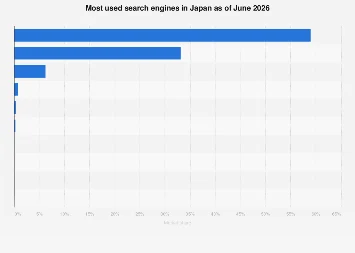
The search engine market in Japan is poised for continued evolution, with current trends and projected data suggesting a consolidated yet dynamic competitive environment through 2026. While specific granular data for future years often requires proprietary access, analysis of historical trends and expert projections offers a clear picture of the forces shaping online discovery in the world’s third-largest economy. Japan’s unique digital ecosystem, characterized by a strong preference for domestic services and a robust mobile-first internet culture, presents a fascinating case study in global search engine dynamics.
For years, Google has maintained a formidable presence, mirroring its global dominance in many Western markets. However, Japan’s digital consumer has historically shown a distinct affinity for locally developed platforms. This has created a dualistic market where international giants coexist with powerful domestic players, each carving out significant market share. Understanding the interplay between these entities is crucial for businesses operating within or targeting the Japanese market, from e-commerce giants to digital advertisers and content creators. The reliance on search engines for everything from product research to news consumption means that shifts in this landscape have far-reaching economic implications.
The projected trajectory through 2026 indicates that while Google is expected to remain a leading force, its absolute market share may face subtle pressures. This is not necessarily due to a decline in Google’s performance, but rather the sustained strength and innovative efforts of its primary Japanese competitor. Yahoo! Japan, operated by Z Holdings Corporation, a subsidiary of SoftBank Group, has long been a dominant player in the Japanese search engine arena. Its success is deeply rooted in its integration with a vast array of other popular online services, including news portals, e-commerce platforms (PayPay Mall, formerly Yahoo! Shopping), email, and social networking features. This comprehensive ecosystem approach fosters user loyalty and creates a sticky environment, making it difficult for users to switch to alternative platforms for their daily online activities.
Market share data, when accessible, consistently highlights Yahoo! Japan’s significant standing. While exact percentages fluctuate, it is not uncommon for Yahoo! Japan to hold a substantial portion of the market, often rivaling or even surpassing Google in certain segments or overall usage. This domestic champion’s strength is further amplified by its deep understanding of the Japanese cultural nuances and consumer preferences. Its search results, algorithms, and user interface are tailored to resonate with the local audience, providing a competitive edge that is difficult for global players to replicate entirely.
Beyond these two titans, other search engines occupy smaller but still relevant niches. Bing, Microsoft’s search engine, has a presence, particularly among users within the Microsoft ecosystem, and it continues to invest in expanding its reach. However, its market share in Japan has historically been considerably smaller compared to Google and Yahoo! Japan. Emerging players or specialized search tools might also gain traction in specific verticals, but their impact on the overall market share is typically marginal. The high cost of user acquisition and the entrenched network effects of established platforms present significant barriers to entry for new, general-purpose search engines.
The economic implications of search engine usage in Japan are profound. Search engines are the primary gateways to the internet for most users, acting as conduits for information, commerce, and entertainment. For businesses, search engine optimization (SEO) and search engine marketing (SEM) are critical components of their digital strategies. A strong presence on the search engines most frequented by their target demographic directly translates into visibility, traffic, and ultimately, sales. Consequently, understanding the dominant players and their respective strengths is paramount for effective marketing spend.
The advertising revenue generated by search engines forms a substantial part of their business model. Companies spend billions of dollars annually on search advertising, seeking to capture the attention of consumers actively searching for products and services. The market share of each search engine directly influences the allocation of this advertising budget. A business targeting the Japanese market would need to strategize its SEM campaigns to account for the user base of both Yahoo! Japan and Google, and potentially other platforms, to maximize its return on investment. The nuances of bidding strategies, keyword research, and ad creative development can differ significantly based on the platform’s user demographics and algorithmic preferences.
Furthermore, the dominance of a few key search engines raises questions about market concentration and potential impacts on innovation and consumer choice. While competition exists, the duopoly-like structure in Japan suggests that smaller players face immense challenges in gaining significant traction. This can influence the diversity of search results and the types of information users are exposed to. Regulatory bodies and industry observers often monitor such market dynamics to ensure fair competition and prevent monopolistic practices.
Looking ahead to 2026, several factors will continue to shape the search engine landscape. The ongoing development of artificial intelligence (AI) and its integration into search functionalities is a key area of innovation. Both Google and Yahoo! Japan are heavily investing in AI to provide more personalized, conversational, and contextually relevant search experiences. This could lead to new ways users interact with search engines and potentially shift preferences based on the quality and intuitiveness of these AI-powered features. Generative AI, in particular, has the potential to fundamentally alter how search results are presented and consumed.
The continued growth of mobile internet usage in Japan will also be a critical determinant. Japan has a high smartphone penetration rate, and users often rely on their mobile devices for quick searches and daily tasks. Search engines that offer seamless, mobile-optimized experiences, including voice search capabilities, are likely to retain and attract users. Yahoo! Japan’s extensive mobile app ecosystem, which includes its search function, further solidifies its position in this mobile-centric environment.
The broader digital economy in Japan is inextricably linked to the performance and user engagement of its search engines. E-commerce, digital media, and online services all depend on efficient discovery mechanisms. As Japan continues to embrace digital transformation across its industries, the role of search engines will only become more pronounced. Businesses that can effectively navigate this intricate search landscape, understanding the preferences and behaviors of Japanese consumers on platforms like Yahoo! Japan and Google, will be best positioned for success in the coming years. The competition for digital attention remains fierce, and the battle for search dominance is a critical front in the ongoing evolution of the Japanese internet.