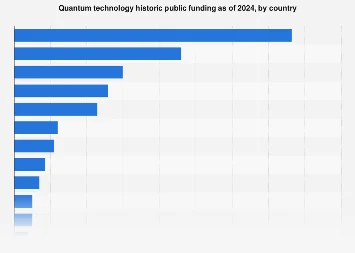
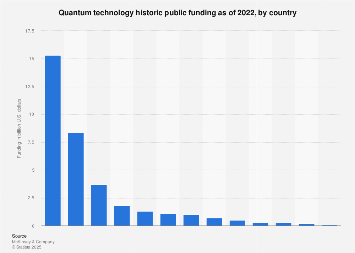
As the world stands on the precipice of a technological revolution, national governments are significantly escalating their financial commitments to quantum technology, recognizing its transformative potential across numerous sectors. In 2024, a surge in public funding underscores a burgeoning global race to achieve quantum supremacy, a state where quantum computers outperform even the most powerful classical supercomputers for specific, complex problems. China has emerged as the frontrunner in this critical investment landscape, allocating a remarkable $15.3 billion in planned public funding for quantum initiatives. This figure dwarfs the investments of other major players, signaling Beijing’s ambitious strategy to dominate this nascent but potentially world-altering field.
The scale of China’s commitment is particularly striking when compared to other leading nations and economic blocs. Its planned expenditure is nearly double that of all European Union member states combined and approximately 2.5 times the investment earmarked by the United States. This aggressive financial backing suggests a comprehensive national strategy, likely encompassing fundamental research, hardware development, software innovation, and the cultivation of a quantum-ready workforce. Such a broad-based approach is crucial for translating theoretical breakthroughs into practical applications, ranging from drug discovery and materials science to advanced cryptography and financial modeling.
Following China, Japan has positioned itself as a significant contender with a planned public investment of $9.2 billion. This substantial allocation highlights Japan’s long-standing commitment to cutting-edge science and technology, building upon its strengths in areas like advanced manufacturing and microelectronics. The United States, despite trailing China in announced public funding at $6 billion, remains a formidable force. The U.S. quantum ecosystem is characterized by a robust private sector alongside government-backed research institutions and universities, fostering a dynamic environment for innovation. However, the gap in public investment signals a potential need for recalibration if the U.S. aims to maintain its leadership position in the long term.
Germany and the United Kingdom are also demonstrating strong commitment, with planned public funding of $5.2 billion and $4.6 billion, respectively. Germany’s investment is particularly noteworthy, reflecting its strategic focus on advanced industrial applications and its role as a leading economy within the EU. The UK’s commitment, while smaller, is indicative of its post-Brexit ambition to carve out a distinct leadership role in strategic technologies.
Further down the list, South Korea ($2.4 billion) and France ($2.2 billion) are making substantial investments, underscoring their national priorities in technological advancement. India, with a planned $1.7 billion, is signaling its growing ambition in the quantum domain, aiming to leverage its considerable scientific talent pool. Canada ($1.4 billion), the Netherlands ($1 billion), and Spain ($1 billion) also feature prominently, indicating a widespread recognition of quantum technology’s strategic importance across developed economies.
The investment figures, while substantial, represent announced plans and may evolve based on economic conditions, geopolitical shifts, and the pace of scientific discovery. However, the consistent pattern of significant public funding across a diverse range of countries underscores a global consensus: quantum technology is not a distant future prospect but an immediate strategic imperative.
The economic implications of this quantum investment are profound and far-reaching. Successful development and deployment of quantum technologies could unlock trillions of dollars in economic value by enabling solutions to problems currently intractable for classical computers. In pharmaceuticals, quantum simulations could revolutionize drug discovery and personalized medicine, drastically reducing development times and costs. In materials science, quantum computers could design novel materials with unprecedented properties, leading to breakthroughs in energy storage, superconductivity, and advanced manufacturing.
The financial sector stands to gain immensely from quantum computing’s ability to perform complex risk analysis, portfolio optimization, and fraud detection with unparalleled speed and accuracy. Cryptography, however, presents a dual-edged sword. While quantum computers could break current encryption standards, necessitating the development of quantum-resistant cryptography, they also offer the potential for fundamentally secure communication channels through quantum key distribution.
The geographical distribution of investment also provides insights into global economic and technological trends. China’s dominant position suggests a concerted effort to leapfrog existing technological paradigms and establish itself as a global leader in advanced computing. Japan’s strong showing reflects its deep-rooted expertise in precision engineering and its strategic vision for future industries. The U.S.’s substantial, albeit comparatively lower, public funding, combined with its vibrant venture capital landscape, indicates a multifaceted approach to quantum development. European nations, through coordinated efforts and national initiatives, are demonstrating a clear intent to remain competitive in this critical technological frontier.
The global quantum market is projected to grow exponentially in the coming decades. Market research firms forecast the quantum computing market to reach tens of billions of dollars annually by the late 2020s and potentially hundreds of billions by the mid-2030s. This growth will be driven not only by advancements in hardware but also by the development of quantum algorithms, software platforms, and specialized applications tailored to specific industry needs.
However, the path to widespread quantum adoption is fraught with challenges. Building stable and scalable quantum computers remains a significant scientific and engineering hurdle. The development of error correction mechanisms is crucial for overcoming the inherent fragility of quantum states. Furthermore, a specialized workforce, proficient in quantum physics, computer science, and algorithm development, needs to be cultivated. Educational institutions worldwide are beginning to offer quantum-focused programs, but the demand for talent is expected to outstrip supply for the foreseeable future.
The $15.3 billion investment by China, $9.2 billion by Japan, and $6 billion by the United States, alongside substantial contributions from Germany, the UK, and other nations, represent a collective global commitment to harnessing the power of quantum mechanics for technological and economic advancement. As these investments translate into tangible progress, the world can anticipate a new era of innovation, with quantum technologies poised to reshape industries, solve complex global challenges, and redefine the boundaries of what is computationally possible. The coming years will be critical in observing how these ambitious public funding strategies translate into concrete quantum capabilities and ultimately, into a new paradigm of economic growth and scientific discovery.