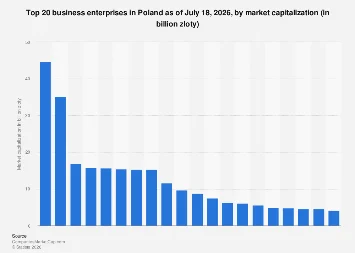
Warsaw – As the global economic landscape continues its dynamic evolution, Poland’s largest publicly traded companies, as measured by their market capitalization in 2026, are poised to reflect both the nation’s established industrial strengths and its burgeoning sectors. Analyzing these market leaders offers a crucial lens through which to understand the health of the Polish economy, its integration into global value chains, and its future growth trajectory. While specific, definitive rankings for a future year are speculative, prevailing trends and the current performance of key players allow for a robust projection of the corporate landscape.
The Polish stock market, represented primarily by the Warsaw Stock Exchange (WSE), has matured significantly over the past two decades. It has transitioned from a frontier market to a more developed one, attracting both domestic and international investors. The companies at the apex of this market, those commanding the highest market capitalizations, are typically those with substantial revenues, consistent profitability, strong balance sheets, and often, a significant international presence. These giants serve as bellwethers for the broader economic sentiment and industrial output of Poland.
Historically, Poland’s economic success has been deeply rooted in its industrial base, particularly in energy, mining, and banking. These sectors are likely to continue to house some of the nation’s largest companies. For instance, energy giants, often state-influenced or fully state-owned, have historically dominated market capitalization rankings due to their sheer scale and strategic importance. Companies involved in the extraction and processing of coal, a historically significant resource for Poland, and increasingly, those pivoting towards renewable energy sources or diversified energy portfolios, will remain critical. Their market valuations will be influenced not only by operational efficiency and commodity prices but also by the accelerating global energy transition and national energy security policies.
The banking sector is another bedrock of the Polish economy and consequently, a consistent feature among its largest listed companies. Major Polish banks, with extensive branch networks, significant loan portfolios, and substantial deposit bases, often vie for top positions. Their market capitalization in 2026 will be a barometer of consumer and corporate credit demand, the health of the real estate market, and the effectiveness of their digital transformation initiatives. Regulatory environments, interest rate policies set by the National Bank of Poland, and competition from fintech innovators will all play a crucial role in shaping their valuations.
Beyond these traditional pillars, Poland has seen the rise of robust manufacturing and retail sectors. Companies engaged in the production of goods for both domestic consumption and export markets, ranging from automotive components and electronics to consumer staples and apparel, are increasingly contributing to the economic output and market capitalization. The resilience of domestic demand, coupled with the ability of these companies to compete on a global scale through quality and price, will be key determinants of their market standing. Retailers, in particular, will need to demonstrate agility in adapting to evolving consumer habits, with a growing emphasis on e-commerce and omnichannel strategies.
The technology sector, while perhaps not yet as dominant in market capitalization as in some Western economies, is a dynamic area of growth for Poland. Software development, IT services, and gaming companies have garnered international attention and investment. While individual companies might not yet rival the scale of established energy or banking behemoths, the aggregate growth and potential for innovation in this space suggest that technology firms could see their valuations climb significantly by 2026, potentially entering the top ranks or at least demonstrating the fastest growth. This sector’s expansion is fueled by a highly skilled workforce, competitive operational costs, and increasing government support for R&D and digital innovation.
Understanding the market capitalization of these leading companies requires an appreciation of several economic factors. Macroeconomic stability, including controlled inflation and steady GDP growth, provides a favorable environment for corporate expansion and investor confidence. Poland’s strategic location in Central Europe, its access to the European Union’s single market, and its relatively competitive labor costs have made it an attractive destination for foreign direct investment, which often bolsters the performance and valuations of domestic companies, especially those integrated into international supply chains.
Furthermore, the performance of the WSE itself is a significant indicator. As an emerging market, it has experienced periods of volatility, influenced by both domestic political developments and broader global economic shifts. In 2026, the overall health of the exchange, its liquidity, and the inflow of foreign capital will directly impact the market capitalization of its listed entities. Investor sentiment towards emerging markets in general, and Central and Eastern Europe in particular, will be a crucial external factor.
The composition of Poland’s corporate elite by market capitalization is not static; it’s a dynamic reflection of economic shifts. While established players in energy, banking, and heavy industry are likely to maintain significant positions, the ascendancy of sectors like technology, advanced manufacturing, and potentially, renewable energy infrastructure, points to a diversifying economic base. The ability of Polish companies to innovate, adapt to global challenges such as climate change and digital disruption, and effectively navigate international markets will be the ultimate determinants of their standing in the global corporate arena by 2026. Investors will be closely watching for evidence of sustainable growth, strategic foresight, and robust corporate governance as they assess the value of Poland’s leading public companies.