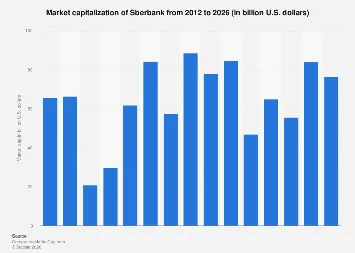
Sberbank, Russia’s largest financial institution, is currently navigating a complex economic landscape that casts a significant shadow over its projected market capitalization in the coming years. While specific, forward-looking market cap figures for a single entity like Sberbank are inherently speculative and subject to a multitude of volatile factors, industry analysts and financial forecasters are closely monitoring key indicators that will shape its valuation by 2026. The institution’s performance is inextricably linked to the broader Russian economy, geopolitical developments, and global financial market trends, making any precise prediction a challenging, albeit essential, exercise for investors and observers.
The prevailing geopolitical environment, characterized by ongoing international sanctions and Russia’s strategic reorientation, presents the most significant hurdle for Sberbank’s market valuation. These external pressures have led to a reassessment of the risk premium associated with Russian assets, impacting both domestic and international investor sentiment. Historically, Sberbank has benefited from its dominant position within the Russian market, its strong retail franchise, and its diversified revenue streams, including digital services and insurance. However, the current sanctions regime has curtailed its access to international capital markets, limited its ability to engage in certain cross-border transactions, and potentially impacted its profitability through increased operating costs and reduced growth opportunities.
Examining Sberbank’s historical performance offers some context, though past trends may not be a reliable predictor of future outcomes given the seismic shifts occurring globally. Prior to the escalation of geopolitical tensions, Sberbank was a consistent performer, often trading at a respectable price-to-earnings ratio that reflected its market leadership and profitability. Its market capitalization, while fluctuating with market cycles, generally demonstrated an upward trajectory. However, the events of recent years have led to significant volatility. The impact on Sberbank’s share price and, consequently, its market capitalization has been substantial, reflecting investor concerns about its long-term sustainability and growth prospects under the current conditions.
To project Sberbank’s market cap towards 2026, analysts typically employ a range of valuation methodologies. These often include discounted cash flow (DCF) analysis, which estimates the future cash flows of the company and discounts them back to their present value, and multiples-based valuation, where Sberbank’s valuation is compared to similar companies based on metrics like price-to-earnings, price-to-book, or enterprise value to EBITDA. However, the inputs for these models are heavily influenced by macroeconomic forecasts for Russia, including GDP growth, inflation, interest rates, and the stability of the ruble. Furthermore, the effectiveness of sanctions and potential shifts in international policy will play a crucial role in determining the discount rates and growth assumptions used in these analyses.
The Russian banking sector as a whole is undergoing a period of adaptation. Sberbank, as the market leader, is expected to weather these challenges better than many smaller, less diversified institutions. Its vast customer base, significant deposit funding, and strong digital platform provide a resilient foundation. The bank’s strategic focus on digitalization, for instance, has been a key driver of its operational efficiency and customer engagement. Initiatives like its super-app, offering a wide array of services beyond traditional banking, are designed to lock in customers and create new revenue streams. The success of these digital ventures will be critical in offsetting potential headwinds in traditional banking segments.
Economically, Russia’s ability to sustain its domestic demand and foster new trade partnerships will be paramount. If the Russian economy can demonstrate resilience, adapt to new supply chains, and maintain a degree of stability, Sberbank’s performance will likely reflect this. Conversely, a prolonged economic downturn, further isolation, or significant disruptions to its key export markets could exert downward pressure on the bank’s valuation. The government’s fiscal policies and its support for the banking sector will also be important factors.
Global comparisons offer a benchmark, though direct comparisons are often complicated by unique national circumstances. Major global banks in more stable economic environments typically trade at higher multiples, reflecting lower perceived risk and greater access to international capital. Sberbank, operating in a more challenging geopolitical and economic climate, is likely to continue to trade at a discount relative to its global peers. The degree of this discount will be a key determinant of its market cap.
Furthermore, Sberbank’s profitability metrics, such as net interest margins, fee and commission income, and return on equity, will be closely scrutinized. While sanctions may have impacted its ability to grow certain revenue lines, its efficiency ratios and cost management will be crucial for maintaining profitability. Analysts will be looking for evidence of Sberbank’s ability to generate sustainable earnings even in a constrained environment. The development of its non-banking services, which can offer diversification from traditional lending, will also be a key area of focus.
The regulatory environment within Russia also plays a significant role. While Sberbank is largely state-controlled, its operational autonomy and adherence to prudential regulations are important for investor confidence. Any changes in capital requirements, dividend policies, or regulatory frameworks could influence its valuation.
Looking ahead to 2026, it is improbable that a precise market capitalization figure will be readily available or universally agreed upon. Instead, market participants will be focused on Sberbank’s ability to adapt to evolving economic and geopolitical realities. Key metrics to watch will include its loan portfolio quality, deposit growth, digital revenue contributions, and its overall resilience to external shocks. The development of its domestic capital markets and its success in fostering new international partnerships outside of traditional Western economies will also be critical.
In conclusion, while the precise market capitalization of Sberbank in 2026 remains a subject of considerable uncertainty, its trajectory will be shaped by a complex interplay of geopolitical events, the resilience of the Russian economy, and the bank’s own strategic adaptability. Its strong domestic franchise and digital innovation offer potential avenues for continued growth, but these will need to be weighed against the persistent challenges posed by international sanctions and the broader economic environment. Investors and analysts will continue to monitor a confluence of economic and political indicators, understanding that Sberbank’s valuation will be a dynamic reflection of these ever-shifting forces. The bank’s ability to navigate these complexities with agility and strategic foresight will ultimately determine its standing in the global financial landscape by the mid-2020s.