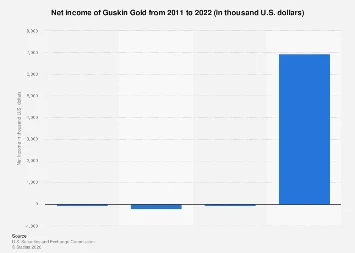
Guskin Gold, a United States-headquartered entity operating within the resource extraction sector, concluded its 2022 fiscal year on September 30th, reporting a net income of several million U.S. dollars. While the precise figure remains proprietary and accessible only through subscription services, this disclosed net income represents a significant point in the company’s recent financial history. When viewed against the earliest available data points from 2011, the 2022 performance indicates a substantial overall increase in profitability over the preceding decade. However, a closer examination of the company’s performance reveals that this growth has not been a steady, uninterrupted ascent, but rather a journey marked by fluctuations and strategic shifts.
The gold mining industry, by its very nature, is subject to a confluence of global economic forces, geopolitical developments, and intrinsic commodity price volatility. Guskin Gold’s financial results are therefore inextricably linked to these broader market dynamics. The price of gold, influenced by factors such as inflation expectations, central bank policies, currency movements, and investor sentiment towards safe-haven assets, directly impacts revenue streams. Fluctuations in the cost of extraction, including labor, energy, and equipment, also play a critical role in determining net income. Furthermore, regulatory landscapes, environmental compliance costs, and the discovery and development of new reserves all contribute to the complex financial ecosystem in which Guskin Gold operates.
Analyzing Guskin Gold’s performance in the context of the global precious metals market provides a more comprehensive understanding of its achievements and challenges. In 2022, the gold market experienced considerable turbulence. While gold prices initially showed strength in the early part of the year, driven by geopolitical tensions and rising inflation, they faced headwinds later on due to aggressive interest rate hikes by major central banks, which increased the opportunity cost of holding non-yielding assets like gold. This environment would have presented Guskin Gold with both opportunities to capitalize on higher spot prices and challenges in managing operational costs and investor expectations.
The company’s reporting period ending September 30th means its 2022 results would encompass the latter half of a period characterized by heightened global economic uncertainty. The broader economic backdrop of 2022, marked by persistent inflation, supply chain disruptions, and the lingering effects of the COVID-19 pandemic, would have undoubtedly influenced Guskin Gold’s operational efficiency and its ability to secure favorable pricing for its output. Labor availability and wage pressures, common across many industries, likely also factored into the company’s cost structure.
The statement that the net income in 2022 represents a total increase of approximately X million U.S. dollars since 2011 suggests a significant long-term growth trajectory. This would imply that Guskin Gold has successfully navigated market downturns, optimized its mining operations, potentially expanded its reserves, or benefited from strategic acquisitions or divestitures over the past decade. Such a sustained period of growth, even with intermediate dips, is a testament to effective management and a robust business strategy.
However, the emphasis on the non-continuous nature of this increase is crucial. It highlights the inherent cyclicality of the mining sector. Periods of high profitability might be followed by leaner years due to declining ore grades, increased operational complexity, or unfavorable market conditions. Investors and analysts would be keenly interested in understanding the specific drivers behind these fluctuations. Were there significant capital expenditures for new projects? Did exploration efforts yield unexpected results, both positive and negative? Were there any major operational disruptions or environmental incidents? The masked financial data implies that a deeper dive into the company’s financial statements, including revenue, cost of goods sold, operating expenses, and capital expenditures, would be necessary to fully deconstruct this performance.
For a U.S.-based company, the strength of the U.S. dollar in 2022 could also have played a dual role. A stronger dollar can make imported goods and services, including mining equipment and supplies, less expensive, potentially reducing operational costs. Conversely, if Guskin Gold has significant international sales or operations priced in other currencies, a stronger dollar could reduce the translated value of those revenues.
Comparing Guskin Gold’s performance to its peers within the junior and mid-tier gold mining sector would provide valuable context. Many companies in this space face similar challenges in securing capital for exploration and development, managing operational risks, and competing for skilled labor. The success of Guskin Gold in demonstrating sustained net income growth, even with volatility, might place it in a favorable position relative to some of its competitors. Market capitalization, debt levels, and dividend policies are other metrics that investors use to assess the relative health and attractiveness of mining companies.
The economic impact of a company like Guskin Gold extends beyond its direct financial performance. As a resource extractor, it contributes to the economy through job creation, both directly within its operations and indirectly through its supply chain. Its activities can stimulate local economies where its mines are located, through wages, local procurement, and tax revenues. Furthermore, its contribution to the global supply of gold, a key component in jewelry, electronics, and investment portfolios, has broader economic implications.
The proprietary nature of the exact net income figure underscores the competitive intelligence aspect of financial data. Companies often guard precise financial details, especially those that could reveal strategic advantages or vulnerabilities. For market participants, accessing such data through specialized platforms is often a prerequisite for informed investment decisions, risk assessment, and competitive analysis. The subscription model for such data reflects its value in a fast-paced and data-driven global economy.
Looking ahead, Guskin Gold’s future performance will likely depend on its ability to adapt to evolving market conditions, manage its cost base effectively, and continue its exploration and development efforts. The global transition towards renewable energy, for instance, could impact energy costs for mining operations. Shifts in investor preferences, driven by environmental, social, and governance (ESG) considerations, are also increasingly influencing the mining sector, demanding greater transparency and commitment to sustainable practices. Guskin Gold’s long-term success will hinge on its capacity to balance profitability with these growing expectations, ensuring a resilient and responsible approach to resource extraction in an increasingly complex world. The trend from 2011 to 2022, marked by both growth and inconsistency, serves as a reminder of the dynamic nature of the commodities market and the strategic agility required to thrive within it.