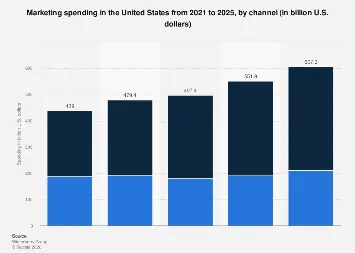
Total U.S. marketing expenditures are projected to reach an estimated $XXX billion by the close of 2025, marking a significant increase from previous years. This substantial investment underscores the critical role of advertising in the American economy. While the overall market continues its upward trajectory, a pronounced and accelerating shift in allocation is evident, with digital and online channels increasingly eclipsing traditional offline methods. By 2025, nearly $XXX billion, representing a substantial proportion of the total spend, is anticipated to be directed towards online marketing initiatives, highlighting a fundamental transformation in how brands connect with consumers.
This substantial reallocation of marketing budgets reflects a broader evolution in consumer behavior and media consumption. The pervasive nature of the internet, coupled with the proliferation of mobile devices and the rise of social media platforms, has fundamentally altered the advertising landscape. Consumers are spending more time online, engaging with digital content, and interacting with brands through a multitude of digital touchpoints. Consequently, advertisers are strategically following this audience, prioritizing platforms and strategies that offer greater reach, measurability, and engagement within the digital realm.
The growth in online marketing spend is not merely a trend but a strategic imperative driven by the inherent advantages offered by digital channels. Unlike traditional media, online advertising provides granular targeting capabilities, allowing marketers to reach specific demographic, psychographic, and behavioral segments with unprecedented precision. This precision minimizes wasted impressions and maximizes the efficiency of marketing campaigns, leading to potentially higher return on investment. Furthermore, the interactive nature of online platforms facilitates two-way communication between brands and consumers, fostering deeper engagement and brand loyalty.
Metrics such as click-through rates, conversion rates, and cost per acquisition provide advertisers with real-time data to optimize campaigns and make informed decisions. This level of trackability and analytics is often more challenging to achieve with traditional media. For instance, while a television advertisement might reach millions, understanding the direct impact of that advertisement on sales can be complex. In contrast, a digital ad campaign can precisely measure how many users clicked on an ad, visited a website, and subsequently made a purchase, offering a clear line of sight to campaign effectiveness.
The projected figures for 2025 indicate a sustained and robust expansion of the digital advertising market. This growth is fueled by a diverse array of online channels, including search engine marketing (SEM), social media advertising, display advertising, video advertising, influencer marketing, and content marketing. Each of these channels plays a distinct role in the consumer journey, from raising awareness and generating interest to driving consideration and ultimately, conversion. The integration of these various digital components into a cohesive strategy is paramount for businesses seeking to maximize their online presence.
Search engine marketing, for example, capitalizes on consumers actively seeking products or services. By appearing at the top of search engine results pages for relevant keywords, businesses can capture high-intent leads. Social media advertising, on the other hand, leverages the vast user bases of platforms like Facebook, Instagram, TikTok, and LinkedIn to deliver targeted messages and build community around brands. Display advertising, often in the form of banner ads and video interstitials, aims to capture attention and drive brand recall across a wide range of websites and applications.
Video advertising, in particular, has experienced explosive growth, driven by the popularity of platforms like YouTube and the increasing bandwidth available to consumers. Brands are investing heavily in creating engaging video content that tells their story, showcases their products, and resonates with their target audience. Influencer marketing has also emerged as a powerful tool, with brands collaborating with individuals who have established credibility and a dedicated following within specific niches. This approach leverages trust and authenticity to promote products and services.
While the dominance of online channels is undeniable, traditional offline marketing avenues are not entirely obsolete. Instead, their role is evolving. Experiential marketing, sponsorship, and shopper marketing are cited as among the fastest-growing offline channels. Experiential marketing focuses on creating immersive brand experiences, such as pop-up shops, events, and interactive installations, designed to forge deeper emotional connections with consumers. Sponsorships continue to be a valuable tool for associating brands with popular events, sports teams, or cultural initiatives, enhancing brand visibility and credibility. Shopper marketing, aimed at influencing purchasing decisions at the point of sale, remains crucial for driving impulse buys and converting browsers into buyers within physical retail environments.
However, even within these offline sectors, there is a discernible trend towards integrating digital elements. For instance, experiential events often incorporate social media campaigns for pre-event buzz and post-event engagement, while sponsorships frequently include digital media packages and online activations. This blurring of lines between online and offline marketing strategies signifies a move towards a more integrated, omnichannel approach, where all touchpoints are coordinated to deliver a seamless and consistent brand experience.
The economic implications of this marketing spend are far-reaching. Advertising is a significant contributor to economic activity, supporting a vast ecosystem of agencies, media companies, technology providers, and creative professionals. The shift towards online advertising has spurred innovation in areas such as data analytics, artificial intelligence for ad optimization, and programmatic advertising platforms, creating new job opportunities and driving technological advancement.
Furthermore, effective marketing campaigns can stimulate consumer demand, leading to increased sales, business growth, and job creation across various industries. The ability of businesses, particularly small and medium-sized enterprises (SMEs), to leverage cost-effective digital marketing tools has democratized access to markets, enabling them to compete with larger corporations on a more level playing field. This increased market access can foster entrepreneurship and contribute to overall economic dynamism.
Looking ahead, the continued evolution of technology, such as augmented reality (AR), virtual reality (VR), and the metaverse, is likely to introduce new frontiers for marketing spend. Brands will need to adapt their strategies to engage consumers in these emerging digital environments, further solidifying the trend of digital-first marketing. The ability to remain agile, embrace innovation, and understand the ever-changing consumer landscape will be critical for businesses seeking to thrive in the competitive U.S. advertising market. The data for 2025 clearly indicates that the future of marketing is increasingly digital, demanding strategic investments and a keen understanding of the online ecosystem.