The global mobile application market continues its relentless expansion, with Android holding a dominant share of smartphone operating systems. This vast ecosystem necessitates sophisticated tools for developers and marketers to effectively engage users, drive downloads, and foster long-term loyalty. Among the critical technologies powering this engagement are Software Development Kits (SDKs) for app marketing automation. As we look towards 2025, the competitive arena for these SDKs is intensifying, marked by innovation, strategic pricing, and an increasing focus on data-driven insights.
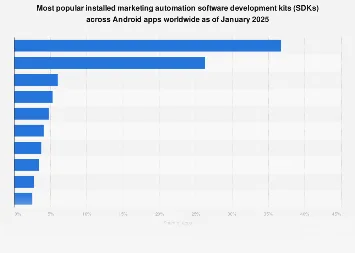
The market for app marketing automation SDKs is not a monolithic entity. Instead, it comprises a diverse range of providers, each offering distinct feature sets, pricing models, and target audience segments. These SDKs are the fundamental building blocks that enable app publishers to implement a spectrum of marketing activities directly within their applications. This includes functionalities such as push notifications, in-app messaging, personalized user segmentation, analytics tracking, and the orchestration of complex user journeys. The effectiveness of these tools directly impacts a developer’s ability to acquire new users, retain existing ones, and ultimately monetize their applications in an increasingly crowded digital space.
For individual developers or small, lean startups, the entry point into utilizing advanced marketing automation often begins with more accessible, albeit potentially limited, offerings. These "Starter" accounts, typically priced around $199 USD per month when billed annually, are designed to provide core functionalities. While specific features can vary, these packages usually grant access to essential analytics and basic automation capabilities, allowing single users to begin segmenting their audience and sending targeted communications. The annual billing structure, common across the industry, incentivizes longer-term commitment and provides providers with predictable revenue streams, while often offering a cost saving for the user compared to month-to-month arrangements. It is crucial to note that such pricing often excludes local sales taxes, a factor that can add a significant percentage to the final outlay for businesses operating in different jurisdictions.
As a business scales, so too does its need for more robust and collaborative marketing tools. This is where "Professional" accounts come into play. These packages are generally tailored for teams, often supporting up to five individuals, and reflect a significant increase in investment. With price points potentially reaching $1,399 USD per month, billed annually, these offerings unlock a more comprehensive suite of features. This typically includes advanced segmentation capabilities, A/B testing functionalities for message optimization, more sophisticated analytics dashboards, and potentially higher tiers of API access or integration support. The substantial price difference between starter and professional tiers underscores the expanded functionality, dedicated support, and the ability to manage more complex, multi-team marketing operations. The annual contract requirement for these professional tiers also highlights the provider’s expectation of sustained engagement and the value they deliver to more mature businesses.
Beyond these tiered account structures, the broader market for accessing comprehensive data and analytics related to app marketing SDKs can command significantly higher figures. For organizations requiring unfettered access to extensive datasets, detailed market research, and in-depth trend analysis, yearly subscriptions can begin at approximately $2,388 USD. This level of access is typically aimed at market research firms, large enterprises with dedicated analytics departments, or companies seeking to benchmark their performance against industry leaders. The "commercial use only" stipulation attached to such premium data access reinforces its intended application in strategic business decision-making and market intelligence gathering.
The competitive dynamics within the Android app marketing SDK market are shaped by several key factors. Firstly, feature innovation is paramount. Providers are continuously investing in R&D to offer cutting-edge capabilities, such as AI-powered personalization, predictive analytics for user churn, and seamless integration with emerging advertising platforms. Secondly, user experience and ease of integration are critical differentiators. Developers are often time-constrained, and SDKs that are well-documented, easy to implement, and offer intuitive dashboards are highly valued. Thirdly, pricing strategy and value proposition play a crucial role. While high-end features command premium prices, providers must also demonstrate clear ROI to justify the investment, particularly for smaller businesses.
The global impact of these SDKs extends beyond individual app success. They are instrumental in driving the growth of the digital economy. By enabling more effective user acquisition and retention, these tools contribute to the overall health and vibrancy of the app marketplace. For developers in emerging markets, access to cost-effective and powerful automation tools can be a game-changer, allowing them to compete on a more level playing field with established players. Conversely, in mature markets, the focus is often on optimizing engagement and maximizing revenue per user, where advanced segmentation and personalization become indispensable.
Looking ahead to 2025, several trends are likely to shape the future of Android app marketing automation SDKs. The increasing prevalence of privacy-centric regulations, such as GDPR and CCPA, will push providers to develop SDKs that offer greater transparency and user control over data. This will likely lead to a greater emphasis on first-party data collection and ethical marketing practices. Furthermore, the rise of cross-platform development frameworks might spur the development of SDKs that offer seamless integration across both Android and iOS ecosystems, simplifying the marketing efforts for publishers targeting multiple platforms.
The integration of Artificial Intelligence and Machine Learning will become even more pervasive. AI will be leveraged not only for personalized content delivery but also for automating complex campaign management tasks, optimizing ad spend, and predicting user behavior with greater accuracy. This will empower marketers to move from reactive to proactive strategies, anticipating user needs and addressing potential issues before they arise.
Moreover, the monetization models themselves might evolve. While annual contracts remain a staple, we could see more flexible options, such as usage-based pricing or performance-based models, emerging for certain services. This would offer greater agility to businesses with fluctuating marketing needs or those seeking to directly tie their marketing expenditure to tangible outcomes.
Ultimately, the success of an Android app in 2025 will hinge on its ability to connect with users on a personal level, deliver relevant experiences, and foster a sense of community. The SDKs that power these marketing automation efforts will be at the forefront of this evolution, providing the essential tools for developers to navigate the complexities of the mobile landscape and achieve sustained growth in an ever-evolving digital world. The investment in these technologies, from starter kits for fledgling developers to enterprise-grade solutions for global brands, reflects their indispensable role in the modern app economy.