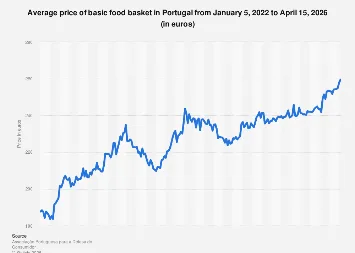
The cost of essential food items for Portuguese households has followed a persistent upward trend since the beginning of 2022, culminating in a projected peak in early 2026. Data tracking the price evolution of a representative basket of basic foodstuffs indicates a significant increase over the past few years, placing a growing financial burden on families. This trend is not isolated to Portugal; it mirrors a broader global challenge of rising food inflation driven by a confluence of geopolitical events, climate change impacts on agricultural yields, and persistent supply chain disruptions.
By mid-April 2026, the estimated cost of this essential food hamper is forecast to reach €259.52. This figure represents a substantial leap from the €187.70 recorded in the first week of January 2022, signalling a cumulative price hike of over 38% within a little over four years. The trajectory reveals periods of accelerated price growth, particularly in early 2023, when the basket’s cost surged to €234.84 by March of that year. While a slight abatement in prices was observed in the subsequent months, a renewed upward momentum began in August 2023, pushing the cost beyond €243 by January 2024.
The year 2024 has seen continued fluctuations, with the price hovering around €225 to €243, before experiencing another notable increase to €245.79 by July 2025. This sustained escalation highlights the complex interplay of factors influencing food affordability. Analysts point to the lingering effects of the war in Ukraine on global grain and fertilizer prices, coupled with increased energy costs that impact transportation and production across the entire food value chain. Furthermore, the intensifying effects of climate change, leading to unpredictable weather patterns and reduced agricultural output in key producing regions, contribute to supply-side pressures.
Examining the weekly price movements provides a granular view of these dynamics. For instance, in the lead-up to April 2026, the price experienced a steady climb: from €251.76 on March 4th to €254.12 by March 11th, and then a more significant jump to €254.99 by April 1st. This suggests that factors influencing price are not static, but rather evolve with market conditions, seasonal demand, and potentially policy interventions or global economic shifts.
The economic implications for Portugal are considerable. As a nation that imports a significant portion of its food, the country is particularly susceptible to international price volatility. The rising cost of basic necessities directly impacts household purchasing power, potentially leading to reduced spending on other goods and services, thereby affecting broader economic growth. Lower-income households are disproportionately affected, as a larger percentage of their disposable income is allocated to food expenditure. This can exacerbate social inequalities and increase the risk of food insecurity.
Economists are closely monitoring how these trends might influence consumer behaviour. A sustained increase in food prices could compel households to make difficult choices, such as substituting more expensive items with cheaper alternatives, reducing meat consumption, or cutting back on non-essential food purchases. This shift in demand patterns could, in turn, influence the strategies of food producers and retailers, potentially leading to changes in product offerings and pricing strategies.
Globally, Portugal’s situation is not unique. Many European countries and nations worldwide have grappled with similar inflationary pressures on food prices. According to Eurostat data, inflation rates for food, beverages, and tobacco have been a persistent concern across the European Union. While specific figures vary by country, the underlying drivers – energy costs, supply chain issues, and geopolitical instability – are largely shared. For example, countries heavily reliant on agricultural imports or those with less diversified economies often face greater challenges in mitigating these price surges.
The long-term outlook for food prices remains uncertain, heavily dependent on the resolution of geopolitical conflicts, the pace of global economic recovery, and the effectiveness of climate adaptation strategies in agriculture. For policymakers in Portugal and beyond, addressing food inflation requires a multi-pronged approach. This could include measures to support domestic agricultural production, invest in more resilient supply chains, provide targeted assistance to vulnerable households, and potentially explore international trade agreements that enhance food security and price stability.
The data up to April 2026 provides a stark projection for Portuguese consumers. The sustained rise in the cost of essential food items underscores the ongoing economic challenges faced by households and highlights the critical need for robust economic policies aimed at ensuring food affordability and mitigating the broader socio-economic consequences of inflation. As the nation navigates these pressures, understanding the precise drivers and impacts of these price evolutions will be crucial for informed decision-making and the implementation of effective solutions. The projected €259.52 for a basic food basket by April 2026 serves as a significant indicator of the financial landscape Portuguese families are anticipated to face in the near future.