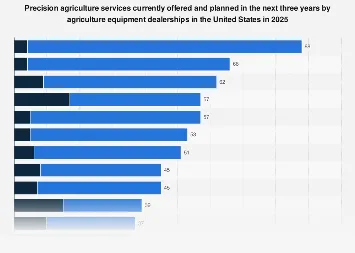
Variable Rate Technology (VRT) for customized fertilizer application stands as the flagship precision agriculture service poised for widespread adoption among U.S. equipment dealerships, according to forward-looking industry analysis projecting into 2025. A significant majority of these dealerships, approaching a substantial majority of respondents, currently offer this sophisticated service, underscoring its established value proposition in optimizing crop nutrient management. Looking ahead, the commitment to VRT is further solidified, with a considerable percentage of dealerships indicating their intention to introduce or expand its availability within the next three years, signaling a robust growth trajectory for this foundational precision farming tool. This widespread embrace of VRT is not merely a trend; it represents a fundamental shift in how agricultural inputs are managed, driven by the imperative to enhance efficiency, reduce waste, and ultimately boost farm profitability.
The economic rationale behind VRT’s prominence is compelling. By enabling farmers to apply fertilizers, seeds, and other inputs at precisely the rate required for specific zones within a field, VRT directly addresses the inefficiencies of uniform application. This targeted approach minimizes over-application in fertile areas, thereby cutting costs on expensive inputs, and prevents under-application in less productive zones, safeguarding yield potential. The environmental benefits are equally significant, with reduced nutrient runoff contributing to improved water quality and a smaller overall carbon footprint. Global markets are increasingly prioritizing sustainable agricultural practices, and VRT services offered by dealerships are directly contributing to this objective, positioning U.S. agriculture as a leader in responsible resource management.
In stark contrast to the ascendant VRT, sales of telematics equipment, while crucial for data collection and fleet management, currently occupy the lower rungs of service offerings among U.S. equipment dealerships. A comparatively smaller segment of dealerships reports offering telematics solutions today, and the anticipated growth in this area over the next three years, extending to 2028, appears modest. This suggests a lag in the perceived immediate value or perhaps a more complex integration pathway for telematics compared to the more direct application-focused benefits of VRT. Telematics systems, which provide real-time location tracking, operational status, and diagnostic information for agricultural machinery, are vital for comprehensive farm management and operational oversight. However, their adoption may be more contingent on farmers’ existing technological infrastructure and their understanding of the long-term data analytics capabilities that telematics unlocks.
The divergence in adoption rates between VRT and telematics highlights a nuanced understanding of farmer needs and dealership service models. While VRT offers tangible, immediate improvements in input management, telematics represents a more strategic investment in data infrastructure and operational intelligence. The challenge for dealerships, and by extension the agricultural technology sector, lies in effectively communicating the broader economic and operational advantages of telematics, potentially through integrated service packages that bundle data acquisition with actionable insights. As farm sizes continue to grow and the complexity of operations increases, the importance of telematics will undoubtedly rise, but its current market penetration suggests a need for enhanced educational outreach and demonstration of its return on investment.
Looking beyond current offerings and into the immediate future, a striking shift in strategic focus is evident in the planned introductions of new precision agriculture services. Machine vision weed detection integrated into sprayer systems has emerged as a standout technology, with a significant percentage of dealerships indicating plans to incorporate this service within the next three years. This figure surpasses the planned adoption rate for any other emerging precision agriculture technology, signaling a strong industry consensus on its transformative potential. Machine vision systems, leveraging advanced algorithms and cameras mounted on sprayers, can identify weeds with remarkable accuracy, enabling spot spraying of herbicides. This capability promises substantial reductions in herbicide usage, leading to significant cost savings for farmers and a considerable decrease in environmental impact.
The economic implications of widespread machine vision adoption are far-reaching. Herbicide costs represent a substantial portion of a farmer’s operating expenses, and even a modest reduction in application rates can translate into millions of dollars in savings annually across the U.S. agricultural landscape. Furthermore, the development of herbicide resistance in weeds is a growing concern, and targeted application strategies facilitated by machine vision can help mitigate this challenge, preserving the efficacy of existing weed control products. This technology aligns perfectly with the growing demand for precision and sustainability in agriculture, positioning it as a critical component of the future of crop protection.
The comparative emphasis on machine vision over other emerging technologies underscores a strategic prioritization by dealerships, likely driven by factors such as perceived farmer demand, technological maturity, and the potential for rapid return on investment. While other precision agriculture tools, such as advanced soil sensing, drone-based imaging for crop health monitoring, and automated guidance systems, are undoubtedly important, machine vision appears to be capturing the immediate strategic imagination of the dealership network. This focus suggests that dealerships are keen to offer solutions that directly address major cost centers and environmental concerns for farmers, thereby solidifying their role as indispensable partners in agricultural innovation.
The broader economic impact of this precision agriculture revolution, spearheaded by dealerships, extends beyond individual farm operations. It fuels innovation within the agricultural technology sector, creating opportunities for software developers, hardware manufacturers, and data analytics firms. The increasing adoption of these technologies also enhances the competitiveness of U.S. agriculture on the global stage, enabling producers to meet the growing demand for food, feed, and fiber in a more sustainable and efficient manner. As global populations continue to expand, the role of precision agriculture in ensuring food security becomes ever more critical, and the proactive strategies being implemented by U.S. equipment dealerships position them at the forefront of this vital global endeavor. The data clearly indicates a strategic pivot towards solutions that offer immediate, quantifiable benefits, with a keen eye on future advancements that promise to further revolutionize farm management and sustainability.