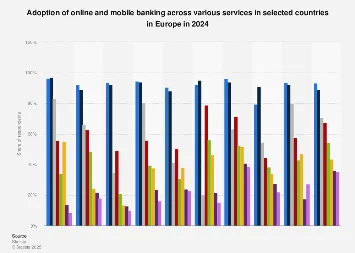
Across the major economies of Europe, the year 2024 has solidified a profound shift in how citizens engage with their financial institutions, with everyday banking activities and interbank transfers emerging as the undisputed leaders in online and mobile adoption. A comprehensive survey conducted at the close of the year reveals a striking pattern: the convenience and efficiency offered by digital platforms have irrevocably altered consumer preferences for routine financial management. In nearly all surveyed nations, the penetration of online banking for daily transactions surpassed a significant threshold, indicating a widespread embrace of digital channels for managing funds, paying bills, and monitoring account activity. The sole exception to this near-universal trend was Spain, where traditional banking methods retained a slightly stronger foothold for these fundamental services.
This burgeoning digital engagement is not merely a marginal trend; it represents a fundamental reorientation of consumer behavior. The ubiquity of smartphones and the increasing sophistication of banking applications have created an environment where immediate access to financial tools is not just expected but demanded. For the average European consumer, checking balances, transferring money between accounts, or initiating payments to third parties has become an almost entirely digital endeavor. This contrasts sharply with previous decades, where a visit to a local branch was often the default for even the most basic of transactions. The data from the survey underscores this transformation, highlighting that for a vast majority of the population, the digital realm is now the primary conduit for their day-to-day financial lives.
The adoption of online banking for routine transactions paints a compelling picture of digital integration. While the exact percentages vary by country, the general trend is clear: these services are deeply embedded in the daily routines of European consumers. This high penetration rate suggests that banks have successfully navigated the complexities of digital service delivery, offering secure, user-friendly, and readily accessible platforms. The focus on day-to-day banking and transfers as the leading digital services is also indicative of their high frequency and relatively low complexity, making them prime candidates for digital optimization. Consumers can now manage their finances with unprecedented ease, often completing tasks in seconds that once required significant time and effort.
Bank transfers, in particular, have witnessed a similarly impressive surge in digital adoption. The survey highlights Austria as a frontrunner in this category, boasting one of the highest penetration rates for online and mobile bank transfers within Europe. This suggests a mature digital banking ecosystem in Austria, where consumers are comfortable and confident in utilizing digital channels for moving funds between different accounts or sending money to others. This high adoption rate for transfers is a critical indicator of trust in digital security and the reliability of the underlying infrastructure. It also reflects the increasing interconnectedness of the European economy, where seamless cross-border and domestic transfers are essential for both personal and business transactions.
The implications of this digital shift extend far beyond individual convenience. For the banking sector, it necessitates a strategic recalibrating of resources and service offerings. Branches are increasingly being re-imagined as advisory hubs rather than transactional centers, with a greater emphasis on complex financial planning, wealth management, and personalized customer support. The reduced footfall for routine transactions frees up valuable real estate and operational capacity, which can be redirected towards innovation and digital service enhancement. This strategic pivot is crucial for banks aiming to remain competitive in a rapidly evolving market, where agility and customer-centricity are paramount.
Conversely, the survey also sheds light on areas where digital adoption has lagged, revealing segments of the financial services market that still lean heavily on traditional, in-person interactions. Loan applications and currency exchange emerged as services with the lowest online and mobile penetration rates. This suggests that for these more complex or sensitive financial decisions, consumers still place a premium on face-to-face interaction, expert advice, and the tangible reassurance of human engagement. The process of applying for a loan often involves significant documentation, complex eligibility criteria, and a need for personalized guidance, which many consumers still find more comfortably addressed through direct interaction with a bank representative.
Similarly, currency exchange, while increasingly accessible through digital platforms, retains a segment of customers who prefer the tangible experience of visiting a physical exchange bureau or bank counter. This preference might stem from a perceived need for immediate cash, a desire for a direct comparison of rates, or a general lack of familiarity with digital currency exchange services. The security and privacy concerns associated with transmitting funds internationally for exchange might also play a role in this preference for in-person transactions. These findings underscore that while digital transformation is sweeping across the banking sector, it is not a monolithic process, and different services will evolve at varying paces, influenced by consumer trust, perceived risk, and the inherent complexity of the service itself.
The economic impact of this widespread digital adoption is multifaceted. On one hand, it promises significant cost savings for financial institutions through reduced operational expenses associated with physical branches and manual processing. These savings can, in theory, be reinvested in product development, lower fees for consumers, or enhanced digital security measures. Furthermore, increased efficiency in banking operations can contribute to overall economic productivity by facilitating faster and smoother financial flows. For consumers, the convenience and potential cost reductions associated with digital banking can lead to improved financial management and greater disposable income.
However, the digital divide remains a persistent concern. While penetration rates are high in major European countries, there are still segments of the population, particularly older individuals or those in less developed regions, who may lack the digital literacy or access to technology necessary to fully participate in the digital banking landscape. Ensuring financial inclusion for all citizens requires a continued commitment to bridging this divide, perhaps through continued investment in accessible digital tools, robust customer support for those less digitally adept, and a gradual, phased approach to the closure of physical branches in underserved areas.
Looking ahead, the trend towards digital dominance in banking is likely to accelerate. As new technologies emerge, such as artificial intelligence for personalized financial advice, blockchain for secure and efficient transactions, and biometric authentication for enhanced security, the banking experience will continue to evolve. Financial institutions that can anticipate these changes and adapt their strategies accordingly will be best positioned to thrive in this dynamic and increasingly digital future. The European banking sector, having already embraced the power of online and mobile channels for everyday transactions, is now poised to leverage these digital foundations for even more innovative and customer-centric financial solutions. The journey towards a fully digitized financial ecosystem is ongoing, with 2024 marking a pivotal chapter in its unfolding narrative.