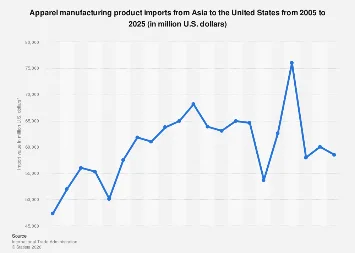
In 2025, the United States is projected to import approximately $58.5 billion worth of apparel manufacturing products from Asia, a figure that underscores the continent’s persistent and significant role in the global fashion supply chain. While this number represents a modest increase from the $57.5 billion recorded in 2010, it also paints a complex picture of market dynamics, reflecting the inherent volatility and cyclical nature of international trade in the apparel sector. This extensive analysis delves into the historical trends, economic drivers, and future implications of this crucial trade relationship, offering insights into the forces shaping the U.S. market’s reliance on Asian manufacturing hubs.
The period between 2005 and 2025 reveals a fascinating trajectory for U.S. apparel imports from Asia. Starting at $47.3 billion in 2005, the value experienced a general upward trend, reaching a peak of $68.1 billion in 2015. This decade-long expansion was fueled by a confluence of factors, including the cost-effectiveness of labor in Asian countries, robust global demand for affordable fashion, and the increasing integration of global supply chains facilitated by advancements in logistics and trade agreements. Countries like China, Vietnam, Bangladesh, and India emerged as manufacturing powerhouses, capable of producing vast quantities of garments at competitive prices, thus enabling American retailers to offer a wide array of fashion items to consumers.
However, the narrative is not one of continuous growth. The data illustrates periods of contraction and fluctuation. For instance, a notable dip occurred in 2009, a year heavily impacted by the global financial crisis, which saw a reduction in consumer spending and, consequently, a decline in import volumes. Similarly, the figures for 2020 registered a significant decrease, reaching $53.7 billion. This sharp decline can be largely attributed to the unprecedented disruption caused by the COVID-19 pandemic. Global lockdowns, factory closures, and widespread supply chain disruptions brought international trade to a standstill, severely impacting the production and movement of goods, including apparel. The subsequent rebound in 2021, with imports reaching $62.6 billion, demonstrated the resilience of the industry and the pent-up demand that emerged as economies began to reopen.
The post-pandemic period has presented a more nuanced economic landscape. While a peak of $76 billion was observed in 2022, this surge was likely influenced by a combination of factors including inventory rebuilding, elevated consumer spending fueled by stimulus measures, and ongoing supply chain adjustments. However, the subsequent moderation in 2023 to $58 billion and the projected figures for 2024 ($60 billion) and 2025 ($58.5 billion) suggest a recalibration of the market. This stabilization, or slight decline from the 2022 peak, can be attributed to several ongoing economic trends.
One of the primary drivers influencing these shifts is the persistent inflation experienced globally, which has increased production costs for manufacturers and shipping expenses for importers. Furthermore, evolving consumer behavior, marked by a growing awareness of sustainability and ethical sourcing, is beginning to influence purchasing decisions. This has led some brands to explore diversified sourcing strategies and near-shoring or re-shoring initiatives, although the sheer scale and established infrastructure of Asian manufacturing continue to make it the dominant player.
Global economic sentiment also plays a critical role. As interest rates rise in major economies to combat inflation, consumer discretionary spending, including on apparel, tends to soften. This reduced demand directly impacts import volumes. Moreover, geopolitical tensions and trade policies can introduce uncertainty and affect the cost-competitiveness of different sourcing regions. While Asia remains a cost-effective option, shifts in trade dynamics can create opportunities and challenges for specific countries within the continent.
The diversification of manufacturing bases within Asia itself is another important trend. While China has historically been the largest supplier, countries like Vietnam have seen significant growth in their apparel export capabilities. Bangladesh, known for its strong position in ready-made garments, continues to be a crucial partner. India, with its vast textile industry and growing manufacturing capacity, also plays an increasingly important role. This regional distribution helps mitigate risks associated with over-reliance on a single nation and allows for greater flexibility in sourcing.
Looking ahead, the U.S. apparel market’s reliance on Asia is unlikely to diminish significantly in the short to medium term. The established infrastructure, skilled labor force, and economies of scale that Asian manufacturers offer are difficult to replicate elsewhere. However, the industry is at a crossroads. Brands and retailers are increasingly under pressure to balance cost-efficiency with ethical considerations, environmental sustainability, and supply chain resilience. This will likely lead to a more strategic approach to sourcing, potentially involving a "China Plus One" strategy or a more diversified approach across multiple Asian nations and potentially other regions.
The NAICS (North American Industry Classification System) code 315, which classifies apparel manufacturing products, encapsulates a broad range of goods, from basic t-shirts to intricate formal wear. The value of imports under this classification from Asia reflects the immense scale and diversity of this sector. The projected figures for 2025, while substantial, suggest a market that is maturing and adapting to a new economic reality characterized by higher costs, evolving consumer preferences, and a greater emphasis on supply chain agility.
Economists and industry analysts are closely monitoring how these factors will shape the future of global apparel trade. The ability of Asian manufacturers to innovate, embrace sustainable practices, and adapt to changing global demands will be critical in maintaining their competitive edge. For the U.S. market, the continued partnership with Asia represents a complex interplay of economic benefits and evolving ethical and logistical considerations, a dynamic that will undoubtedly continue to define the global fashion landscape for years to come. The projected figures for 2025 serve as a snapshot in this ongoing evolution, highlighting both the enduring strength and the subtle shifts occurring within one of the world’s most significant trade relationships.