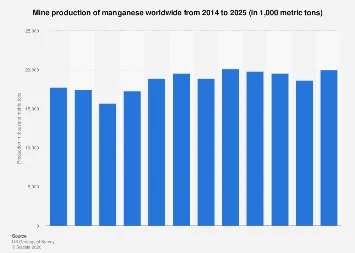
The global landscape of manganese mine production is on a trajectory for substantial expansion, with projections indicating robust growth leading up to and including 2025. This anticipated surge is intricately linked to the metal’s indispensable role in critical industries, particularly steel manufacturing, as well as its burgeoning applications in battery technology and specialized alloys. As geopolitical and economic factors continue to shape commodity markets, understanding the future supply dynamics of manganese is paramount for industry stakeholders, investors, and policymakers alike.
Manganese, a vital transition metal, is a cornerstone of modern industrial economies. Its primary application, consuming approximately 85-90% of global production, lies in the production of steel. It acts as a deoxidizer and desulfurizer, improving the strength, toughness, and workability of steel. Without manganese, the vast majority of steel produced today would be brittle and unsuitable for construction, infrastructure, and manufacturing. Beyond steel, manganese is crucial for the production of stainless steel and other high-performance alloys, imparting corrosion resistance and hardness. Emerging applications in lithium-ion batteries, specifically in nickel-manganese-cobalt (NMC) cathodes, are also driving demand, positioning manganese as a key component in the electrification of transportation and energy storage solutions.
Forecasting global mine production for any commodity involves navigating a complex interplay of factors. These include existing mine capacities, planned expansions, new project developments, technological advancements in extraction and processing, environmental regulations, and the ever-present influence of commodity prices. The specific data points for 2025 production levels, while often proprietary and requiring specialized access, are indicative of a market that is responding to sustained and growing demand. This growth is not uniform, however, and is heavily influenced by the concentration of manganese reserves and production capabilities in a few key countries.
South Africa stands as the undisputed leader in global manganese ore production, possessing vast reserves and accounting for a significant portion of the world’s output. Its production levels are often a bellwether for the global market. Other major producing nations include Australia, China, Gabon, and Brazil. Each of these countries plays a crucial role in the global supply chain, with their respective production capacities and export strategies impacting market availability and pricing. For instance, China, while a significant producer, is also a massive consumer of manganese, influencing its export policies and domestic market dynamics.
The projected growth in manganese mine production towards 2025 is likely to be driven by several key trends. Firstly, the continued expansion of global infrastructure projects, particularly in emerging economies, will sustain robust demand for steel, thereby underpinning manganese consumption. Secondly, the accelerating shift towards electric vehicles (EVs) and renewable energy storage systems is a significant growth catalyst. As battery manufacturers increasingly adopt NMC cathode chemistries, the demand for high-purity manganese will escalate. Industry analysts predict that the manganese content in EV batteries could represent a substantial new demand driver in the coming years.
However, this growth is not without its challenges. Manganese extraction and processing can have significant environmental impacts, including land disturbance, water usage, and the generation of waste materials. Increasingly stringent environmental regulations in many producing countries, coupled with growing societal pressure for sustainable mining practices, could impact production costs and project timelines. Companies are therefore investing in cleaner technologies and more responsible mining methods, which can, in turn, influence overall production efficiency and output.
Furthermore, the geographical concentration of manganese reserves presents its own set of risks. Reliance on a few key suppliers can lead to supply chain vulnerabilities, susceptible to geopolitical tensions, trade disputes, or unforeseen disruptions within those nations. This has led some consuming nations and industries to explore strategies for diversifying their manganese sources or investing in domestic processing capabilities.
Market data from recent years illustrates a pattern of steady demand growth for manganese, with prices fluctuating based on supply-demand balances and macroeconomic conditions. While specific production figures for 2025 are subject to ongoing market analysis and may be part of premium data sets, the overarching trend points towards an expansionary phase. This expansion is likely to be characterized by increased output from existing mines, potential recommissioning of idled capacity, and the gradual development of new projects, particularly those focusing on higher-grade ores or those with access to more advanced processing technologies.
The economic impact of this production growth is multifaceted. For producing nations, it represents an opportunity for revenue generation, job creation, and economic development. For consuming industries, it signifies a more stable and potentially more affordable supply of a critical raw material, enabling continued growth and innovation. Investors in the mining sector will be closely watching the profitability and sustainability of manganese operations, considering the capital expenditures required for new mines and the long-term demand outlook.
The future of manganese mine production is intrinsically tied to the global economic outlook and the pace of technological advancement. The continued growth of the steel industry, particularly in developing nations, will remain the primary demand driver. Simultaneously, the burgeoning battery sector offers a significant, high-growth complementary market. Companies that can navigate the complex regulatory, environmental, and logistical challenges while investing in efficient and sustainable production will be best positioned to capitalize on the anticipated expansion in global manganese mine output leading up to 2025 and beyond. The strategic importance of manganese is set to increase, making its production dynamics a critical area of focus for the global economy.