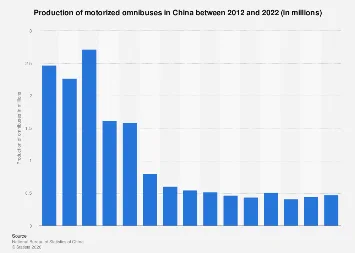
China’s role as a global manufacturing powerhouse extends significantly into the production of omnibuses, commonly known as buses, a sector critical for urban transportation, long-haul travel, and increasingly, specialized commercial applications. While specific, up-to-the-minute production figures are often proprietary and subject to market data subscriptions, the broader trends in China’s bus manufacturing industry offer substantial insights into its economic trajectory, technological advancements, and global impact. This analysis delves into the multifaceted aspects of this vital sector, exploring its scale, key players, technological shifts, and the economic forces shaping its future.
The sheer scale of China’s manufacturing capacity means that it is inherently a dominant force in global omnibus production. The country’s vast industrial infrastructure, coupled with a significant labor pool and robust supply chains, allows for high-volume output. This has not only catered to immense domestic demand driven by rapid urbanization and infrastructure development but has also positioned China as a major exporter of buses to various international markets. From city transit buses to luxury coaches and specialized shuttle vehicles, Chinese manufacturers produce a wide spectrum of models designed to meet diverse needs.
Several key factors underpin China’s strength in this sector. Firstly, government support and industrial policies have historically played a crucial role in fostering the growth of the automotive industry, including bus manufacturing. This support has often manifested through subsidies, tax incentives, and strategic investments in research and development. Secondly, the competitive domestic market has spurred innovation and efficiency. A multitude of manufacturers, ranging from state-owned enterprises to private companies, have vied for market share, pushing for improvements in design, performance, and cost-effectiveness. This intense competition has also driven the adoption of new technologies.
In recent years, a significant transformation has been underway within China’s bus manufacturing industry, mirroring global trends towards electrification and sustainability. The push for cleaner air in urban centers and the national commitment to reducing carbon emissions have accelerated the adoption of new energy vehicles (NEVs), with electric buses taking center stage. Chinese manufacturers have been at the forefront of this transition, investing heavily in battery technology, electric drivetrains, and intelligent charging systems. This has not only reshaped the product portfolio of domestic manufacturers but has also given them a competitive edge in the global NEV market, particularly in regions prioritizing sustainable transport solutions.
Companies like BYD, Yutong, and King Long have emerged as global leaders in electric bus production. BYD, in particular, has leveraged its expertise in battery manufacturing to become a formidable player, supplying electric buses to cities across the globe. Yutong, already a dominant force in traditional bus manufacturing, has also made substantial inroads into the electric bus segment, securing major contracts both domestically and internationally. These companies are not merely assembling vehicles; they are developing integrated solutions that encompass battery management, vehicle control systems, and charging infrastructure, positioning themselves as comprehensive mobility providers.
The economic implications of China’s omnibus production are far-reaching. The sector contributes significantly to the country’s GDP, generates substantial employment opportunities, and fuels growth in related industries such as steel, electronics, and component manufacturing. Furthermore, the export of Chinese-manufactured buses contributes positively to the country’s trade balance. As Chinese companies expand their global footprint, they not only export finished products but also share technological expertise and establish manufacturing partnerships in other countries, further solidifying China’s position in the global automotive supply chain.
Analyzing the market dynamics, several sub-sectors within omnibus production warrant attention. The urban public transport segment is a major driver, characterized by large-scale orders for low-floor, high-capacity buses, increasingly with electric powertrains. The long-distance coach market, while perhaps more mature in some regions, still represents a significant segment, demanding comfort, safety, and fuel efficiency. Emerging applications, such as autonomous shuttles and specialized vehicles for logistics and tourism, are also beginning to gain traction, presenting new avenues for innovation and market growth.
Global comparisons highlight China’s commanding presence. While established automotive giants in Europe and North America also produce buses, China’s sheer volume and its aggressive push into electrification have allowed it to capture a disproportionately large share of the global market, especially for electric buses. Countries like South Korea and Japan also have significant automotive manufacturing capabilities, but China’s focus and scale in bus production, particularly in the NEV space, often outpace them. Emerging markets in Southeast Asia, Latin America, and Africa are increasingly looking to Chinese manufacturers for cost-effective and technologically advanced bus solutions.
The future of China’s omnibus production is intrinsically linked to several key trends. The continued global drive towards decarbonization will further bolster demand for electric and alternative-fuel buses. Advancements in battery technology, leading to longer ranges and faster charging times, will be critical. The development of autonomous driving technology also holds immense potential, promising to revolutionize public transportation and logistics. Furthermore, the evolving nature of urban mobility, with a greater emphasis on integrated transport systems and shared services, will likely influence bus design and functionality.
However, the sector also faces challenges. Geopolitical tensions, trade disputes, and evolving regulatory landscapes in international markets can impact export volumes. The increasing cost of raw materials, particularly for batteries, can affect profitability. Moreover, the need to constantly innovate and adapt to rapidly changing technological paradigms requires sustained investment in research and development. Ensuring the long-term sustainability of supply chains and addressing potential labor market shifts due to automation are also critical considerations.
In conclusion, China’s omnibus production sector is a dynamic and influential force within the global automotive industry. Driven by robust domestic demand, government support, and a relentless pursuit of technological advancement, Chinese manufacturers have established themselves as leaders, particularly in the burgeoning electric bus market. As the world continues its transition towards more sustainable and efficient transportation, China’s role in shaping the future of bus manufacturing is set to remain pivotal, offering both opportunities and challenges for the global economic landscape. The sector’s ability to navigate evolving technological demands, geopolitical shifts, and market pressures will ultimately determine its sustained success on the international stage.