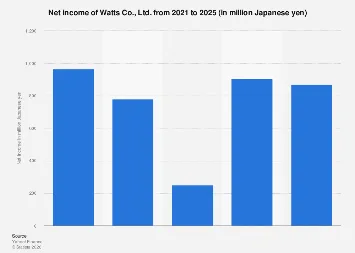
Watts Co., Ltd., a prominent Japanese enterprise, concluded its fiscal year on August 31, 2025, reporting a significant contraction in its net income. While specific figures remain proprietary and are subject to subscription access, available data indicates a notable decrease compared to the fiscal year 2021 performance. This downturn, observed over a four-year period, did not follow a consistent linear trajectory, suggesting a dynamic interplay of market forces and internal operational adjustments.
The company’s financial performance between fiscal years 2021 and 2025 reveals a complex narrative of fluctuating profitability. This period, spanning from September 1, 2020, to August 31, 2025, has been characterized by global economic recalibrations, supply chain disruptions, and evolving consumer behaviors, all of which can profoundly impact corporate earnings. For a company like Watts Co., Ltd., operating within the intricate Japanese economic landscape, these macro-environmental factors, coupled with industry-specific challenges and strategic decisions, would have shaped its bottom line.
The announcement of a net income decrease, even without precise quantitative disclosure, signals a critical juncture for the company. In the contemporary business environment, where transparency and predictable performance are highly valued by investors and stakeholders, such a trend warrants a deeper examination of the underlying causes. Analysts will be keen to understand the specific segments or product lines contributing to this decline, as well as any new initiatives or market shifts that may have exacerbated the situation.
The Japanese market, known for its sophisticated industrial base and highly competitive consumer sectors, presents unique challenges. Companies often grapple with an aging demographic, evolving labor dynamics, and intense competition from both domestic and international players. Furthermore, the global economic climate, including inflation rates, interest rate policies, and geopolitical stability, plays a crucial role in shaping the financial health of Japanese corporations. Watts Co., Ltd.’s performance in fiscal year 2025 must be viewed within this broader economic context.
While the exact magnitude of the decrease from fiscal year 2021 to 2025 remains undisclosed, the mention of a non-continuous decline implies periods of recovery or stabilization interspersed with periods of contraction. This suggests that the company may have implemented strategies to mitigate losses or capitalize on emerging opportunities during this timeframe. Identifying these strategic interventions and their efficacy is key to understanding the company’s resilience and future prospects.
The fiscal year ending August 31 is a common reporting period for many Japanese companies, aligning with the agricultural harvest cycle and also allowing for strategic planning and budget finalization before the calendar year’s end. This particular fiscal year 2025 falls within a period where many economies were navigating post-pandemic recovery and adjusting to new global trade dynamics. The performance of Watts Co., Ltd. could be indicative of broader trends within its specific industry sector in Japan and globally.
To fully comprehend the implications of this net income reduction, it is essential to consider the company’s industry. Without specific information about Watts Co., Ltd.’s sector, a general analysis of the Japanese economy provides a framework. Japan’s economy is broadly diversified, with strengths in automotive manufacturing, electronics, machinery, and financial services. Each of these sectors faces distinct challenges and opportunities. For instance, companies in the manufacturing sector might be affected by raw material costs and global demand fluctuations, while technology firms could be navigating rapid innovation cycles and intense R&D investments.
The reported decrease in net income could stem from a combination of factors. Reduced revenues, increased operating expenses, higher interest payments, or significant one-time charges could all contribute to a lower net profit. Market analysts often look at key performance indicators such as gross profit margin, operating profit margin, and return on equity to gain a more nuanced understanding of a company’s financial health. The inability to access precise figures for Watts Co., Ltd. highlights the value of detailed financial reporting and the subscription-based models employed by data providers to disseminate such information.
Globally, the corporate landscape in recent years has been volatile. Companies worldwide have faced inflationary pressures, rising energy costs, and supply chain bottlenecks. The semiconductor shortage, for example, has had a ripple effect across numerous industries, from automotive to consumer electronics. Geopolitical tensions have also introduced uncertainty, impacting international trade and investment. Japanese companies, with their significant global footprint, are particularly susceptible to these external shocks.
For Watts Co., Ltd., the comparison to fiscal year 2021 is particularly telling. That period, while still impacted by the initial phases of the COVID-19 pandemic, might represent a benchmark against which current performance is measured. The subsequent years could have seen a recovery in some sectors, followed by new challenges. Understanding the specific economic conditions and market dynamics prevalent in Japan during each of these fiscal years would provide critical context. For example, the yen’s exchange rate against major currencies can significantly impact the profitability of Japanese companies with international operations or import/export activities. A weaker yen generally benefits exporters, while a stronger yen can make imports cheaper.
The fact that the decrease was not continuous suggests a complex operational environment. It might indicate that the company has been able to adapt and achieve some level of profitability in certain periods within the four-year span. This could be due to successful cost-cutting measures, effective product launches, or favorable market conditions in specific quarters. Conversely, it could also point to erratic market demand or unforeseen operational disruptions that have impacted profitability in an uneven manner.
In the absence of detailed financial statements, speculative analysis is limited. However, the broad observation of a net income decline for Watts Co., Ltd. in fiscal year 2025 serves as a crucial indicator for market participants. It underscores the importance of ongoing monitoring of corporate financial health, especially in a globalized economy where interconnectedness amplifies both opportunities and risks. For investors, potential partners, and industry observers, this information prompts further inquiry into the company’s strategic direction, competitive positioning, and its ability to navigate the evolving economic landscape. The fiscal year 2025 results for Watts Co., Ltd. are a reminder that even established companies must continuously adapt to maintain and grow their profitability in an unpredictable global marketplace.