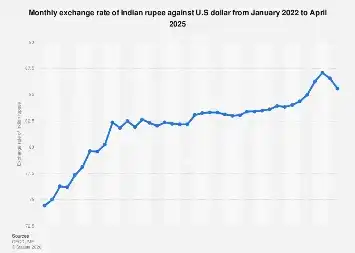
The Indian Rupee’s (INR) performance against the United States Dollar (USD) in 2025 is poised to be a critical indicator for the subcontinent’s economic health, influencing trade balances, foreign investment flows, and inflationary pressures. While precise predictions remain elusive in the dynamic global financial landscape, a confluence of domestic and international factors will shape the currency’s valuation throughout the year. Analysts are closely monitoring key economic indicators, geopolitical developments, and monetary policy shifts that could steer the USD-INR exchange rate.
India’s economic momentum, characterized by robust domestic demand and a burgeoning manufacturing sector, provides a foundational strength for the rupee. Projections for India’s Gross Domestic Product (GDP) growth in 2025 generally remain optimistic, with many international financial institutions forecasting rates well above the global average. This sustained economic expansion typically attracts foreign direct investment (FDI), which in turn increases the demand for rupees, thereby supporting its value. Data from India’s Department for Promotion of Industry and Internal Trade (DPIIT) has consistently shown significant inflows into sectors like services, computer software and hardware, and manufacturing, suggesting a continued appetite for Indian assets.
However, the rupee’s strength is not insulated from external headwinds. The U.S. dollar’s own trajectory, heavily influenced by the Federal Reserve’s monetary policy stance, will be a paramount determinant. Should the Fed maintain or further tighten its monetary policy, potentially through higher interest rates, it could lead to a strengthening of the dollar globally, exerting downward pressure on emerging market currencies like the rupee. Conversely, any dovish pivot by the Fed, signaling interest rate cuts, could offer relief to currencies like the INR. The market’s perception of the relative stability and growth prospects of the two economies will also play a crucial role. For instance, a significant slowdown in the U.S. economy, or conversely, a surge in global risk aversion, could prompt a flight to safety, benefiting the dollar.
India’s trade deficit remains a persistent concern for the rupee. While exports have shown resilience, imports, particularly of crude oil, often outpace them, creating a demand for foreign currency that can weaken the rupee. The global energy market’s volatility, influenced by geopolitical tensions and supply-demand dynamics, will therefore have a direct impact. A sustained rise in oil prices, a significant import for India, would necessitate larger dollar outflows, potentially depreciating the rupee. Conversely, any stabilization or decline in global energy prices could provide a tailwind for the currency. Data from the Reserve Bank of India (RBI) regularly highlights the components of India’s current account deficit, with the trade balance being a primary driver.
The Reserve Bank of India’s (RBI) monetary policy decisions are another critical lever. While the primary mandate of the RBI is price stability, its actions regarding interest rates and liquidity management can significantly influence the exchange rate. If inflation remains elevated, the RBI might be compelled to maintain a hawkish stance, keeping interest rates higher to curb price pressures. Higher interest rates can attract foreign portfolio investment seeking better yields, thus bolstering the rupee. However, such a stance could also dampen domestic economic activity. The central bank’s intervention in the foreign exchange market, buying or selling dollars to manage excessive volatility, is also a factor, albeit one that is often used to smooth out sharp movements rather than dictate a long-term trend.
Geopolitical stability, both domestically and internationally, is a foundational element for currency markets. Any escalation of regional conflicts or significant global political uncertainty can trigger risk-off sentiment, leading investors to seek the perceived safety of the U.S. dollar. India’s own domestic political landscape and the predictability of its policy environment also contribute to investor confidence. A stable and reform-oriented government is generally viewed favorably by international markets, supporting currency stability.
Looking at historical trends, the USD-INR exchange rate has exhibited a general depreciating bias over the long term, though with significant fluctuations. For example, in the past decade, the rupee has moved from approximately INR 60 to a dollar to levels around INR 83. These movements have been punctuated by periods of relative stability and sharp depreciations, often triggered by global financial crises or specific domestic economic challenges. The average exchange rate for 2024 has hovered in a certain band, and the trajectory for 2025 will likely be a continuation or reversal of the prevailing trends, modulated by the factors outlined above.
The implications of the rupee’s movement are far-reaching. For Indian importers, a weaker rupee makes goods denominated in dollars more expensive, potentially fueling inflation. Conversely, it makes Indian exports cheaper for foreign buyers, boosting competitiveness and potentially improving the trade balance. For foreign investors, the exchange rate directly impacts the returns on their investments. A depreciating rupee erodes the dollar value of their Indian holdings, while an appreciating rupee enhances it. For Indian citizens holding foreign currency assets or planning international travel, the rupee’s value is a direct consideration.
Moreover, the global context of emerging market currencies will also influence the rupee’s performance. If other major emerging economies face currency pressures, it could create contagion effects, impacting the rupee even if India’s fundamentals remain strong. Conversely, a broad strengthening of emerging market currencies could provide a supportive backdrop for the rupee. The performance of other BRICS nations (Brazil, Russia, China, South Africa) and key Asian economies like South Korea and Taiwan can offer comparative insights into broader market sentiment.
In conclusion, while definitive pronouncements on the USD-INR exchange rate for 2025 are speculative, the interplay of India’s economic growth, U.S. monetary policy, global commodity prices, RBI’s actions, and geopolitical stability will be the primary drivers. Investors and businesses will need to closely monitor these evolving dynamics to navigate the currency landscape effectively. The rupee’s journey in 2025 will be a testament to the complex forces shaping the global financial order and India’s place within it.