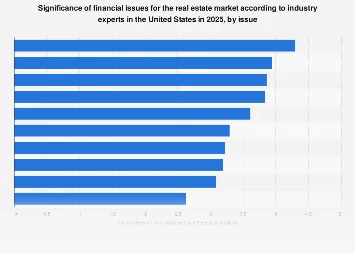
The trajectory of the United States real estate market in 2025 is poised to be significantly shaped by a constellation of financial factors, with industry experts identifying interest rates and the cost of capital as the paramount concerns. A comprehensive survey of over 1,600 stakeholders, including investors, fund managers, developers, lenders, and consultants, underscores the critical role these economic variables will play in dictating market performance. On a scale where a rating of five signifies "great importance," both interest rates and the cost of capital received an average score that heavily outweighs other considerations, signaling a market environment highly sensitive to monetary policy and the expense of funding.
Following closely behind, capital availability emerged as the second most significant financial issue, indicating a keen awareness among market participants regarding the ease with which development projects and transactions can be financed. This dual focus on the price of borrowing and the sheer accessibility of funds highlights a landscape where liquidity and borrowing costs are intrinsically linked to the health and dynamism of the real estate sector. The insights derived from this broad spectrum of industry professionals paint a clear picture: the coming year will demand a strategic navigation of a complex financial terrain.
The perceived importance of various financial issues for the U.S. real estate market in 2025, as rated by industry experts, reveals a concentrated concern. While specific numerical values for each issue are proprietary, the overwhelming consensus points to the top-tier significance of interest rates and capital costs. This sentiment resonates with broader macroeconomic trends, as central banks globally have been engaged in a delicate balancing act between taming inflation and avoiding economic recession. The Federal Reserve’s monetary policy decisions, particularly concerning benchmark interest rates, have a direct and profound impact on mortgage rates for residential properties and borrowing costs for commercial development and acquisitions. Higher interest rates translate to increased monthly payments for homebuyers, potentially dampening demand and putting downward pressure on property values. For commercial real estate, elevated borrowing costs can shrink profit margins, making new projects less feasible and potentially leading to a slowdown in construction and investment activity.
The second-tier concern of capital availability further amplifies the sensitivity of the market to financial conditions. In an environment of rising interest rates, lenders may become more risk-averse, tightening lending standards and reducing the amount of credit extended. This can create a challenging environment for developers seeking construction loans or investors looking to acquire properties, particularly those relying heavily on leverage. The interplay between interest rates and capital availability creates a feedback loop; as borrowing becomes more expensive, the demand for capital may decrease, but if lenders simultaneously pull back, liquidity can dry up, exacerbating the challenges. This dynamic is particularly acute in sectors with long development cycles or those heavily reliant on debt financing, such as large-scale residential developments, office buildings, and retail spaces.
Beyond these primary concerns, other financial issues, while rated with lesser but still notable importance, contribute to the overall economic outlook for real estate. These might include factors such as inflation rates, the cost of construction materials, consumer confidence, and the overall health of the broader economy. While not at the forefront of immediate concern for the majority of experts surveyed, these secondary factors can exert significant influence, particularly if they converge to create a more challenging economic backdrop. For instance, persistent inflation can erode purchasing power, while rising material costs can further inflate development budgets, compounding the pressure from higher interest rates. Consumer confidence, a crucial driver of residential demand, is often closely tied to employment prospects and wage growth, which are themselves influenced by the overall economic climate and the effectiveness of monetary policy.
The economic implications of these financial headwinds are multifaceted. For the residential market, a sustained period of high interest rates could lead to a cooling of price appreciation, a potential decrease in transaction volumes, and an increase in the inventory of homes for sale. First-time homebuyers, in particular, may find it increasingly difficult to enter the market due to higher mortgage payments. Existing homeowners with variable-rate mortgages could face increased financial strain. Conversely, a slowdown in the residential market might present opportunities for cash buyers or those with fixed-rate mortgages to acquire properties at more attractive prices.
In the commercial real estate sector, the impact is equally significant. Higher borrowing costs and reduced capital availability can lead to a slowdown in new construction projects, potentially impacting job creation in the construction industry and related sectors. Existing properties may see a decline in valuations if rental income growth cannot keep pace with increased financing costs. Sectors that have been more resilient, such as industrial and logistics, might still face headwinds, while sectors already under pressure, like traditional office spaces, could experience further challenges. The performance of different property types will likely diverge, with sectors demonstrating strong demand fundamentals and lower capital intensity potentially weathering the financial storm more effectively.
Global comparisons offer valuable context. Many developed economies are grappling with similar challenges of inflation and rising interest rates. Countries that have seen aggressive interest rate hikes by their central banks may experience more pronounced slowdowns in their real estate markets. The U.S. market, while subject to its own unique dynamics, is not isolated from these global financial pressures. International investors, a significant source of capital for the U.S. real estate market, will be closely monitoring these financial trends, potentially shifting their investment strategies based on perceived risk and return across different geographies.
The outlook for 2025, therefore, hinges on the Federal Reserve’s ability to achieve a soft landing for the economy – managing inflation without triggering a severe recession. The market will be keenly observing inflation data, employment figures, and any signals from the Fed regarding future monetary policy. The cost of capital is not merely an abstract economic indicator; it directly translates into the affordability of housing, the viability of development projects, and the overall investment attractiveness of real estate assets. As 2025 unfolds, the financial landscape will undoubtedly be the dominant narrative shaping the fortunes of the U.S. real estate market. Investors, developers, and policymakers will need to remain agile and strategically positioned to navigate the currents of interest rates, capital flows, and broader economic stability. The year ahead promises to be a testament to the enduring influence of financial fundamentals on the built environment.