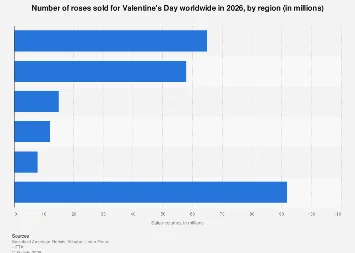
The global market for roses, intrinsically linked to the enduring tradition of Valentine’s Day, is poised for significant activity in 2026, with projections indicating a substantial sales volume across key international regions. While precise figures for the total worldwide sales volume of roses specifically for Valentine’s Day in 2026 remain under subscription, preliminary estimates and regional breakdowns offer a clear picture of the market’s scale and the pivotal roles played by major economic blocs. The overall demand is expected to aggregate in the hundreds of millions, underscoring the holiday’s consistent economic impact on the floral industry.
The United States consistently ranks as a powerhouse in Valentine’s Day rose consumption, reflecting deep-seated cultural norms around gift-giving. For 2026, the U.S. market is anticipated to account for tens of millions of rose sales. This robust demand is fueled by a combination of factors, including a high disposable income among consumers, widespread adoption of Valentine’s Day as a significant commercial event, and a well-established network of florists and online retailers adept at meeting peak season demand. The average spending on Valentine’s Day gifts in the U.S. has seen a steady upward trend over the past decade, with flowers frequently appearing at the top of consumer purchase lists. This trend is expected to continue, translating into sustained high sales volumes for roses.
Across the Atlantic, the European Union presents another substantial market for Valentine’s Day roses. Projections suggest that member states collectively will contribute tens of millions to the global rose sales volume for the occasion. Within the EU, consumer preferences and spending habits can vary significantly by country, but the overarching sentiment towards celebrating love and affection through floral gifts remains strong. Nations like Germany, France, and the United Kingdom are typically major contributors to this figure, supported by sophisticated logistics chains that ensure the timely delivery of fresh flowers from cultivation centers to consumers. The agricultural sector in several European countries also plays a role in supplying local markets, although a significant portion of roses, particularly those of premium quality or specific varieties, are imported.
The methodology behind these sales volume estimates is typically derived from aggregated data provided by a range of industry stakeholders. National florist associations, agricultural ministries, and market research firms play a crucial role in compiling these figures. Shipping manifests from major floral exporting countries also provide valuable insights into the flow of goods. However, it is important to acknowledge that these statistics often represent a best-effort aggregation and may not capture the entirety of the market. Informal sales channels, such as roadside vendors or smaller, independent operations that do not report to formal industry bodies, could represent a segment of the market that remains unrecorded in official tallies.
Beyond the United States and the European Union, other regions are also significant contributors to the global Valentine’s Day rose trade. Emerging markets, particularly in Asia, are showing increasing engagement with Western-style celebrations like Valentine’s Day. China, for instance, has witnessed a growing middle class with rising disposable incomes and a burgeoning interest in international trends, leading to a noticeable uptick in demand for flowers, including roses, during this period. Similarly, countries like Japan, while having its own unique traditions of gift-giving on Valentine’s Day, also participates in the global market for roses. Canada, a close economic partner of the United States, also represents a considerable market for roses, with consumer behavior often mirroring that of its southern neighbor.
The economic implications of this annual surge in rose sales extend far beyond the immediate transaction. The cultivation of roses for international markets is a significant agricultural undertaking, often concentrated in countries with favorable climates and labor conditions, such as Ecuador, Colombia, Kenya, and the Netherlands. These regions benefit from substantial export revenues, creating employment opportunities and contributing to their national economies. The logistics and transportation sector also sees a considerable boost, with air cargo and shipping companies operating at peak capacity to deliver perishable goods across continents. Furthermore, the retail side of the industry, encompassing florists, online retailers, and gift shops, experiences a seasonal economic boom, with significant revenue generation during the Valentine’s Day period.
The market for roses is also subject to various economic forces, including currency exchange rates, fuel costs impacting transportation, and labor expenses in producing countries. Environmental considerations and sustainability practices are also becoming increasingly important factors for consumers and businesses alike. The industry is continually adapting to meet these evolving demands, with investments in more efficient cultivation techniques, reduced carbon footprint logistics, and ethical sourcing practices.
Looking ahead to 2026, the Valentine’s Day rose market is expected to remain a resilient and economically vital sector. While the exact figures for global and regional sales volumes require access to premium data sets, the overarching trend points towards continued robust demand. The cultural significance of roses as a symbol of love, coupled with sophisticated global supply chains and evolving consumer behavior in both established and emerging markets, ensures that the bloom of this particular market will continue to flourish. The ability of the industry to adapt to economic fluctuations, technological advancements in cultivation and logistics, and shifting consumer preferences will be key to its sustained success in the years to come.