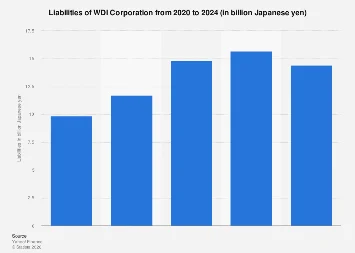
As of the fiscal year ending March 31, 2024, WDI Corporation, a prominent Japanese enterprise, reported significant liabilities, underscoring the dynamic nature of corporate financial structures. While precise figures for the current fiscal year remain confidential for broader access, available data indicates a notable escalation in the company’s financial obligations when compared to the fiscal year 2020. This trend, though showing an overall increase, has not been a linear progression, suggesting periods of both debt reduction and accumulation over the analyzed timeframe. Understanding these fluctuations is crucial for assessing WDI Corporation’s financial health, risk profile, and its capacity to navigate future economic challenges and opportunities.
The strategic management of liabilities is a cornerstone of any corporation’s financial strategy. Liabilities represent a company’s obligations to external parties, encompassing everything from short-term payables to long-term debt. For a global entity like WDI Corporation, which operates within diverse markets and potentially engages in various capital-intensive projects, the composition and magnitude of its liabilities can offer profound insights into its operational scale, investment strategies, and overall financial leverage. The fiscal year 2024 figures, therefore, serve as a critical benchmark for analysts, investors, and stakeholders seeking to gauge the company’s financial standing.
Comparing the reported liabilities of WDI Corporation in 2024 to those of 2020 reveals a substantial increase. This growth, measured in billions of Japanese yen, suggests a strategic expansion of the company’s operations, potential acquisitions, or a more aggressive financing approach. However, the data also points to a non-continuous increase, implying a more nuanced financial narrative. This volatility in liability levels could be attributed to several factors, including the repayment of existing debts, the issuance of new debt instruments, changes in operational expenses, or fluctuations in foreign currency exchange rates if WDI Corporation has significant international operations or borrowings.
The non-linear trend observed between 2020 and 2024 is particularly noteworthy. A continuous, unchecked rise in liabilities without a corresponding proportional increase in assets or revenue can signal financial distress. Conversely, a fluctuating pattern might indicate proactive debt management, strategic refinancing, or investments that are yet to yield full returns. For instance, the company might have undertaken significant capital expenditures in one or two years, leading to a temporary surge in liabilities, followed by periods of debt servicing or asset disposals. Understanding the specific drivers behind these fluctuations—whether they are related to organic growth, mergers and acquisitions, or cyclical industry pressures—is key to a comprehensive analysis.
In the broader context of the Japanese economy and global corporate finance, WDI Corporation’s liability management is subject to various influences. Japan’s ultra-low interest rate environment, while historically supportive of borrowing, is undergoing subtle shifts. Central bank policies and global economic conditions can impact the cost of debt, influencing a company’s decision-making regarding leverage. Furthermore, the specific industry in which WDI Corporation operates—whether it be retail, manufacturing, services, or technology—will dictate its typical liability profile. Industries requiring substantial fixed assets, such as heavy manufacturing or real estate, often carry higher levels of long-term debt compared to service-oriented businesses.
Global comparisons can also provide valuable perspective. Many multinational corporations globally have been managing increasing debt loads in recent years, driven by low interest rates, share buybacks, and strategic investments. However, rising inflation and the prospect of interest rate hikes in major economies are prompting a reassessment of debt strategies. Companies with a high proportion of variable-rate debt, for instance, face increased interest expenses as rates climb, potentially squeezing profit margins. WDI Corporation’s liability structure, therefore, needs to be evaluated against these global trends to understand its competitive positioning and resilience.
Economically, an increase in liabilities, if managed effectively, can fuel growth. Debt financing can be a powerful tool for companies to expand their capacity, invest in research and development, and enter new markets, ultimately leading to increased revenue and profitability. However, excessive leverage can pose significant risks. High debt levels increase financial risk, making a company more vulnerable to economic downturns, rising interest rates, or operational disruptions. A substantial portion of liabilities also means a larger proportion of future earnings will be dedicated to debt servicing, potentially limiting funds available for dividends, reinvestment, or strategic initiatives.
The fiscal year ending March 31, 2024, marks a critical juncture for WDI Corporation. The undisclosed precise figures for its liabilities invite speculation and highlight the importance of transparency in corporate reporting. For investors and financial institutions, understanding the composition of these liabilities—distinguishing between short-term and long-term debt, secured versus unsecured loans, and the currency of denomination—is paramount. This granular detail allows for a more accurate assessment of liquidity, solvency, and the company’s ability to meet its financial commitments.
The narrative of WDI Corporation’s liabilities between 2020 and 2024 is not merely a set of numbers; it is a story of strategic financial decisions, market responses, and the overarching economic climate. The increase in obligations, coupled with its non-linear trajectory, suggests a company that is actively navigating its financial landscape. Whether this represents a deliberate strategy for growth or a response to external pressures remains to be seen without the detailed financial statements. However, the continued analysis of these financial metrics will be essential for stakeholders to form a complete picture of WDI Corporation’s financial health and its prospects in the coming fiscal years. The company’s ability to manage its debt effectively will undoubtedly be a key determinant of its long-term success and its standing within the competitive global marketplace.