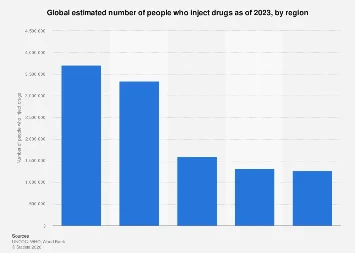
The Americas emerged as the region with the most significant estimated number of people who inject drugs in 2023, underscoring a persistent global challenge that demands comprehensive public health and economic strategies. While precise figures for many regions remain undisclosed, this substantial concentration in the Americas signals a critical area for intervention and resource allocation. The dynamics of drug use, particularly through injection, are complex, influenced by socioeconomic factors, drug availability, harm reduction policies, and the efficacy of treatment programs. Understanding these regional disparities is crucial for developing targeted and effective responses to mitigate the associated health and social costs.
Globally, the practice of injecting drugs presents a multifaceted public health crisis, intertwined with issues of infectious disease transmission, overdose deaths, and the broader social and economic implications of addiction. While comprehensive, up-to-date global statistics are often challenging to compile due to varying data collection methodologies and reporting standards across nations, available estimates for 2023 highlight significant regional variations. The Americas, as indicated, represent a major area of concern, where an estimated millions of individuals are believed to be currently injecting drugs. This figure, while a broad estimation, points to the scale of the challenge and the need for robust public health infrastructure.
The economic burden associated with injection drug use is substantial. This includes direct healthcare costs for treating infections such as HIV and hepatitis C, which are disproportionately prevalent among people who inject drugs due to shared needle practices. Indirect costs arise from lost productivity, increased crime rates, and the strain on social services and the criminal justice system. In regions with a higher prevalence, these economic impacts can significantly affect national budgets and hinder overall economic development. For instance, healthcare systems in heavily impacted areas face increased demands for emergency services, addiction treatment, and long-term care for individuals suffering from chronic health conditions exacerbated by drug use.
Beyond the direct costs, the societal impact is profound. The stigma surrounding addiction often prevents individuals from seeking help, perpetuating a cycle of isolation and despair. Community cohesion can be eroded, and families often bear immense emotional and financial burdens. The presence of a significant injection drug-using population can also influence tourism and foreign investment, as perceived safety and public health concerns can deter economic activity. Therefore, addressing injection drug use is not merely a health imperative but also an economic and social development priority.

While the Americas are highlighted, it is essential to acknowledge that injection drug use is a global phenomenon. Other regions, including parts of Asia, Eastern Europe, and Africa, also grapple with significant numbers of people who inject drugs. Each region presents unique challenges, shaped by local drug markets, cultural contexts, and the specific types of substances being injected. For example, the opioid crisis has had a devastating impact in North America, while stimulant injection may be more prevalent in other areas. The availability and price of drugs, coupled with factors like unemployment, poverty, and lack of access to education and healthcare, all contribute to the complex web of reasons why individuals turn to injecting drugs.
The effectiveness of harm reduction strategies plays a critical role in mitigating the negative consequences of injection drug use. Programs such as needle and syringe exchange programs (NSEPs), opioid agonist therapy (OAT), and overdose prevention sites have demonstrated efficacy in reducing the transmission of infectious diseases and preventing overdose deaths. Regions that have implemented comprehensive harm reduction frameworks often see better health outcomes and reduced societal costs. Conversely, areas with restrictive policies that prioritize enforcement over public health interventions tend to experience higher rates of infectious diseases and overdose fatalities.
The economic argument for investing in harm reduction is compelling. Studies have shown that for every dollar invested in evidence-based harm reduction interventions, such as OAT, there are significant returns in terms of reduced healthcare costs, decreased crime, and increased economic productivity. For example, access to methadone or buprenorphine treatment can stabilize individuals, enabling them to maintain employment, improve their health, and reintegrate into society, thereby reducing their reliance on public services and contributing to the economy.
Looking ahead, the global response to injection drug use must be informed by a nuanced understanding of regional dynamics and a commitment to evidence-based practices. International cooperation and the sharing of best practices are vital. Organizations such as the United Nations Office on Drugs and Crime (UNODC) and the World Health Organization (WHO) play a crucial role in coordinating global efforts, providing technical assistance, and advocating for policies that prioritize public health and human rights.
The challenge of injection drug use is not static; it evolves with changes in drug markets, the emergence of new substances, and shifts in socioeconomic conditions. Therefore, ongoing research, robust surveillance systems, and adaptive policy-making are essential. Investing in prevention, treatment, and harm reduction services is not only a moral imperative but also a sound economic strategy that can lead to healthier communities and more resilient economies worldwide. The data from 2023, particularly the spotlight on the Americas, serves as a stark reminder of the persistent nature of this issue and the urgent need for sustained, evidence-based action on a global scale.